Diversity and Inclusion in Executive Search in Spain 

In 2025, diversity and inclusion are no longer optional — they’re expected. Regulatory pressure, investor scrutiny, and shifting societal norms are reshaping the way companies in Spain approach leadership. At the center of this transformation is the growing expectation for executive search in Spain to deliver not just qualified leaders, but representative and inclusive ones. 

This article explores where Spain stands in terms of female leadership, the legal frameworks influencing change, the challenges of turning targets into outcomes, and how search firms can actively support lasting inclusion. 

  1. Where Spain Stands on Inclusive Leadership

There has been visible progress, but significant gaps remain: 

  • As of 2024, only 19.8% of executive committee members in IBEX 35 companies were women. 
  • Board representation is higher — around 34% — but progress at C-suite level is slower, especially in industrial, tech, and finance sectors. 
  • A McKinsey study found that companies with the most gender-diverse executive teams were 25% more likely to outperform financially — evidence that inclusion isn’t just ethical, it’s strategic. 

While some firms have embraced the challenge, many are still searching for meaningful, measurable ways to build diverse leadership teams in Spain. 

  1. Policy and Regulation: What’s Driving the Shift

Spain has introduced multiple frameworks pushing companies toward more balanced leadership: 

  • The CNMV Code of Good Governance recommends at least 40% female representation on boards. 
  • The 2023 Ley de Paridad (Parity Law) mandates gender balance in political and corporate institutions. 
  • The Equality Law (Ley Orgánica 3/2007) requires larger companies to implement equality plans and monitor gender metrics. 
  • The new ESG-linked disclosures expected from 2025 will force firms to show progress not only in climate risk — but also in leadership diversity. 

These frameworks don’t just encourage change — they demand accountability, especially in the executive hiring process. 

  1. Why Inclusive Executive Hiring Remains a Challenge

Despite strong policy signals, many companies still struggle with inclusive recruitment: 

  • Narrow pipelines: In sectors like energy, logistics, and construction, fewer women reach VP level — limiting succession candidates. 
  • Informal decision-making: Many top roles are filled through closed networks that unintentionally exclude diverse profiles. 
  • DEI fatigue: After initial enthusiasm, some companies struggle to turn policy into long-term culture. 
  • Fear of tokenism: Boards may hesitate to set hard diversity goals to avoid perceived optics issues — slowing progress further. 
  1. The Role of Executive Search in Spain

Progressive executive search firms in Spain are shifting their focus — from simply meeting a brief to actively helping clients transform their leadership model. 

Here’s how inclusive search is done right: 

  • Expanding the talent map: Going beyond known networks to surface high-potential candidates from underrepresented paths. 
  • Bias-aware processes: Using structured interviews, scorecards, and psychometrics to reduce unconscious bias. 
  • Advisory role: Helping clients set clear inclusion goals, build internal buy-in, and align hiring with strategy. 
  • Tracking outcomes: Monitoring not just shortlists, but placements and retention across diversity dimensions. 

Case Insight: Financial Services

In a recent search for a COO in the financial services sector, our client required a shortlist with at least 50% gender balance. While the industry skews male at senior levels, we built a finalist pool that exceeded expectations — including two women with strong fintech and regulatory backgrounds. One was hired. Six months later, the client reported increased engagement scores across their leadership team. 

This shows how inclusion and performance go hand-in-hand — when recruitment is handled intentionally. 

Inclusive executive hiring isn’t about quotas — it’s about resilience, decision-making, and business credibility. Companies that invest in representative leadership benefit from: 

  • Stronger innovation and strategic thinking 
  • Increased trust with clients, partners, and talent 
  • Improved ESG performance and regulatory alignment 


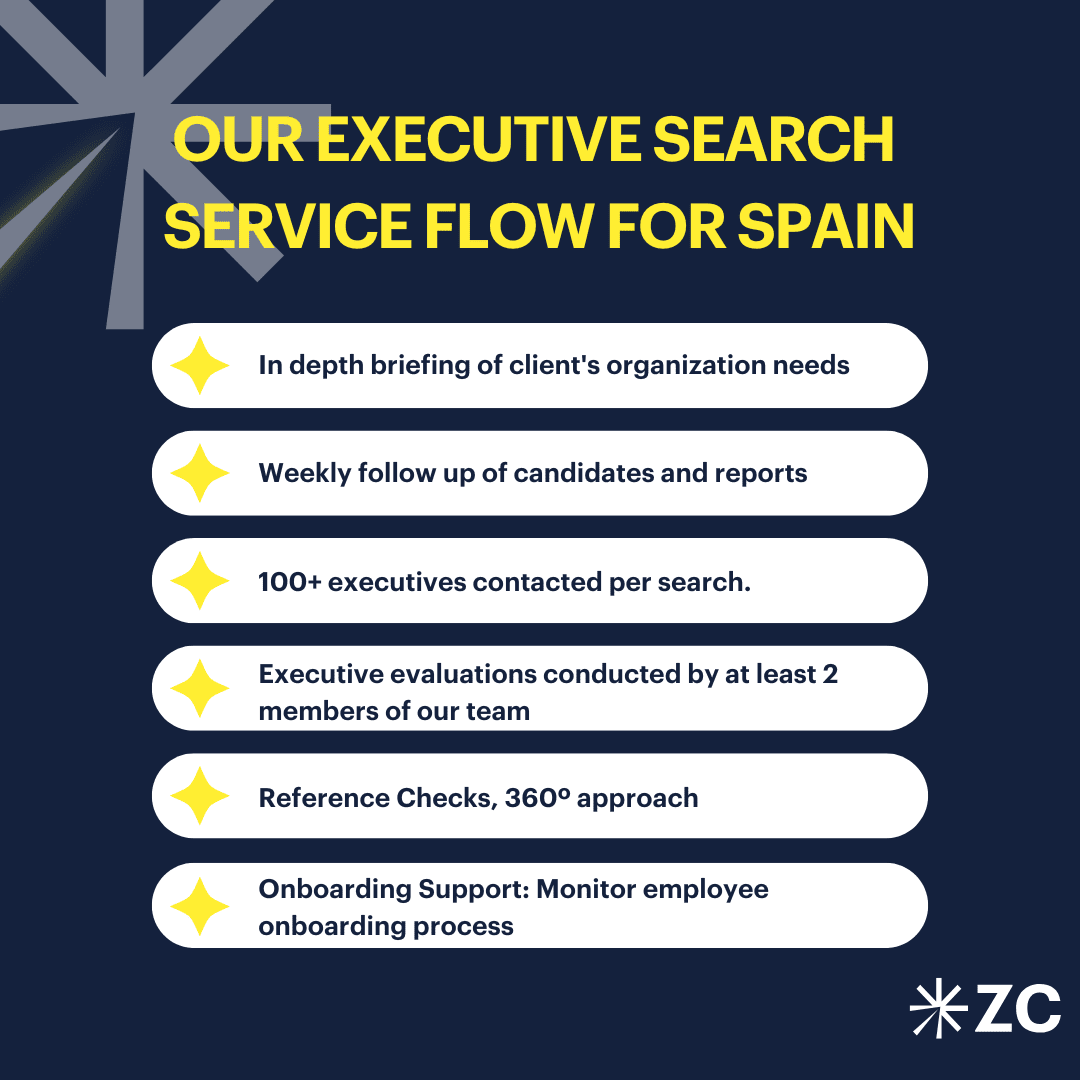
Zavala Civitas executive search methodology for Spain

Click here to learn more about our services: Executive Search | Zavala Civitas Executive Search


Executive Search en México: Líderes en EPC y Energías Renovables 

México se ha convertido en uno de los países más destacados de América Latina para el desarrollo de proyectos EPC (Ingeniería, Adquisiciones y Construcción) y energías renovables. Sin embargo, el financiamiento y la tecnología ya no son las mayores barreras.  Es el talento ejecutivo.  El crecimiento de este sector está

Read More

Executive Search in Mexico: Leading Sectors Shaping Demand 

Over the last few years, Mexico swiftly garnered international investment, earning it the title of one of the fastest-growing countries in capturing global foreign direct investments.   This scenario creates new talent opportunities.  Most Executive Search firms in Mexico have modified their approach from simply filling highest roles in an organization to competing for the extremely limited pool of qualified executive talent for all roles in all sectors.  The demand isn’t even  It is very much concentrated.  Where Demand is Actually Growing  Mexico’s hiring executive pressure is unequal across all sectors. Some sectors are faster and are pulling talent from other sectors. Manufacturing is the clearest example.  With nearshoring, Mexico is becoming a strategically important center for the supply chain for North America. This is due to the fact that international companies are relocating and/or expanding their operations in Mexico. This is supported by McKinsey & Company.  The growth of a business is dependent on its leadership. Companies are in need of quickly scalable plant directors, operations managers, and supply chain executives. Such profiles are deficit.  Executive Search Energy and Infrastructure: Complexity at Scale  There is the highest demand for executive talent within the energy and infrastructure sectors.  Major projects and regulatory complexities, as well as lengthy investments, require leaders who are comfortable with uncertainty in all the essential domains, not just the technical. This includes stakeholder

Read More

Executive Search in Spain: Talent Gaps and Leadership Trends 

The Spanish talent market is perceived to be mature and easy to operate in. This makes some sense from afar. There is a solid network of business centers, a developing international business presence, and a considerable pool of experienced talent.  Problems arise when businesses attempt to recruit senior executives.  In Spain, executive search is shifting from talent arbitrage to understanding the true gaps and the reasons behind their expansion.  Where the Talent Gaps Are Actually Emerging  Spain may appear to have many senior professionals, but the issues here are more complex.  The problem is not the experience, but the type of experience that is most required by the different companies.  As per McKinsey & Company, the nature of change of senior leadership roles in Europe is at a much quicker pace than the nature of change in the senior leadership roles in the talent pool. Executives are required who are able to be strategic, also have the ability to execute, and be the change agent.  That blend is still too little. This is especially the case in Spain in the industries that are shifting the fastest—energy transition, infrastructure, and technology. There are many executives who have strong functional experience, but far fewer who have held positions to manage large, complex transformations, or to operate internationally in complex situations.  This results in the mismatch between the hopes of the companies and the actual situation in the labor market.  The Shift from Stability to Transformation Leadership  For many years, leadership in Spain emphasized operational stability and incremental change.  This is not enough anymore.  At present, companies expect executives to manage change and uncertainty, and lead in multiple dimensions simultaneously, including at the same time digital transformation, new business models, and the increased need for operational efficiency. 

Read More

Related posts

Executive Search en México: Líderes en EPC y Energías Renovables 

México se ha convertido en uno de los países más destacados de América Latina para el desarrollo de proyectos EPC (Ingeniería, Adquisiciones y Construcción) y energías renovables. Sin embargo, el financiamiento y la tecnología ya no son las mayores barreras.  Es el talento ejecutivo.  El crecimiento de este sector está

Read More

Leadership in the Middle East: Why Fit Matters More Than Origin 

As companies in the Middle East scale and institutionalize, the long-standing debate around local versus international leadership in the Middle East is largely outdated. The real issue today is alignment: whether the leadership profile fits the business challenge the organization is facing.  Too often, leadership appointments are driven by assumptions: that international executives

Read More

The Role of Compliance Officers in Strategic Decision-Making

Over the past decade, the role of compliance functions within organizations has progressed significantly. Traditionally, compliance was responsible primarily for ensuring the company’s compliance with regulation, particularly that Relations to bribery and corruption.  They developed codes of conduct, supplier due diligence process and the like and were responsible for ensuring compliance with these by employees of

Read More

Executive Search in Mexico: Leading Sectors Shaping Demand 

Over the last few years, Mexico swiftly garnered international investment, earning it the title of one of the fastest-growing countries in capturing global foreign direct investments.   This scenario creates new talent opportunities.  Most Executive Search firms in Mexico have modified their approach from simply filling highest roles in an organization to competing for the extremely limited pool of qualified executive talent for all roles in all sectors.  The demand isn’t even  It is very much concentrated.  Where Demand is Actually Growing  Mexico’s hiring executive pressure is unequal across all sectors. Some sectors are faster and are pulling talent from other sectors. Manufacturing is the clearest example.  With nearshoring, Mexico is becoming a strategically important center for the supply chain for North America. This is due to the fact that international companies are relocating and/or expanding their operations in Mexico. This is supported by McKinsey & Company.  The growth of a business is dependent on its leadership. Companies are in need of quickly scalable plant directors, operations managers, and supply chain executives. Such profiles are deficit.  Executive Search Energy and Infrastructure: Complexity at Scale  There is the highest demand for executive talent within the energy and infrastructure sectors.  Major projects and regulatory complexities, as well as lengthy investments, require leaders who are comfortable with uncertainty in all the essential domains, not just the technical. This includes stakeholder

Read More

Executive Search in Spain: Talent Gaps and Leadership Trends 

The Spanish talent market is perceived to be mature and easy to operate in. This makes some sense from afar. There is a solid network of business centers, a developing international business presence, and a considerable pool of experienced talent.  Problems arise when businesses attempt to recruit senior executives.  In Spain, executive search is shifting from talent arbitrage to understanding the true gaps and the reasons behind their expansion.  Where the Talent Gaps Are Actually Emerging  Spain may appear to have many senior professionals, but the issues here are more complex.  The problem is not the experience, but the type of experience that is most required by the different companies.  As per McKinsey & Company, the nature of change of senior leadership roles in Europe is at a much quicker pace than the nature of change in the senior leadership roles in the talent pool. Executives are required who are able to be strategic, also have the ability to execute, and be the change agent.  That blend is still too little. This is especially the case in Spain in the industries that are shifting the fastest—energy transition, infrastructure, and technology. There are many executives who have strong functional experience, but far fewer who have held positions to manage large, complex transformations, or to operate internationally in complex situations.  This results in the mismatch between the hopes of the companies and the actual situation in the labor market.  The Shift from Stability to Transformation Leadership  For many years, leadership in Spain emphasized operational stability and incremental change.  This is not enough anymore.  At present, companies expect executives to manage change and uncertainty, and lead in multiple dimensions simultaneously, including at the same time digital transformation, new business models, and the increased need for operational efficiency. 

Read More

Executive Search in China: The Complexity of Hiring Executives

China is one of those markets where opportunities are easy to find but the right leaders are not.  many international firms, executive recruitment in China becomes challenging for one simple reason: the market does not act as they expect. What works for Europe or the US, tends to break down here.  Recruiting

Read More