Key Takeaway: Brazil is the world’s largest economy in Latin America, receiving over $60 billion in annual FDI, with a $260 billion infrastructure programme deployed through Novo PAC. Yet Fragomen data shows Brazilian emigration for visas to Portugal grew 200% in 2022, to the U.S. by 114%, and to Australia/New Zealand by 567%. The talent that Brazil needs most is also the talent most likely to leave. Executive search that understands this dynamic — and builds a case that keeps top executives in the Brazilian market — is operating with a materially different value proposition than standard recruitment.
Last updated: August 13, 2026
Current Economics of the Brazilian Market
Brazil has a GDP of $1.92 trillion (2022) and is the world’s 11th economy and the largest economy in Latin America. Brazil’s service sector includes a diverse range of industries, including hospitality, financial services, retail sales, and professional services. The financial sector has particular significance in the country. It plays a key role in the financing of large projects, particularly mining and aerospace.
Travel and tourism are key parts of the services sector, contributing significantly to revenues in the country. This includes revenues generated by hotels, travel agencies, airlines, restaurants and other directly associated activities.
The development in these industries creates a constant demand for highly qualified executive talent. However, Brazil is falling behind in the dispute for talent. According to data from Fragomen in Brazil, a company specialised in immigration, only in 2022 the number of Brazilians who applied for a visa and residence for Portugal increased by 200%. For the United States, growth was 114%, and for Australia and New Zealand, it reached 567%. In the last ten years, this demand has been recorded, with the exception of the period of closed borders in the pandemic.
Key Figures at a Glance
| Data point |
Figure |
Source |
| Annual FDI flowing into Brazil |
+$60 billion USD annually |
UNCTAD, 2025 |
| Growth in Brazilian visa applications to Portugal (2022) |
+200% |
Fragomen Brazil |
| Novo PAC infrastructure programme total commitment |
$260 billion USD ($142.2B deployed by end-2024) |
Government of Brazil, 2025 |
| Primary challenge for executive search in Brazil |
Talent emigration + CLT regulatory complexity + bureaucratic barriers for foreign companies |
Zavala Civitas Brazil market analysis |
Challenges of the Executive Search Market in Brazil
- Intense talent competition: The executive search market is highly competitive and extends beyond national borders, as Portuguese and U.S. firms, as well as nearshore players, are actively engaging in recruiting talent.
- Impact of nearshore players: The entry of nearshore players, traditionally hesitant to navigate Brazil’s bureaucratic and tax-heavy processes, adds a new dimension to the talent competition. These players, though previously uninterested, are now actively participating in the recruitment, intensifying the challenges faced by local recruiters.
- Bureaucratic and tax hurdles: The country’s bureaucratic environment poses significant challenges for foreign companies looking to establish a presence. Incorporating a business in Brazil is time-consuming, and there are complex legal restrictions that companies must handle. The tax system involves multiple levels of government, which further complicates the process for international investors.
- Rising wages: The demand for executive talent has led to an increase in wages, making it more challenging for companies to attract and retain skilled professionals. Average salaries have seen an upward trend — particularly in northern Brazil and nearshoring regions where competition for bilingual leadership is most acute.
- Language skills and cultural diversity: Brazil’s demographic history has resulted in individuals speaking multiple languages, including Italian, Spanish, and German. This cultural diversity can be both an advantage and a challenge for recruiters — an asset when properly leveraged, a complexity when not assessed structurally.
- Perception of Brazil as a challenging market: Despite the potential and talent pool, Brazil is still perceived as a challenging market, both politically and bureaucratically. This perception, however, is changing, with a recognition that Brazil is becoming more digitised and is a crucial part of the strategy for the entire Latin American region.
Brazil’s talent emigration trend — 200% growth in visa applications to Portugal, 114% to the U.S., 567% to Australia and New Zealand — is not primarily a compensation story. The Brazilian executives who emigrate are not leaving because another market pays more (though some do). They are leaving because the combination of bureaucratic complexity, political uncertainty, and perceived career ceiling in Brazil makes the risk-adjusted return on staying structurally lower than the risk-adjusted return on leaving. Executive search that makes a compelling case for staying — through the mandate quality, the organisation’s growth trajectory, and the leadership opportunity — is addressing the real retention challenge, not just the compensation arithmetic.
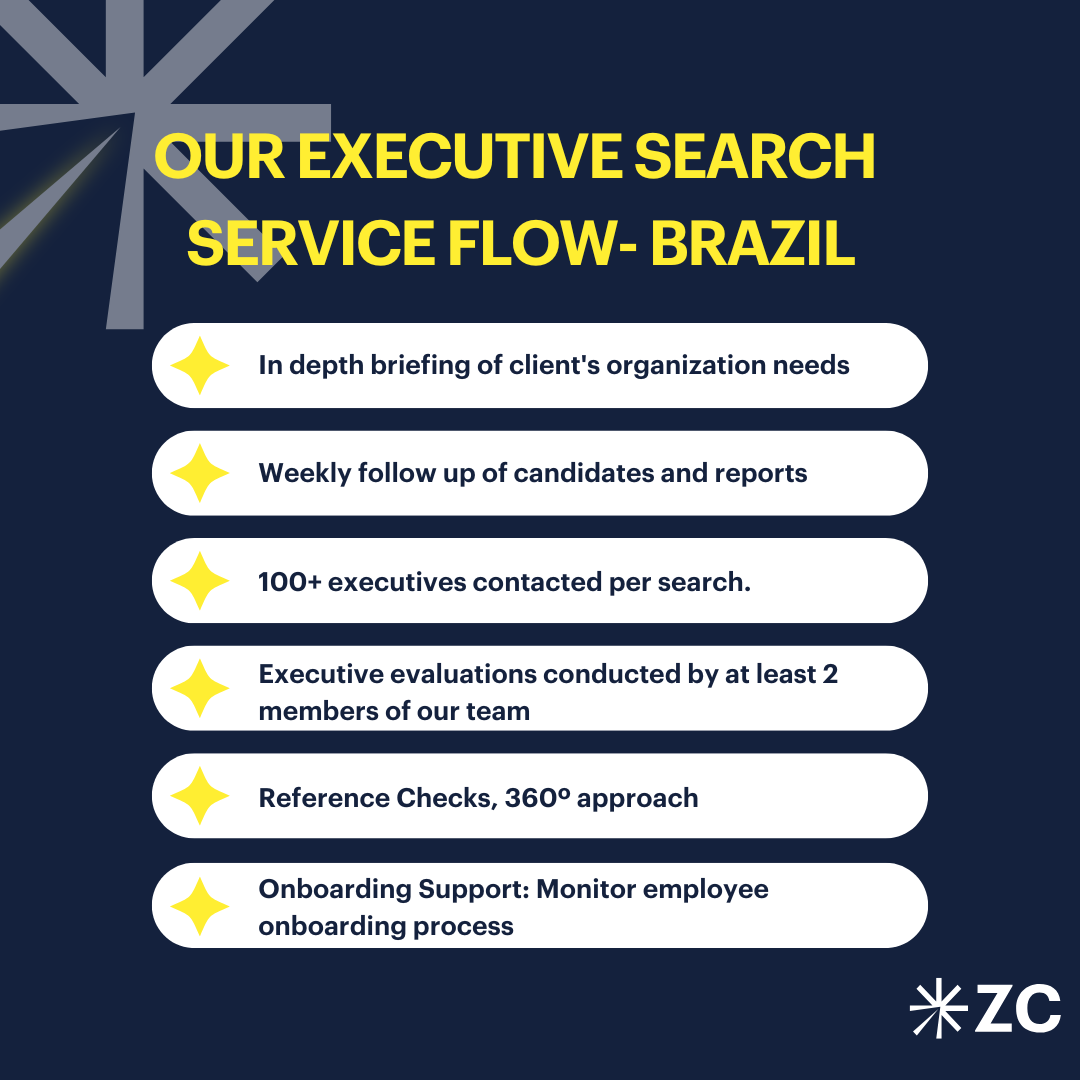
At Zavala Civitas, we have had a presence in the Brazilian market for over a decade with seasoned professionals and industry-specialised experts in finding executive and high-middle management talent.
Brazil’s regulatory complexity is not just an operational challenge for foreign companies — it is an executive selection criterion in its own right. A CFO or General Manager who does not have genuine CLT fluency is not managing a compliance risk at the margins. They are creating one — through contract structures that generate retroactive labour court exposure, through welfare obligations that accumulate invisibly until audit, and through dismissal processes that create legal liability when managed without Brazilian-specific knowledge. Executive search in Brazil that assesses regulatory fluency as a core requirement — not a background check — is the only approach that genuinely protects the hiring organisation’s investment.
If you find that executive search might be of interest, you can read more about our service flow and methodology or directly contact us to learn more firsthand.
Frequently Asked Questions: Executive Search in Brazil — Trends and Leadership Insights
Why is talent emigration from Brazil a structural challenge for executive search — not a cyclical one?
Because the factors driving emigration — bureaucratic complexity, political uncertainty, and perceived career ceiling — are structural features of Brazil’s operating environment, not temporary conditions that will self-correct. The Fragomen data showing 200% growth in Portugal visa applications and 567% growth in Australia/New Zealand applications reflects a multi-year pattern with pre-pandemic roots. Executive search in Brazil must therefore compete for talent not just against other Brazilian employers, but against the option of leaving entirely — which requires a compelling case for the mandate, the organisation, and the long-term career trajectory.
How does Brazil’s cultural and linguistic diversity affect executive search and assessment?
Brazil’s demographic history — with significant Italian, German, Japanese, and other immigrant community influences — has produced a linguistically and culturally diverse population that is a genuine competitive advantage for organisations competing internationally. The Brazilian executive who speaks Portuguese, English, and Italian, and whose professional network extends across communities that most Brazilian organisations cannot reach, is a rare and valuable profile. Executive search that maps this diversity systematically — rather than treating Portuguese fluency as the only relevant language criterion — surfaces candidates that standard processes consistently miss.
Why is bureaucratic complexity in Brazil a leadership selection criterion rather than just an operational barrier?
Because the executives who create real value in Brazil are those who navigate the bureaucratic environment effectively — not those who are surprised by it. A General Manager who understands CLT obligations, labour court dynamics, and the multi-level tax system before they encounter them is managing operational complexity. One who discovers these dimensions during an audit or a labour dispute is managing accumulated liability. The former is a strategic competency; the latter is a risk exposure.
Why are nearshore players intensifying executive talent competition in Brazil differently than traditional multinational employers?
Because nearshore players offer Brazilian executives the combination of international corporate exposure, compensation linked to international benchmarks, and operational complexity that develops leadership capability faster than a solely domestic career trajectory. The nearshore employer is not just offering a salary — they are offering a career trajectory that makes the Brazilian executive more valuable on the international market. That value proposition is genuinely competitive against domestic employers who can offer stability and market depth but not necessarily the international career development that the best candidates are increasingly prioritising.
How does Zavala Civitas approach executive search leadership insights for the Brazilian market?
Through a decade of active presence in the Brazilian market from our São Paulo office, with a team that combines direct access to the senior executive ecosystem across the main Brazilian markets with genuine CLT and labour court contextual knowledge. We assess cultural fluency, regulatory awareness, and relationship-building capability alongside functional competency. We extend the service to include structured onboarding through the first year — the period most critical for executive integration in Brazil. With a 92% closing rate across completed mandates.