Executive Search in Brazil: How to Hire Senior Leaders in a Complex Market

Brazil is one of Latin America’s most strategic leadership markets and also one of the most complex. Companies expanding or consolidating operations in the country quickly realize that  hiring in Brazil is less about accessing talent and more about navigating regulation, culture, governance, and market volatility. 

This article outlines how Executive search in Brazil  works at senior levels, what typically goes wrong, and how companies can de-risk leadership decisions in a demanding environment. 

Executive Search in Brazil: Why the market requires a different approach 

Brazil combines scale with complexity. According to the World Bank, Brazil remains the largest economy in Latin America, but its business environment is shaped by regulatory intensity, regional disparities, and frequent macroeconomic shifts. 

From an executive hiring perspective, three structural elements stand out: 

  • Regulatory and labor complexity
    According to Chambers Global Practice Guides – Employment Brazil, the Brazilian labor framework (CLT) imposes specific obligations on employers that directly affect senior contracts, incentives, and termination risk. 
  • Data protection and privacy in hiring
    According to the Brazilian Federal Government, the LGPD (Lei Geral de Proteção de Dados) applies to employment and recruitment activities, including executive search processes, particularly when candidate data is processed or transferred internationally. 
  • Economic volatility and leadership risk
    According to Reuters, inflation expectations, currency fluctuations, and sector cycles continue to influence corporate decision-making and investment planning in Brazil—raising the cost of leadership misalignment. 


Defining the role beyond a job description 

One of the most common mistakes in executive hiring is translating global job descriptions directly into the Brazilian context. 

Effective hiring  starts with a business mandate, not a list of requirements: 

  • What must the executive deliver in the first 12–18 months? 
  • How much autonomy does the local leadership role truly have? 
  • Which decisions remain at HQ level—and which must be local? 
  • What stakeholder tensions (regulatory, union, family ownership, government-facing) are already present? 

According to McKinsey research on decision-making, leadership success at senior levels correlates more strongly with judgment under uncertainty than with past experience alone—particularly in volatile markets. 

Leadership traits that consistently perform 

While technical competence is assumed at senior levels, executive success in Brazil tends to correlate with specific behavioral traits. 

According to Harvard Business Review research on high-context cultures, Brazil rewards leaders who are able to: 

  • Build trust through relationships, not hierarchy 
  • Navigate informal influence networks 
  • Balance structure with flexibility 
  • Communicate nuance in negotiation and conflict situations 

In hiring processes, overemphasizing international brand names without assessing these behaviors often leads to poor long-term outcomes. 

Local executives vs expats 

Choosing between local and expatriate leadership is a strategic decision, not a default one. 

When local talent tend to outperform 

  • High regulatory exposure 
  • Strong dependence on local customer or partner relationships 
  • Need for rapid market execution 

When expatriates may add value 

  • Post-merger integration or transformation mandates 
  • Strong HQ-driven operating models 
  • Cross-market or global standardization initiatives 

According to BCG’s research on leadership effectiveness, cross-border executives succeed primarily when cultural adaptability and local empowerment are explicitly assessed—not assumed. 


Compliance, privacy, and risk exposure 

Employment risk at senior levels 

According to Chambers Global, executive employment disputes in Brazil often arise from misaligned contract structures, incentive plans, or termination clauses—particularly in multinational environments. 

This makes early legal alignment a core part of talent hiring, not a post-offer formality. 

Data protection and executive search 

According to the Brazilian Data Protection Authority (ANPD), recruitment and executive profiling activities fall under LGPD obligations, including transparency, lawful purpose, and data minimization. 

For companies running international searches, this has direct implications for: 

  • Candidate data sharing 
  • Assessment tools 
  • Interview documentation 
  • Long-term data storage 


What a robust search process looks like 

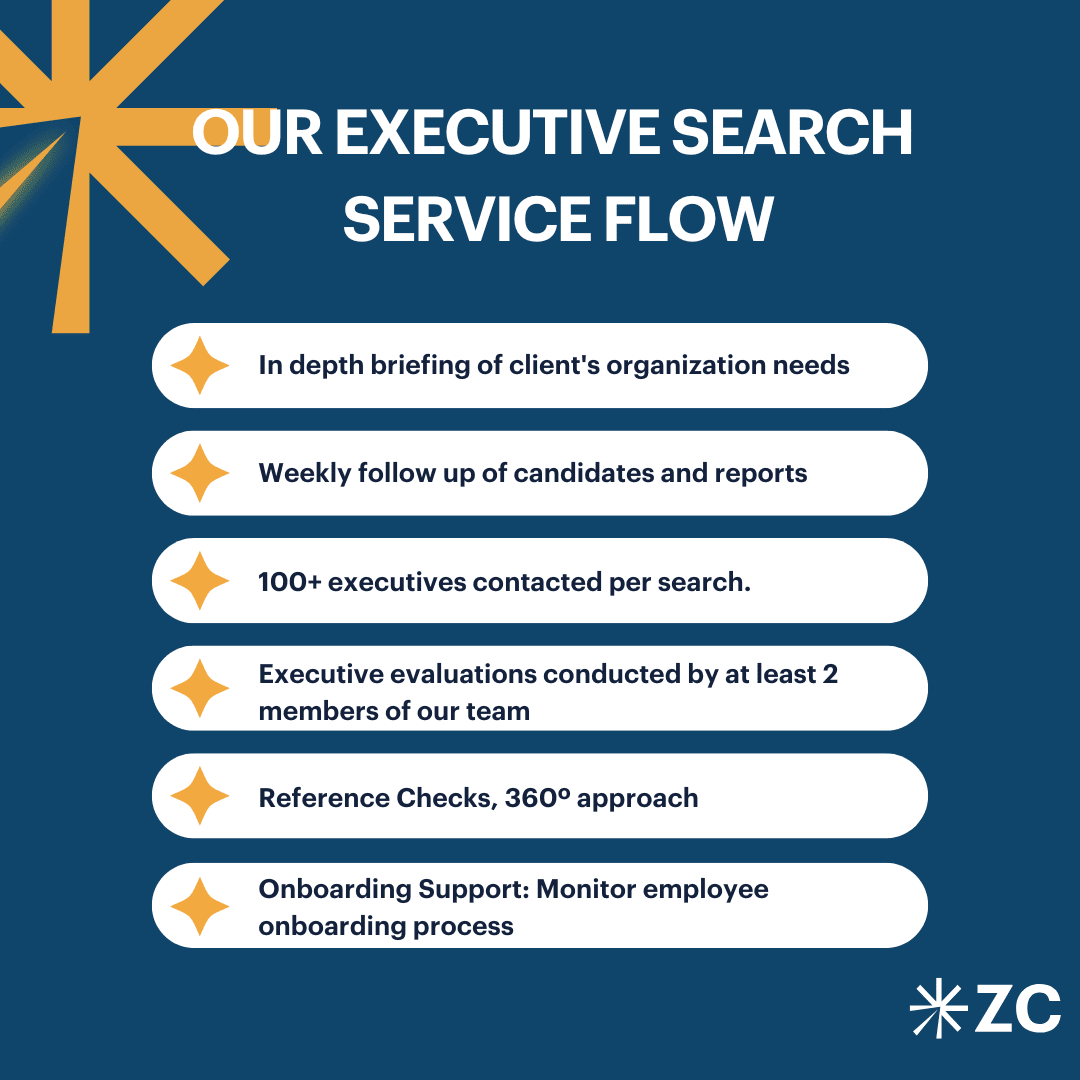
A complete hiring process in Brazil typically includes: 

  1. Market mapping grounded in talent intelligence, not visibility
    According to industry research by Korn Ferry, the most successful executive hires come from non-obvious competitor and adjacent-sector pools. 
  1. Structured interviews focused on judgment and context
    According to McKinsey, decision quality—not experience length—is the strongest predictor of executive effectiveness in uncertain environments. 
  1. Assessment and referencing tied to outcomes
    References should validate how candidates handled comparable levels of complexity, governance pressure, and ambiguity. 
  1. Offer design aligned with risk and mandate
    According to WTW’s global executive compensation outlook, governance scrutiny and cost pressures are reshaping pay structures, especially in emerging markets. 


Onboarding as a value lever 

Executive ROI in Brazil is often won—or lost—after the contract is signed. 

According to Gartner research on executive onboarding, poorly structured onboarding increases failure risk within the first 6–9 months, particularly in cross-border leadership roles. 

Effective onboarding in Brazil should include: 

  • Explicit decision rights 
  • Stakeholder alignment 
  • Clear governance cadence 
  • Early credibility-building milestones 

Executive Search in Brazil: When executive search is essential 

According to industry benchmarks in executive recruitment, executive search becomes critical when: 

  • The role is business-critical or confidential 
  • Market visibility is limited 
  • Failure costs exceed the investment in search 
  • Cultural and governance fit are decisive 

In Brazil, these conditions apply to most senior leadership roles. 

For companies planning senior leadership hires in Brazil, a structured executive search approach can significantly reduce risk and improve long-term outcomes. Click here and learn about our executive search service or here to contact with us.


Zavala Civitas executive search methodology for Brazil


Executive Search in Mexico: Leading Sectors Shaping Demand 

Over the last few years, Mexico swiftly garnered international investment, earning it the title of one of the fastest-growing countries in capturing global foreign direct investments.   This scenario creates new talent opportunities.  Most Executive Search firms in Mexico have modified their approach from simply filling highest roles in an organization to competing for the extremely limited pool of qualified executive talent for all roles in all sectors.  The demand isn’t even  It is very much concentrated.  Where Demand is Actually Growing  Mexico’s hiring executive pressure is unequal across all sectors. Some sectors are faster and are pulling talent from other sectors. Manufacturing is the clearest example.  With nearshoring, Mexico is becoming a strategically important center for the supply chain for North America. This is due to the fact that international companies are relocating and/or expanding their operations in Mexico. This is supported by McKinsey & Company.  The growth of a business is dependent on its leadership. Companies are in need of quickly scalable plant directors, operations managers, and supply chain executives. Such profiles are deficit.  Executive Search Energy and Infrastructure: Complexity at Scale  There is the highest demand for executive talent within the energy and infrastructure sectors.  Major projects and regulatory complexities, as well as lengthy investments, require leaders who are comfortable with uncertainty in all the essential domains, not just the technical. This includes stakeholder

Read More

Executive Search in Spain: Talent Gaps and Leadership Trends 

The Spanish talent market is perceived to be mature and easy to operate in. This makes some sense from afar. There is a solid network of business centers, a developing international business presence, and a considerable pool of experienced talent.  Problems arise when businesses attempt to recruit senior executives.  In Spain, executive search is shifting from talent arbitrage to understanding the true gaps and the reasons behind their expansion.  Where the Talent Gaps Are Actually Emerging  Spain may appear to have many senior professionals, but the issues here are more complex.  The problem is not the experience, but the type of experience that is most required by the different companies.  As per McKinsey & Company, the nature of change of senior leadership roles in Europe is at a much quicker pace than the nature of change in the senior leadership roles in the talent pool. Executives are required who are able to be strategic, also have the ability to execute, and be the change agent.  That blend is still too little. This is especially the case in Spain in the industries that are shifting the fastest—energy transition, infrastructure, and technology. There are many executives who have strong functional experience, but far fewer who have held positions to manage large, complex transformations, or to operate internationally in complex situations.  This results in the mismatch between the hopes of the companies and the actual situation in the labor market.  The Shift from Stability to Transformation Leadership  For many years, leadership in Spain emphasized operational stability and incremental change.  This is not enough anymore.  At present, companies expect executives to manage change and uncertainty, and lead in multiple dimensions simultaneously, including at the same time digital transformation, new business models, and the increased need for operational efficiency. 

Read More

Executive Search in the United States: Private Equity and Portfolio Leadership  

According to McKinsey’s Global Private Markets Review the United States remains the largest private equity market globally. It accounts for nearly half of global PE deal value.    Unlike traditional recruiting, Executive Search in the U.S. private equity-backed environments is much more complex.  In PE platforms, leadership is directly tied to value creation, EBITDA expansion,

Read More

Related posts

Leadership in the Middle East: Why Fit Matters More Than Origin 

As companies in the Middle East scale and institutionalize, the long-standing debate around local versus international leadership in the Middle East is largely outdated. The real issue today is alignment: whether the leadership profile fits the business challenge the organization is facing.  Too often, leadership appointments are driven by assumptions: that international executives

Read More

The Role of Compliance Officers in Strategic Decision-Making

Over the past decade, the role of compliance functions within organizations has progressed significantly. Traditionally, compliance was responsible primarily for ensuring the company’s compliance with regulation, particularly that Relations to bribery and corruption.  They developed codes of conduct, supplier due diligence process and the like and were responsible for ensuring compliance with these by employees of

Read More

Executive Search in Mexico: Leading Sectors Shaping Demand 

Over the last few years, Mexico swiftly garnered international investment, earning it the title of one of the fastest-growing countries in capturing global foreign direct investments.   This scenario creates new talent opportunities.  Most Executive Search firms in Mexico have modified their approach from simply filling highest roles in an organization to competing for the extremely limited pool of qualified executive talent for all roles in all sectors.  The demand isn’t even  It is very much concentrated.  Where Demand is Actually Growing  Mexico’s hiring executive pressure is unequal across all sectors. Some sectors are faster and are pulling talent from other sectors. Manufacturing is the clearest example.  With nearshoring, Mexico is becoming a strategically important center for the supply chain for North America. This is due to the fact that international companies are relocating and/or expanding their operations in Mexico. This is supported by McKinsey & Company.  The growth of a business is dependent on its leadership. Companies are in need of quickly scalable plant directors, operations managers, and supply chain executives. Such profiles are deficit.  Executive Search Energy and Infrastructure: Complexity at Scale  There is the highest demand for executive talent within the energy and infrastructure sectors.  Major projects and regulatory complexities, as well as lengthy investments, require leaders who are comfortable with uncertainty in all the essential domains, not just the technical. This includes stakeholder

Read More

Executive Search in Spain: Talent Gaps and Leadership Trends 

The Spanish talent market is perceived to be mature and easy to operate in. This makes some sense from afar. There is a solid network of business centers, a developing international business presence, and a considerable pool of experienced talent.  Problems arise when businesses attempt to recruit senior executives.  In Spain, executive search is shifting from talent arbitrage to understanding the true gaps and the reasons behind their expansion.  Where the Talent Gaps Are Actually Emerging  Spain may appear to have many senior professionals, but the issues here are more complex.  The problem is not the experience, but the type of experience that is most required by the different companies.  As per McKinsey & Company, the nature of change of senior leadership roles in Europe is at a much quicker pace than the nature of change in the senior leadership roles in the talent pool. Executives are required who are able to be strategic, also have the ability to execute, and be the change agent.  That blend is still too little. This is especially the case in Spain in the industries that are shifting the fastest—energy transition, infrastructure, and technology. There are many executives who have strong functional experience, but far fewer who have held positions to manage large, complex transformations, or to operate internationally in complex situations.  This results in the mismatch between the hopes of the companies and the actual situation in the labor market.  The Shift from Stability to Transformation Leadership  For many years, leadership in Spain emphasized operational stability and incremental change.  This is not enough anymore.  At present, companies expect executives to manage change and uncertainty, and lead in multiple dimensions simultaneously, including at the same time digital transformation, new business models, and the increased need for operational efficiency. 

Read More

Executive Search in China: The Complexity of Hiring Executives

China is one of those markets where opportunities are easy to find but the right leaders are not.  many international firms, executive recruitment in China becomes challenging for one simple reason: the market does not act as they expect. What works for Europe or the US, tends to break down here.  Recruiting

Read More

Executive Search in the United States: Private Equity and Portfolio Leadership  

According to McKinsey’s Global Private Markets Review the United States remains the largest private equity market globally. It accounts for nearly half of global PE deal value.    Unlike traditional recruiting, Executive Search in the U.S. private equity-backed environments is much more complex.  In PE platforms, leadership is directly tied to value creation, EBITDA expansion,

Read More