
Last updated: August 13, 2026
Canada has one of the most trusted and stable insurance markets globally. Yet 2023 and 2024 have introduced a combination of financial obstacles, technological disruption, and consumer demand shifts that are compelling insurers to rethink their approaches. As organisations navigate changing consumer preferences, new regulations, and insurtech competition, executive search firms are connecting companies with the leadership talent necessary to go through it.
Key Figures at a Glance
| Data point | Finding | Source |
|---|---|---|
| Canadian insurers struggling to recruit executives with the right skills | 68% — especially in risk management and digital innovation | Canadian Institute of Actuaries (CIA) |
| Regulatory oversight trend | OSFI increased supervisory scrutiny — heightened compliance demands | OSFI (Office of the Superintendent of Financial Institutions) |
| Canada total insurance premiums (2023) | ~$250 billion — P&C, life, and health combined | Insurance Bureau of Canada (IBC), 2023 |
| Consumer demand shift driving product adaptation | Rising cost of living driving demand for adaptable, value-oriented insurance products | IBC report, 2023 |
Understanding the Current State of Canada’s Insurance Sector
Canada’s insurance industry is known for its trustworthiness and stability. Yet 2023 introduced a combination of financial obstacles — rising interest rates, economic uncertainty, and the rapid emergence of insurtech companies reshaping the traditional model. Insurers are now compelled to rethink their approaches, striving to deliver services that resonate with today’s demanding clients. Canadians are looking for insurance that offers adaptability given inflation and the rising cost of living. A recent report from the Insurance Bureau of Canada showed that many insurers are adjusting their product offerings to meet these new demands while maintaining profitability in a competitive market.
Key Challenges Confronting the Insurance Market
- Shortage of leadership talent: 68% of insurers are struggling to recruit executives who possess the right skills — especially in risk management and digital innovation. As the industry constantly changes, it has become crucial to have leaders who can guide organisations through complex transitions and resistance to change from traditionally structured workforces.
- Regulatory changes: The insurance industry operates within a strict regulatory framework that varies across provinces. Legislative shifts have increased compliance demands — OSFI has increased oversight, highlighting the need for leaders who understand the regulatory landscape across provincial and federal dimensions and can develop effective compliance strategies while maintaining commercial performance.
- Embracing technological change: The rise of insurtech has brought disruption to the industry. Consumers are turning to digital platforms for their insurance needs, prompting traditional insurers to upgrade their technology capabilities — creating urgent demand for leaders who can champion digital transformation, utilise data analytics, and enhance customer experience without disrupting the actuarial risk management discipline that underlies insurance profitability.
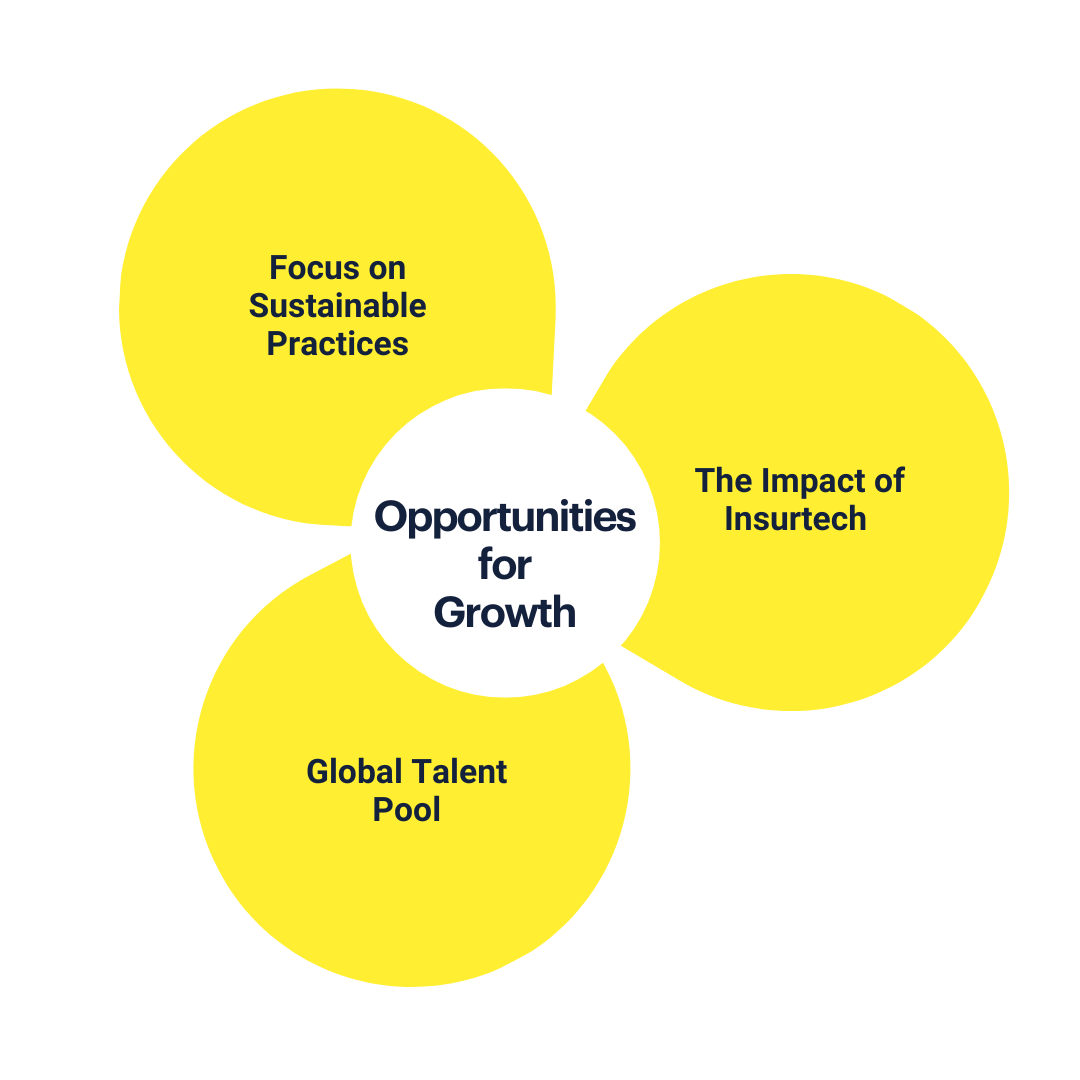
Opportunities for Growth
- Focus on sustainable practices: With increasing environmental awareness, many insurers are incorporating ESG criteria into their operations. There is growing demand for executives with expertise in sustainable insurance products and climate risk modelling — the specific capability that allows an insurer to price physical climate risk accurately and integrate it into underwriting strategy rather than treating it as a regulatory reporting obligation.
- The impact of insurtech: Insurtech companies are introducing innovative solutions that challenge traditional business models. To remain competitive, established insurers must be willing to explore partnerships with these agile firms. Executive search firms find leaders who are flexible and possess the insight needed to harness collaborations with insurtechs effectively — specifically the skill of evaluating which insurtech partnership creates genuine competitive differentiation versus which one creates operational complexity without proportional benefit.
- Global talent pool: Canadian insurance companies can benefit from a diverse talent pool. Executive search firms facilitate acquisition of leaders from around the globe — particularly from the UK, Australia, and Europe, where insurance market sophistication in digital underwriting, climate risk modelling, and insurtech partnership management provides experience that the domestic Canadian pool cannot match at the required depth.
The Role of Executive Search Firms
- Bridging leadership gaps: Executive search firms understand the unique challenges in the insurance sector and provide essential support in identifying and recruiting leaders capable of addressing them — particularly the actuarial-digital bridge profile that the 68% talent shortage identifies as the scarcest combination.
- Understanding regulatory nuances: Executive search firms excel at finding candidates with a strong background in OSFI compliance and provincial regulatory frameworks — candidates whose regulatory management experience is operational rather than purely administrative.
- Driving digital innovation: Executive search firms help organisations identify leaders who can embrace change and foster a culture of innovation — candidates with the right technical skills and the leadership capability to bring traditionally structured insurance workforces through digital adoption.
The Canadian insurance industry is facing a unique set of challenges — economic pressures, regulatory changes, and technological disruption. With these challenges come significant opportunities for growth and innovation. Executive search firms are playing a vital role in connecting companies with the leadership talent necessary to overcome these obstacles and seize the future.
Click here to get in contact with us.
Frequently Asked Questions: Executive Search in Canada’s Insurance Sector
Finding executive leadership for Canada’s insurance sector?
Zavala Civitas provides sector-specific executive search for Canada’s insurance organisations — actuarial-digital bridge profiles, OSFI compliance governance, and insurtech partnership leadership. 92% closing rate.