Key Takeaway: Italy’s PE investment grew 83% in 2024 to €56.4 billion in deal value, and over 40% of Italian manufacturers are now investing in digital technologies. The same industrial fabric that made Italy the EU’s third-largest economy — its SME structure, family ownership, and deep sector specialisation — is now the primary source of executive talent complexity. Leaders who can combine international governance fluency with Italian business culture are structurally the scarcest resource in the market.
Last updated: August 13, 2026
Italy remains one of Europe’s most influential economies, combining a strong industrial base, world-leading luxury brands, and growing innovation hubs. Yet, as competition intensifies and the global economy evolves, companies are under pressure to secure leaders who can manage complexity while driving growth. For many organisations, executive search has become a critical tool to connect with visionary executives who combine local insight with international experience.
Below are the key trends shaping the executive search landscape in Italy for 2025 and beyond.
Key Figures at a Glance
| Data point |
Figure |
Source |
| Italian manufacturers investing in digital technologies and automation |
40%+ |
Eurostat |
| PE investment growth in Italy (2024) |
+83% — €56.4 billion deal value |
AIFI / PwC, 2025 |
| Women in board seats at listed Italian companies (2024) |
<20% |
Consob, 2024 |
| EU Green Deal emissions reduction target by 2030 |
-55% — driving demand for CSOs and green transition leadership across Italian industry |
European Commission |
1. Digital Transformation and Industry 4.0
Italy’s industrial fabric is largely built on small and medium-sized enterprises (SMEs). According to Eurostat, over 40% of Italian manufacturers are investing in digital technologies and automation. However, many family-owned businesses still face challenges in scaling digital solutions.
This creates demand for executives who can guide companies through Industry 4.0 transitions, balancing innovation with operational continuity. Executive search is increasingly focused on leaders with experience in AI, robotics, and smart manufacturing, as well as those capable of transforming traditional SMEs into digitally resilient enterprises.
The Industry 4.0 executive challenge in Italy is not primarily a technology problem — it is a governance problem. The executives most capable of leading a manufacturing SME through digital transformation are those who can do it without alienating the family owners who built the company, without disrupting the supplier relationships that define the industrial cluster, and without creating a pace of change that the existing workforce cannot absorb. That requires a specific kind of change management intelligence that is different from the digital transformation experience accumulated in a large corporate environment. Italian executive search for Industry 4.0 must assess that distinction explicitly.
2. Sustainability and the Green Transition
Italy is deeply committed to the EU’s Green Deal, aiming to cut emissions by 55% by 2030. Fashion, automotive, and energy companies are under growing pressure to embed sustainability into their business models.
This shift has created demand for leaders with expertise in circular economy, renewable energy projects, and ESG compliance. A recent example is a major Italian fashion group that appointed a Chief Sustainability Officer via executive search to oversee its transition to eco-friendly production lines — a move that boosted both reputation and investor confidence.
3. Globalisation and Bilingual Leadership
Italian companies remain highly export-driven, with luxury, food, and engineering products among the country’s most important exports. Yet, there is a well-known shortage of executives with bilingual capabilities and global management experience.
Executive search plays a vital role in identifying leaders who combine multilingual skills (English, French, German) with cultural adaptability. These executives are critical for companies expanding abroad or managing cross-border operations with international partners.
Italy’s bilingual leadership gap is more acute than the headline data suggests because the country’s most internationally competitive sectors — luxury, fashion, food, advanced manufacturing — are also the ones with the deepest reliance on relationship-based business development. An export-oriented CEO or Commercial Director who speaks English at a functional level is not the same as one who can negotiate strategic partnerships in English, represent the brand credibly at international trade events, and manage a global commercial team without losing the Italian cultural identity that differentiates the product. That combination exists in a narrow pool — and with PE investment at €56.4 billion in 2024, the demand for it is intensifying across portfolio companies simultaneously.
4. Leadership Diversity and Inclusion
While Italy has made progress, women still account for less than 20% of board seats in listed companies (Consob, 2024). Diversity is increasingly seen not just as a compliance measure but as a driver of innovation and competitiveness.
C-level recruitment is helping organisations meet governance standards and embrace diversity by presenting a broader pool of candidates, including women and leaders from underrepresented backgrounds. This shift is gradually reshaping Italian corporate culture — driven both by regulatory pressure and by PE investors who require board diversity as part of their governance standards.
5. Geopolitical and Economic Resilience
Italy faces ongoing challenges, including an ageing population, high public debt, and regional economic disparities between the north and south. Combined with EU-wide geopolitical uncertainties, this has heightened the need for leaders skilled in risk management, regulatory navigation, and long-term strategy.
Executive search firms are prioritising executives with resilience and adaptability — leaders who can help Italian companies remain stable and competitive despite external shocks.
Conclusion: Why Executive Search in Italy Matters Now
From digital transformation to sustainability and diversity, the trends shaping Italy highlight the growing complexity of leadership. Companies are no longer looking only for technical expertise — they are searching for executives who can navigate uncertainty, build resilience, and deliver sustainable growth.
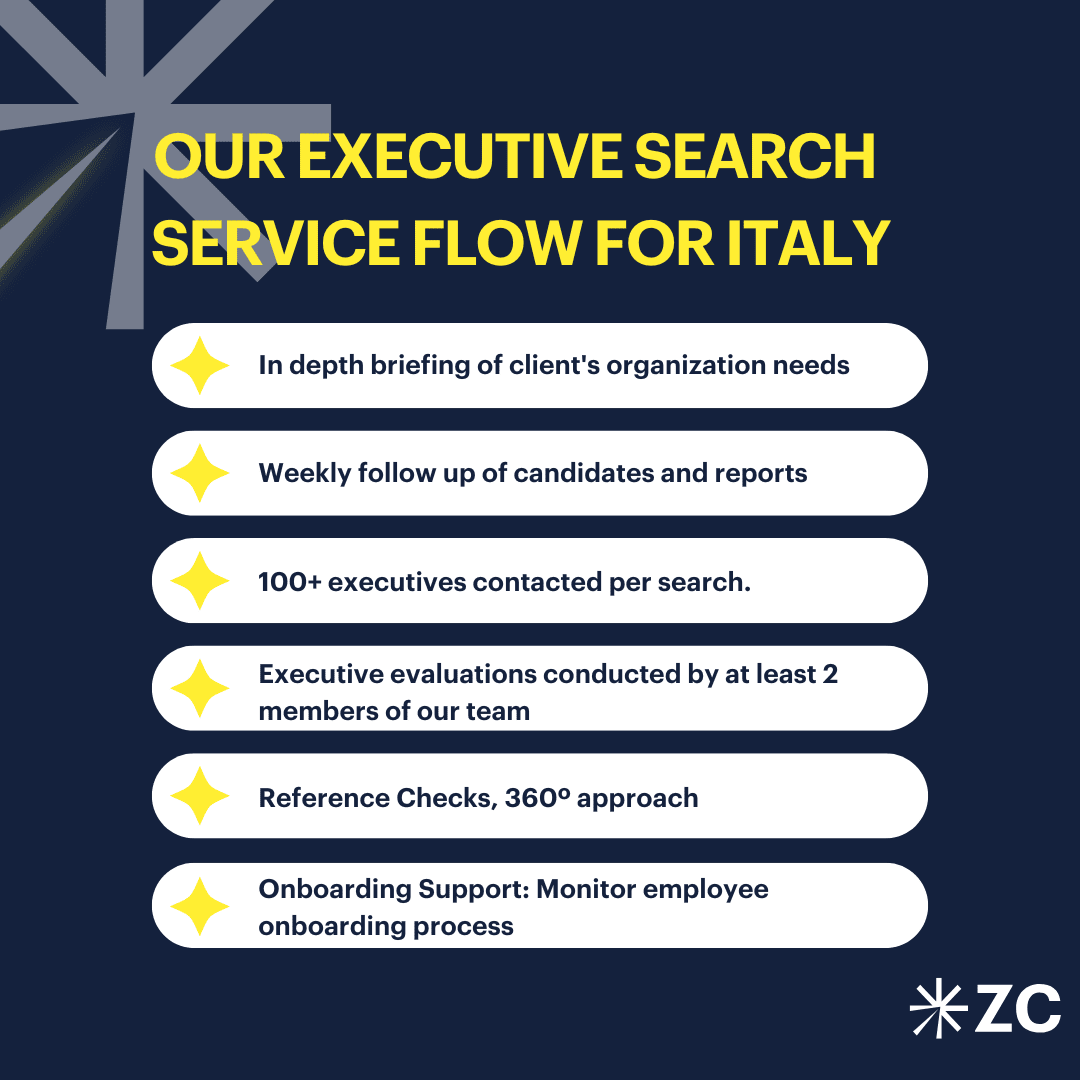
At Zavala Civitas, we partner with organisations to identify and secure top executive talent across Italy’s most competitive industries. If your company is preparing for transformation or expansion in Italy, our team is ready to connect you with leaders who will make a lasting impact.
Click here to learn more about our services.
Frequently Asked Questions: Executive Search in Italy — Trends 2025 and Beyond
Why is Italy’s SME structure both its greatest strength and its biggest executive search challenge?
Because the same characteristics that make Italian SMEs globally competitive — deep sector specialisation, family ownership, strong supplier networks, and long-term relationship capital — also make them resistant to the governance changes that executive leadership transitions require. The executive who succeeds in an Italian family-owned SME is not the one who arrives with the best corporate credentials. It is the one who earns trust within the family ownership structure, navigates the informal influence networks that determine real decisions, and introduces change at a pace the organisation can absorb without triggering defensive reactions.
How is PE investment reshaping executive search requirements in Italy?
Significantly and rapidly. With €56.4 billion in PE deal value in 2024 — an 83% increase — a large share of Italian companies are now under PE governance for the first time. PE investors require executive profiles that are substantially different from what family-owned businesses typically develop: KPI discipline, board reporting fluency, investor communication, and value creation accountability within a defined exit horizon. Those profiles are structurally scarce in Italy’s executive pool, because most of the available candidates have built their careers in environments that did not require them.
What is the real bottleneck in the bilingual leadership shortage in Italy?
It is not English proficiency — it is the combination of genuine international management experience and Italian cultural credibility. Italy has many executives who speak English. Far fewer have managed international teams, negotiated cross-border deals in English, and represented Italian brands credibly in global commercial environments — while still retaining the relationship capital and cultural fluency needed to operate within Italy’s consensus-driven, relationship-based business culture. The search for that combination consistently extends beyond Italy’s borders to the Italian diaspora in London, New York, and other global hubs.
How does the north–south divide in Italy affect executive search?
Materially. Italy’s industrial and executive talent concentration is overwhelmingly in the north — Milan for financial services, luxury, and corporate headquarters; Turin for automotive and advanced manufacturing; Bologna and the Emilia-Romagna corridor for industrial and food sectors; Veneto for SME manufacturing and wine. Southern Italy presents a different talent dynamic, with a smaller senior executive pool, different labour market conditions, and a distinct relational culture. Executive search that does not account for this divide — mapping national averages rather than regional realities — consistently produces shortlists that underperform at the interview stage.
How does Zavala Civitas approach executive search in Italy?
By mapping candidates by regional cluster and sector rather than national market — with direct access to the senior executive ecosystem in Milan, Turin, Bologna, and Veneto. We assess international governance fluency alongside Italian cultural credibility, evaluate PE-readiness as a specific competency where relevant, and extend the search to the Italian diaspora for mandates requiring genuine international management experience. With a 92% closing rate across completed mandates.