Key Takeaway: With salary pressure running 10–20% above prior-year levels in Mexico’s nearshoring regions and 40% of companies reporting shortages of bilingual senior leadership, compensation benchmarking for C-suite roles in Mexico is no longer optional. Organisations that go to market with below-benchmark offers are not losing to higher salaries — they are losing to the first credible offer the candidate receives from a competitor who did the benchmarking first.
Last updated: August 13, 2026
In Mexico’s evolving business landscape, compensation is no longer just a matter of salary — it is a strategic tool for attracting and retaining C-level talent. As the executive search market in Mexico becomes more competitive, boards and HR leaders must rethink how they structure offers for C-suite candidates. From performance-linked incentives to ESG-aligned bonuses, this article explores the key trends shaping C-level pay in 2025.
Key Figures at a Glance
| Data point |
Figure |
Source |
| Salary pressure for senior executives in Mexico’s nearshoring regions |
10–20% above prior year (northern Mexico) |
Zavala Civitas market analysis |
| Companies reporting shortages of bilingual senior leadership in Mexico |
40% |
ManpowerGroup |
| Mexico FDI Jan–Sep 2025 (record) |
~$41 billion USD (+15% YoY) — driving compensation competition |
Secretaría de Economía / AIG, 2025 |
| Cumulative nearshoring investment in Mexico (5 years) |
$46 billion USD — creating sustained upward pressure on executive pay |
Nearshoring market analysis, 2025 |
Trend 1: Long-Term Incentives Replace Short-Term Bonuses as the Differentiating Factor
Short-term bonuses are no longer enough. Mexican companies are increasingly offering equity-based incentives to attract senior talent — especially in private equity-backed firms and multinationals. These packages help align leadership goals with shareholder value and create stronger retention over time.
Implication for executive search: Search firms now need to assess candidates not just for leadership skills but also for how well they understand value creation and long-term strategic alignment — and advise clients on structuring packages that compete with the increasing sophistication of what the best candidates are being offered simultaneously by multiple organisations.
With $46 billion in cumulative nearshoring investment and salary pressure running 10–20% above prior-year levels in northern Mexico, the compensation environment for senior executives is not just competitive — it is structurally driven by a supply/demand imbalance that is not closing. A COO or Plant Director in the Bajío corridor who has the specific operational depth and bilingual fluency that three new facilities need simultaneously is receiving multiple offers. In that context, the long-term incentive structure — equity, retention bonuses, vesting timelines tied to specific milestones — is frequently more decisive than the base salary differential.
Trend 2: ESG Metrics Are Entering Executive Pay Conversations
Environmental, Social, and Governance (ESG) goals are starting to show up in compensation packages — particularly for CEO and CFO roles. While this trend is still emerging in the Mexican market, it is quickly gaining traction among companies with international stakeholders, listed parent companies operating under CSRD, or active sustainability agendas.
Candidates are being evaluated not only on their business acumen, but also on their experience leading ESG initiatives — adding a new dimension to the assessment process and to the compensation negotiation.
Trend 3: Rising C-Level Compensation — What Executive Search Firms Are Seeing
Despite global economic pressures, compensation for top executives in Mexico continues to rise. Demand for bilingual, globally experienced leaders is outpacing supply — particularly in manufacturing, logistics, and fintech. With 40% of companies already reporting shortages of bilingual senior leadership (ManpowerGroup), the compensation pressure is structural, not cyclical.
Insight: Competitive compensation is not optional. Organisations must benchmark offers realistically, based on current market expectations by cluster and sector — not national averages or global headquarters benchmarks that were calibrated for different operating environments.
The most common compensation mistake in Mexico’s executive hiring market is applying a national benchmark to a regional search. The compensation gap between a COO in Monterrey’s automotive cluster and a COO in Mexico City’s financial services sector for comparable scopes of responsibility can be 20–30% in base salary and substantially more in total package when equity and long-term incentives are included. Organisations that apply a single national benchmark consistently discover the gap at the final offer stage — when the candidate is already in a competing process and the timing advantage has been lost.
Trend 4: Customised Offers Are Now the Standard in C-Level Hiring
The most sought-after candidates expect packages tailored to their personal and professional goals — whether it is relocation support, hybrid work arrangements, long-term incentives, or involvement in high-impact strategic initiatives. A standard package that has not been calibrated to the candidate’s specific situation and priorities is being interpreted as a signal that the organisation has not invested sufficiently in understanding who they are trying to hire.
What This Means for Executive Hiring in Mexico
Each of these trends underscores a growing truth: C-level recruitment in Mexico is no longer about finding the right candidate — it is about building the right offer for the right candidate in the right cluster. Firms that serve as strategic advisors in this process, providing real-time market benchmarking alongside candidate identification, are better positioned to close top talent and retain it.
The executive compensation landscape in Mexico is becoming more sophisticated — and so are the expectations of leadership candidates. For companies working with executive search firms in Mexico, understanding these evolving pay structures is no longer optional — it is a key part of winning the talent competition in 2025 and beyond.
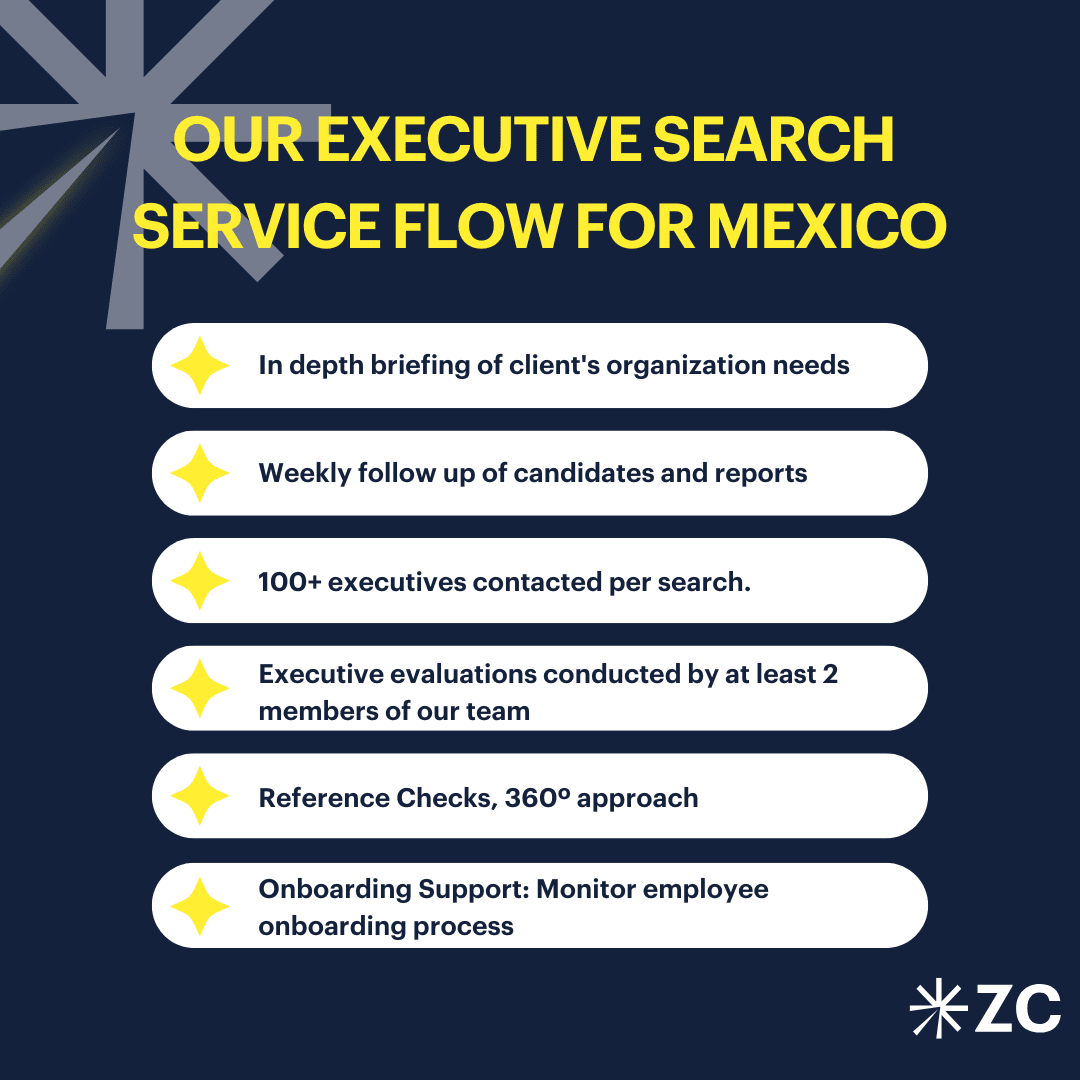
Click here to learn more about our executive search service process.
Frequently Asked Questions: Executive Compensation Trends in Mexico 2025
Why is compensation pressure for senior executives in Mexico structural rather than cyclical?
Because it is driven by a supply/demand imbalance that does not close automatically over time. With $41 billion in FDI in the first nine months of 2025 and cumulative nearshoring investment of $46 billion, the number of new operations requiring senior executive leadership is growing faster than the pool of executives who have the specific combination of bilingual fluency, sector expertise, and cluster-specific credibility. Opening more plants does not create more qualified executives. It intensifies competition for the same people — which drives compensation up structurally.
Why does applying a single national compensation benchmark in Mexico consistently produce failed offers?
Because the compensation gap between different regional clusters in Mexico for the same functional role can be 20–30% in base salary and substantially more in total package. A COO in Monterrey’s automotive cluster, a COO in the Bajío, and a COO in Mexico City’s financial services sector are not competing in the same talent market. Organisations that discover this gap at the final offer stage — after the candidate is already in a competing process — have lost the timing advantage that distinguishes a successful hire from a prolonged search.
Why are long-term incentives more decisive than base salary in Mexico’s senior executive market?
Because the most sought-after candidates are receiving multiple simultaneous offers from organisations that are all aware of the national compensation benchmarks. In a field where base salaries are converging, the structure of the long-term incentive — equity, vesting timeline, milestone-linked bonuses — is the component that differentiates the offer. It also signals how seriously the organisation has thought about the candidate’s long-term alignment with the company’s strategic direction, which is itself an evaluation criterion for senior executives choosing between competitive offers.
How are ESG metrics changing what CFOs and CEOs are assessed on in Mexico?
For companies with international parent organisations subject to CSRD mandatory reporting, or with institutional investors who have ESG as a portfolio condition, the CFO and CEO are now accountable for ESG performance metrics that appear in compensation scorecards. This shifts the assessment from “does this candidate have sustainability values” to “does this candidate have the specific ESG reporting experience and governance competency to manage the obligations that come with this role.” It is a harder requirement — and a narrower talent pool.
How does Zavala Civitas support compensation benchmarking for executive search in Mexico?
By providing real-time, cluster-specific compensation benchmarking alongside candidate identification — not after the shortlist is delivered. We calibrate base salary, bonus structure, long-term incentive design, and total package benchmarking by cluster, sector, and functional scope before going to market. This ensures organisations enter candidate conversations with a competitive, well-structured offer rather than discovering the gap in the final negotiation. With a 92% closing rate across completed mandates.
Building a competitive compensation strategy for senior executive hiring in Mexico?
Zavala Civitas provides cluster-specific benchmarking alongside executive search in Mexico. 92% closing rate.
Executive Search →
Industrial →
Contact Us →