
Executive Search in Spain: The Generational Shift Reshaping Leadership 

A leadership turning point in Spain 

Spain’s executive landscape is changing quietly but profoundly.
Many of the country’s senior business leaders — those who rebuilt corporations in the 1990s and steered them through the financial crisis — are now approaching retirement.
As this experienced generation steps back, companies are facing a new challenge: identifying and empowering successors who think differently, lead faster, and bring global perspective to traditionally local structures. 

This is not a simple handover. It is a cultural shift that touches every sector of Spanish business. 

A narrowing leadership pipeline 

The demographic gap between long-tenured executives and emerging leaders is becoming evident.
Executives in their late 30s and 40s often prefer flexible, purpose-driven careers over hierarchical leadership paths.
They are less loyal to institutions and more selective about culture, autonomy, and impact — a mindset that contrasts sharply with the corporate traditions that shaped previous generations. 

As a result, many Spanish companies are discovering that they lack ready successors for key executive and board roles. The leadership pipeline has depth of experience, but limited renewal. 

Rethinking what “leadership potential” means 

This new context is forcing organizations — and executive search firms — to look beyond the CV.
Track record and tenure still matter, but adaptability, curiosity, and global exposure are becoming stronger indicators of readiness.
Assessment tools and advisory-led searches are helping boards identify transformative potential, not just proven performance. 

Executive search in Spain is evolving from selection to strategic evaluation — aligning leadership profiles with the pace of change each company must achieve. 

Sectors leading the transition 

Some industries are already acting faster.
Energy and infrastructure groups are rotating leadership to accelerate the sustainability agenda.
Consumer and retail firms are bringing in younger executives with digital and customer experience backgrounds.
And in the legal and professional services sectors, the rise of new partnerships is redefining succession planning altogether. 

What unites these changes is a growing acceptance that diversity of age, perspective, and leadership style strengthens resilience. 

Executive Search in Spain:

The most effective transitions in Spain are not abrupt replacements but collaborative successions.
Senior leaders remain as mentors and board advisors, while younger executives gradually assume operational control.
Executive search partners play a key role in designing these transitions — ensuring cultural continuity while embedding new capabilities at the top. 

Spain’s generational shift represents both a risk and a renewal opportunity.
Organizations that manage it proactively — investing in assessment, succession planning, and leadership development — will preserve experience while injecting fresh vision. 

For executive search firms, the mission is clear: help Spanish companies bridge the gap between legacy and transformation, ensuring that the next generation of leaders not only inherits the business but redefines it. 
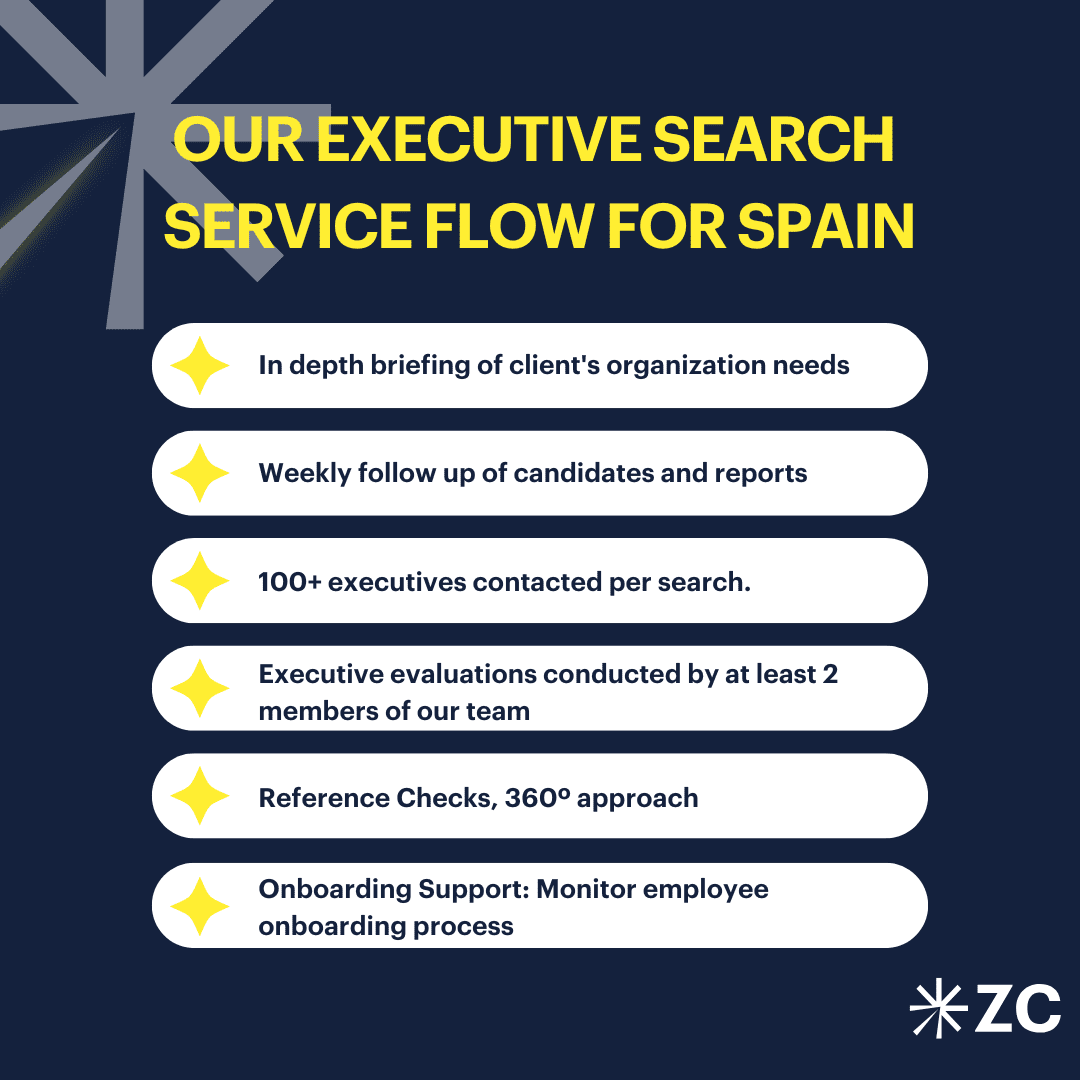
Learn how our executive search service flow work for Spain

About Zavala Civitas Executive Search

Zavala Civitas supports Spanish and international organizations in identifying, assessing, and developing executives who combine experience with innovation. Our cross-border expertise connects leadership generations and builds succession strategies that ensure long-term continuity and growth. Click here.


Executive Development and Assessment in Portugal for Senior talent

In Portugal, the market is relatively small, executive mobility is limited, and reputations travel quickly. Many companies already have solid senior leaders in place.It’s not about whether these leaders are competent. The question is how to assist them in improving performance as they take on greater roles.  Most people have an area that they can

Read More

Executive Search in Mexico: Leadership Demand Shaped by Nearshoring 

Over the past few years, Mexico has moved to the center of many global expansion strategies. Nearshoring has accelerated investment decisions, operational scale, and organizational complexity across the country. As a result, leadership hiring has shifted from being opportunistic to becoming a critical risk factor.  In this environment, Executive Search in Mexico is

Read More

Executive Search in Portugal: Competing for Leadership in a Small Talent Market 

Portugal has become an increasingly attractive location for international businesses. While stability, talent quality, and quality of life are strong advantages, the senior talent pool is small, highly visible, and intensely competitive.   Because of this hiring in Portugal is about strategy. It involves managing scarcity, confidentiality, and long-term sustainability of

Read More

Related posts

Leadership and Decision-Making in Asia-Pacific’s Age of AI 

From Technology Adoption to Strategic Accountability  Across the Asia-Pacific (APAC) region, artificial intelligence has moved beyond experimentation. What only a few years ago sat within innovation labs or IT functions has now reached the center of executive and board-level decision-making.  This shift is already measurable. Nearly 48% of companies in Asia now

Read More

Tomás Grimaldi becomes Partner at Zavala Civitas Executive Search 

Madrid, Spain – January 2026  Zavala Civitas Executive Search announces the promotion of Tomás Grimaldi to Partner, reinforcing the firm’s long-term commitment to leadership, growth, and equity partnership continuity.  Tomás joined Zavala Civitas initially as Finance Manager and has progressively taken on broader responsibilities across business development, executive search, and

Read More

Executive Development and Assessment in Portugal for Senior talent

In Portugal, the market is relatively small, executive mobility is limited, and reputations travel quickly. Many companies already have solid senior leaders in place.It’s not about whether these leaders are competent. The question is how to assist them in improving performance as they take on greater roles.  Most people have an area that they can

Read More

The Insider Paradox: Why APAC Boards Are Choosing Continuity Over Disruption 

In H1 2025, 83% of all new CEOs in APAC were internal promotions the highest ratio ever recorded and dramatically higher than Western markets.  This surge is not accidental, nor is it a sign of risk-aversion. It reflects a deeper leadership strategy shaped by the geopolitical uncertainty of the region, operational complexity, and the rising value

Read More
china business landscape

Executive Search in China: Local Leadership vs Global Executives 

Over the past ten years, many multinational companies in China have quietly changed how they think about leadership. The model of relying primarily on expatriate executives is no longer taken for granted.   Boards and CEOs are increasingly weighing the trade-offs between local Chinese executives and global leaders sent from headquarters.

Read More

Executive Search in Mexico: Leadership Demand Shaped by Nearshoring 

Over the past few years, Mexico has moved to the center of many global expansion strategies. Nearshoring has accelerated investment decisions, operational scale, and organizational complexity across the country. As a result, leadership hiring has shifted from being opportunistic to becoming a critical risk factor.  In this environment, Executive Search in Mexico is

Read More