Key Takeaway: 82% of Spanish companies struggle to hire senior talent and 63% of CEOs cite leadership shortages as their top strategic risk. At the same time, high-performing executives in Spain receive three to five unsolicited approaches per month. The market is not short of candidates — it is short of the right candidates, and those candidates are already being recruited.
Last updated: August 13, 2026
Spain has become one of the most competitive executive talent markets in Europe. According to Eurostat and PwC, 63% of Spanish CEOs identify leadership shortages as their top strategic risk, and 82% report difficulties hiring for senior roles — a challenge intensified by digital transformation, internationalisation, and hybrid work models.
As organisations navigate expansion, restructuring, and succession, executive search in Spain is evolving fast, requiring deeper sector specialisation, data-driven assessment, and global talent mapping capabilities.
Key Figures at a Glance
| Data point |
Figure |
Source |
| Spanish companies struggling to hire senior talent |
82% |
Eurostat / PwC |
| CEOs citing leadership shortages as top strategic risk |
63% |
PwC Spain |
| Senior executives in Spain who consider hybrid work essential |
74% |
Deloitte Spain |
| Spanish companies expecting headcount expansion in 2025 |
54% |
CEOE |
Market Trends Redefining Executive Search in Spain
- Spain’s leadership market is tightening despite broader economic uncertainty. 41% of Spanish companies struggle to hire senior managers, with pressure highest in legal, renewables, industrial, consumer, technology, energy, infrastructure, and real estate.
- High-performing executives report receiving three to five unsolicited approaches per month, increasing competition for top talent.
- Spain also continues attracting international executives thanks to investment in renewables, infrastructure, pharma, agrifood, and tech, plus favourable quality of life. However, retention challenges persist due to onboarding, multicultural integration, and compensation benchmarking.
At the same time, CEOs expect search partners to deliver predictive leadership analytics, culture-fit assessment, structured references, and transparent milestone-driven pipelines.
When 82% of companies struggle to hire senior talent and the best-performing executives are receiving three to five unsolicited approaches per month, the problem is not access to the market. It is the quality of the mandate and the credibility of the approach. An executive who is simultaneously being recruited by five organisations will respond to the one with the clearest brief, the most specific conversation, and the most credible search partner. That is not a compensation question — it is an execution quality question.
Talent Insights: What Spain’s Top Executives Expect in 2025
Executives in Spain are becoming significantly more selective. They expect clarity, speed, and confidentiality across the process: defined scopes, transparent compensation ranges, and structured communication.
- 80% of senior executives say international exposure is a decisive factor in accepting a role. Culture, purpose, and leadership style are now among the top decision drivers.
- Hybrid expectations are standard, with leaders favouring 2–3 days on-site, except in industrial or field-based sectors.
What CEOs in Spain Must Know Before Starting an Executive Search
Compensation benchmarking is essential. Offers below market standard fail in most cases, and salary benchmarks vary widely between Madrid, Barcelona, Valencia, and Bilbao.
Internal alignment must occur before starting the search. Misalignment on scope, KPIs, or must-haves is one of the biggest causes of failed processes.
Diversity has become a strategic requirement. Spanish companies increasingly demand gender-balanced and multicultural leadership teams.
Onboarding quality is now recognised as the key factor determining executive success within the first 180 days.
Key Data: Spain Executive Search 2024–2025
- 63% of CEOs cite leadership shortages as a top concern (PwC).
- 82% of companies struggle to hire senior talent (Eurostat).
- 41% report difficulty filling managerial roles (Manpower).
- 74% of executives consider hybrid work essential (Deloitte).
- 54% of Spanish companies expect to expand headcount in 2025 (CEOE).
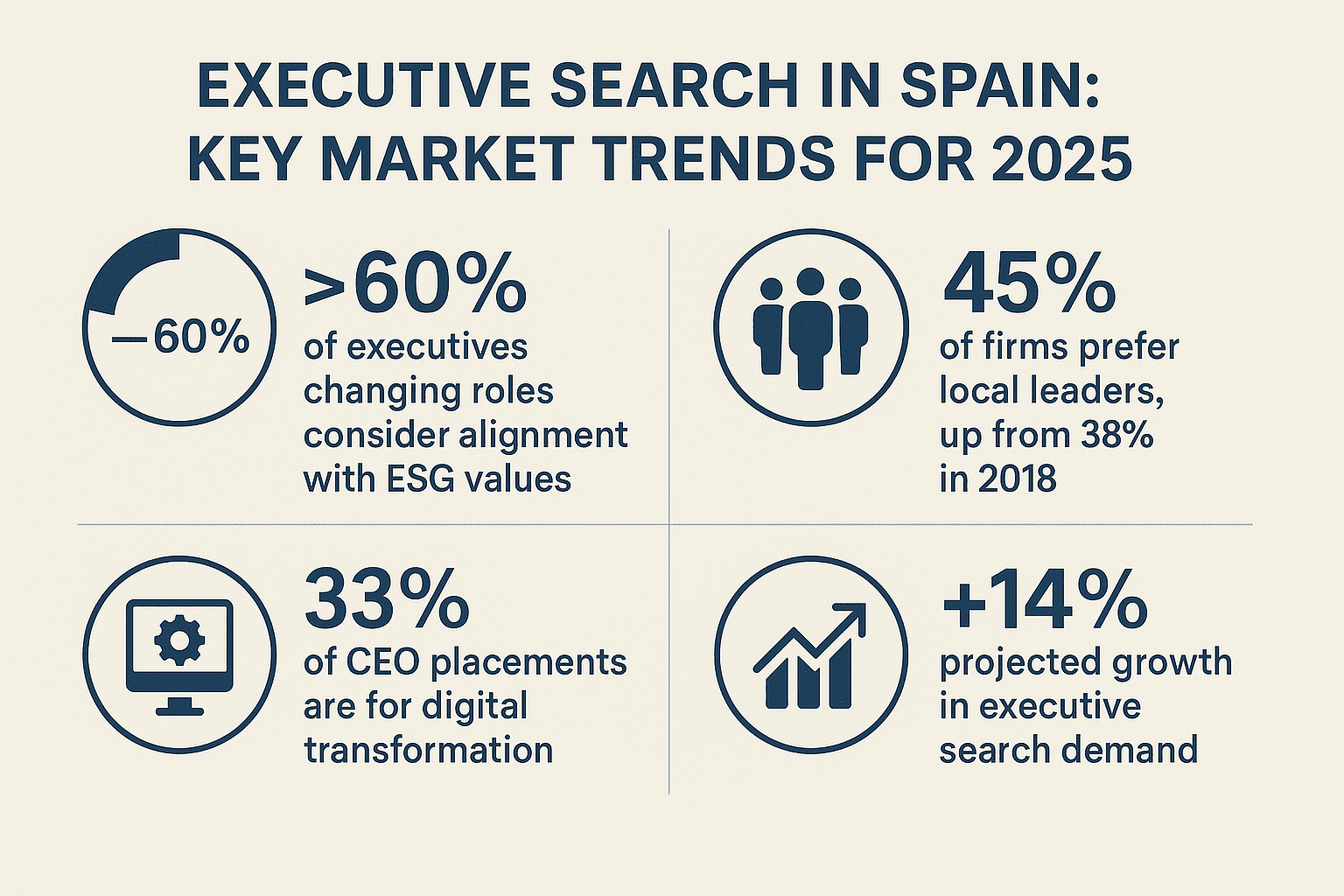
Spain’s executive talent market has a structural tension that the headline data does not fully capture: 54% of companies plan to expand headcount in 2025 while 82% already struggle to fill senior roles. That gap does not close by raising salaries — the profiles most in demand in renewables, industrial, and technology are also the least price-sensitive and the most likely to evaluate an opportunity based on the quality of the mandate, the board, and the long-term trajectory. The companies that win the best executives in Spain in 2025 are the ones that define the role precisely, align internally before going to market, and approach candidates with a proposal worth considering — not a generic offer.
Zavala Civitas Executive Search
At Zavala Civitas Executive Search, we support organisations in Spain and across EMEA with leadership advisory, executive search, and strategic talent insights. If your company is preparing for growth, succession, restructuring, or market expansion, our team can help you attract and evaluate leaders capable of driving long-term impact.
Contact us to learn more about our process or to discuss your talent and leadership needs.
Frequently Asked Questions: Executive Search in Spain — Market Trends 2025
Why do 82% of Spanish companies struggle to hire senior talent if there are more candidates than ever?
Because volume and fit are not the same thing. The candidate pool in Spain has grown, but the combination of capabilities companies actually need — international exposure, digital transformation experience, cross-cultural leadership, and sector-specific depth — remains structurally scarce. The executives who have that combination are receiving three to five unsolicited approaches per month. The challenge is not finding candidates. It is reaching the right ones with a mandate worth their attention.
Why does internal misalignment kill more executive searches in Spain than competition from other companies?
Because the most capable candidates evaluate mandates — not vacancies. When the scope changes mid-process, the KPIs shift, or the hiring committee cannot agree on what success looks like in the first 12 months, the process slows, the strongest candidates move on, and the company ends up choosing from whoever remained available — which is almost never the top of the shortlist. Alignment before the search is not a procedural step. It determines the quality of the final hire.
How significant is the regional difference in compensation benchmarks across Spain?
Very significant — and systematically underestimated. Madrid and Barcelona operate at substantially different compensation levels than Valencia, Bilbao, or Seville for the same role. International companies that apply a single national benchmark — or worse, a European benchmark — consistently lose candidates in the final stages to companies that have done the regional calibration. The gap can be 15–25% at senior levels in certain sectors.
Why has onboarding become a defining factor in executive success in Spain?
Because the first 180 days determine whether the executive builds the credibility, relationships, and operational understanding needed to lead effectively — or arrives, finds the context different from what was described in the process, and begins to disengage. Companies that invest in structured onboarding — explicit decision rights, stakeholder alignment, clear milestones — have significantly lower executive turnover in the first two years. Those that do not are often back in market within 18 months.
How does Zavala Civitas approach executive search in Spain’s competitive 2025 market?
By starting with mandate clarity rather than job description, applying regional compensation benchmarking before going to market, mapping the passive talent pool directly in the relevant sector and geography, assessing cultural fit and governance alignment alongside functional competency, and extending the service to include structured onboarding support. Zavala Civitas has operated in Spain since 1971 with a 92% closing rate across completed mandates.