
Executive Search in China in 2025: Trends, Challenges, and What Global Firms Must Know 

In 2025, China continues to be a critical market for multinational growth — but with increasingly complex dynamics. Economic headwinds, regulatory shifts, demographic change, and evolving workforce expectations are reshaping how companies recruit and retain leadership. As traditional recruitment models prove insufficient, executive search in China is playing a key role in helping global firms adapt to new realities and secure the leadership required to navigate uncertainty. 

This article explores the current environment, key challenges, high-growth sectors, and how a strategic approach to senior hiring can support long-term success in China. 

  1. A Complex Landscape: Slowing Growth and Rising Pressure

China’s economic outlook in 2025 reflects a blend of cautious recovery and structural pressure: 

  • Slower GDP Growth: Forecasts range from 3.8% to 4.8%, with Moody’s citing trade and domestic constraints as major headwinds. 
  • Geopolitical Risk: Tariffs, export restrictions, and decoupling trends (particularly in tech and energy) are influencing corporate strategy and hiring needs. 
  • Property Sector Instability: Real estate remains fragile, weakening regional economies and business confidence. 
  • Demographic Shifts: With nearly 39% of the population projected to be over retirement age by 2050, the leadership pipeline is tightening. 

Together, these factors amplify the importance of resilient, agile leadership — especially in strategic or regulated industries. 

  1. Challenges in Executive Hiring

Why is senior recruitment in China particularly complex? 

  • Limited Senior Talent Pool
    Demand for bilingual, globally experienced executives with local insight continues to exceed supply — especially in regulated sectors. 
  • Compliance and Governance Pressure
    Executives must now navigate complex tax rules, data laws, and ESG frameworks that vary from global norms. 
  • Insufficient Succession Planning
    Many foreign firms in China lack strong internal leadership pipelines, leaving them exposed to sudden changes or market shifts. 
  • Cultural Fit Challenges
    Understanding guanxi, local business etiquette, and nuanced stakeholder dynamics is essential — and hard to teach retroactively. 


  1. Growth Areas and Leadership Opportunities

Despite the challenges, specific sectors in China offer growth and transformation — and require strong executive talent: 

  • High-Tech Industries
    Under Made in China 2025, AI, semiconductors, and advanced robotics are core priorities. This demands leadership with deep industry and innovation experience. 
  • Green Energy and Infrastructure
    Carbon-neutral targets and sustainability policies have accelerated demand for talent in solar, battery, EV, and large-scale infrastructure projects. 
  • Domestic Market Expansion
    As China pivots toward internal consumption, companies require leaders with strong local market knowledge, regional branding expertise, and consumer insight. 
  • Digital Transformation & Fintech
    Rapid digitalization continues in e-commerce, payments, and logistics — creating roles that require both technical fluency and policy awareness. 


  1. The Strategic Role of Executive Search Firms in China

Executive search firms are more than recruiters — they are strategic partners. Here’s how they support success in China: 

  • Access to Passive Talent
    The most qualified candidates rarely apply through open channels. Trusted search partners engage high-impact leaders discreetly through their networks. 
  • Regulatory and Market Insight
    Local search consultants understand evolving compensation norms, sector volatility, and risk areas — providing valuable guidance during hiring. 
  • Cultural and Leadership Fit Evaluation
    Executive search firms assess candidates beyond the resume — aligning leadership style with company values, team culture, and local context. 
  • Future-Proofing via Succession Planning
    Search firms don’t just fill current roles — they help clients build internal and external pipelines for future leadership.

Hiring the right leader in China isn’t just about qualifications — it’s about timing, cultural understanding, and strategic foresight. In today’s landscape, where uncertainty and reform intersect, global companies need executive talent that blends global perspective with deep local fluency. 
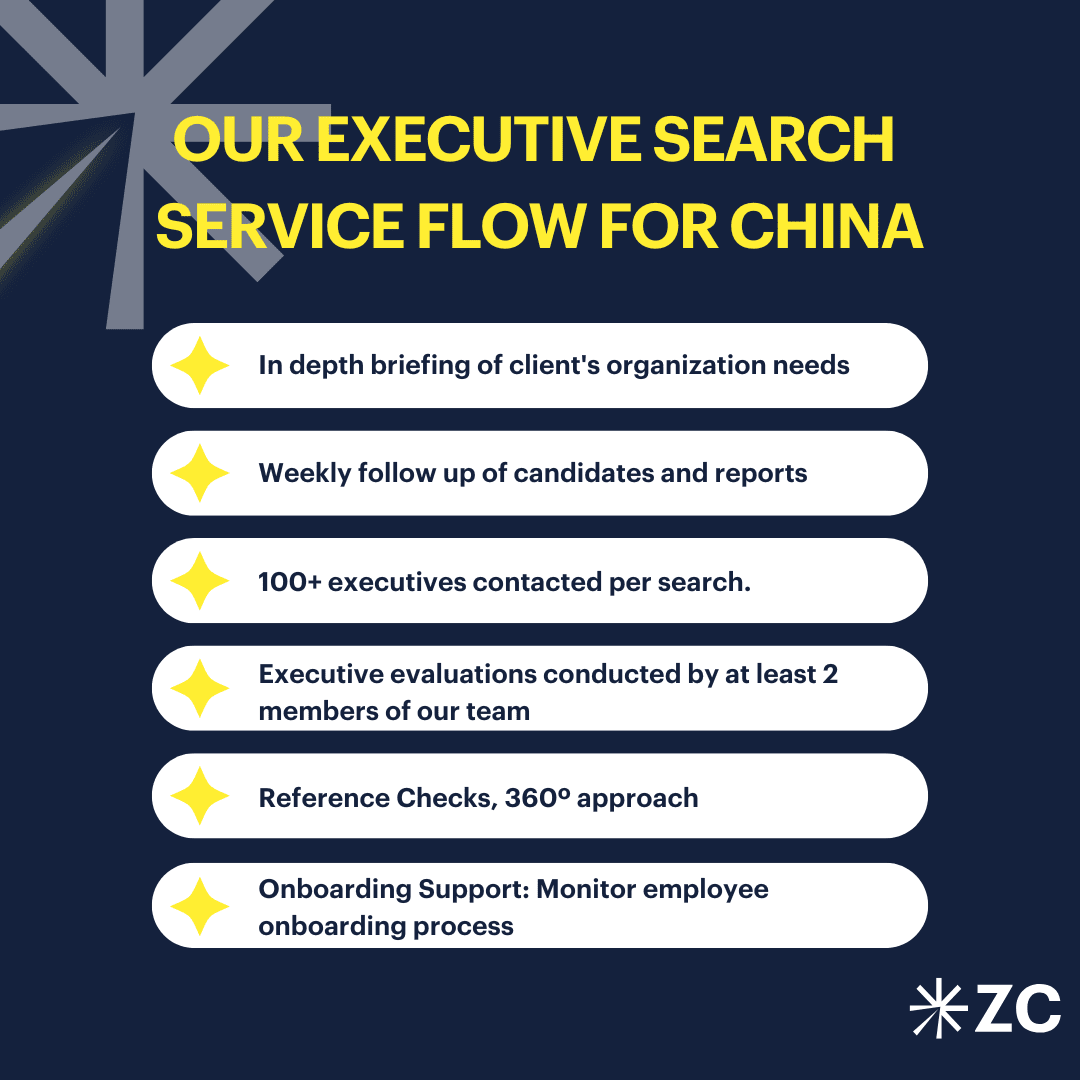
 

Our executive search methodology in china

From our experience at Zavala Civitas, we believe executive search in China in 2025 must move beyond transactional recruitment. It should serve as a bridge — connecting business strategy to real leadership capability. With the right partnerships and approach, companies can strengthen their resilience and lead with confidence in the world’s second-largest economy. 

Click here to learn about our executive search methodology: Executive Search | Zavala Civitas Executive Search


Executive Search in Mexico: Leading Sectors Shaping Demand 

Over the last few years, Mexico swiftly garnered international investment, earning it the title of one of the fastest-growing countries in capturing global foreign direct investments.   This scenario creates new talent opportunities.  Most Executive Search firms in Mexico have modified their approach from simply filling highest roles in an organization to competing for the extremely limited pool of qualified executive talent for all roles in all sectors.  The demand isn’t even  It is very much concentrated.  Where Demand is Actually Growing  Mexico’s hiring executive pressure is unequal across all sectors. Some sectors are faster and are pulling talent from other sectors. Manufacturing is the clearest example.  With nearshoring, Mexico is becoming a strategically important center for the supply chain for North America. This is due to the fact that international companies are relocating and/or expanding their operations in Mexico. This is supported by McKinsey & Company.  The growth of a business is dependent on its leadership. Companies are in need of quickly scalable plant directors, operations managers, and supply chain executives. Such profiles are deficit.  Executive Search Energy and Infrastructure: Complexity at Scale  There is the highest demand for executive talent within the energy and infrastructure sectors.  Major projects and regulatory complexities, as well as lengthy investments, require leaders who are comfortable with uncertainty in all the essential domains, not just the technical. This includes stakeholder

Read More

Executive Search in Spain: Talent Gaps and Leadership Trends 

The Spanish talent market is perceived to be mature and easy to operate in. This makes some sense from afar. There is a solid network of business centers, a developing international business presence, and a considerable pool of experienced talent.  Problems arise when businesses attempt to recruit senior executives.  In Spain, executive search is shifting from talent arbitrage to understanding the true gaps and the reasons behind their expansion.  Where the Talent Gaps Are Actually Emerging  Spain may appear to have many senior professionals, but the issues here are more complex.  The problem is not the experience, but the type of experience that is most required by the different companies.  As per McKinsey & Company, the nature of change of senior leadership roles in Europe is at a much quicker pace than the nature of change in the senior leadership roles in the talent pool. Executives are required who are able to be strategic, also have the ability to execute, and be the change agent.  That blend is still too little. This is especially the case in Spain in the industries that are shifting the fastest—energy transition, infrastructure, and technology. There are many executives who have strong functional experience, but far fewer who have held positions to manage large, complex transformations, or to operate internationally in complex situations.  This results in the mismatch between the hopes of the companies and the actual situation in the labor market.  The Shift from Stability to Transformation Leadership  For many years, leadership in Spain emphasized operational stability and incremental change.  This is not enough anymore.  At present, companies expect executives to manage change and uncertainty, and lead in multiple dimensions simultaneously, including at the same time digital transformation, new business models, and the increased need for operational efficiency. 

Read More

Executive Search in the United States: Private Equity and Portfolio Leadership  

According to McKinsey’s Global Private Markets Review the United States remains the largest private equity market globally. It accounts for nearly half of global PE deal value.    Unlike traditional recruiting, Executive Search in the U.S. private equity-backed environments is much more complex.  In PE platforms, leadership is directly tied to value creation, EBITDA expansion,

Read More

Related posts

Leadership in the Middle East: Why Fit Matters More Than Origin 

As companies in the Middle East scale and institutionalize, the long-standing debate around local versus international leadership in the Middle East is largely outdated. The real issue today is alignment: whether the leadership profile fits the business challenge the organization is facing.  Too often, leadership appointments are driven by assumptions: that international executives

Read More

The Role of Compliance Officers in Strategic Decision-Making

Over the past decade, the role of compliance functions within organizations has progressed significantly. Traditionally, compliance was responsible primarily for ensuring the company’s compliance with regulation, particularly that Relations to bribery and corruption.  They developed codes of conduct, supplier due diligence process and the like and were responsible for ensuring compliance with these by employees of

Read More

Executive Search in Mexico: Leading Sectors Shaping Demand 

Over the last few years, Mexico swiftly garnered international investment, earning it the title of one of the fastest-growing countries in capturing global foreign direct investments.   This scenario creates new talent opportunities.  Most Executive Search firms in Mexico have modified their approach from simply filling highest roles in an organization to competing for the extremely limited pool of qualified executive talent for all roles in all sectors.  The demand isn’t even  It is very much concentrated.  Where Demand is Actually Growing  Mexico’s hiring executive pressure is unequal across all sectors. Some sectors are faster and are pulling talent from other sectors. Manufacturing is the clearest example.  With nearshoring, Mexico is becoming a strategically important center for the supply chain for North America. This is due to the fact that international companies are relocating and/or expanding their operations in Mexico. This is supported by McKinsey & Company.  The growth of a business is dependent on its leadership. Companies are in need of quickly scalable plant directors, operations managers, and supply chain executives. Such profiles are deficit.  Executive Search Energy and Infrastructure: Complexity at Scale  There is the highest demand for executive talent within the energy and infrastructure sectors.  Major projects and regulatory complexities, as well as lengthy investments, require leaders who are comfortable with uncertainty in all the essential domains, not just the technical. This includes stakeholder

Read More

Executive Search in Spain: Talent Gaps and Leadership Trends 

The Spanish talent market is perceived to be mature and easy to operate in. This makes some sense from afar. There is a solid network of business centers, a developing international business presence, and a considerable pool of experienced talent.  Problems arise when businesses attempt to recruit senior executives.  In Spain, executive search is shifting from talent arbitrage to understanding the true gaps and the reasons behind their expansion.  Where the Talent Gaps Are Actually Emerging  Spain may appear to have many senior professionals, but the issues here are more complex.  The problem is not the experience, but the type of experience that is most required by the different companies.  As per McKinsey & Company, the nature of change of senior leadership roles in Europe is at a much quicker pace than the nature of change in the senior leadership roles in the talent pool. Executives are required who are able to be strategic, also have the ability to execute, and be the change agent.  That blend is still too little. This is especially the case in Spain in the industries that are shifting the fastest—energy transition, infrastructure, and technology. There are many executives who have strong functional experience, but far fewer who have held positions to manage large, complex transformations, or to operate internationally in complex situations.  This results in the mismatch between the hopes of the companies and the actual situation in the labor market.  The Shift from Stability to Transformation Leadership  For many years, leadership in Spain emphasized operational stability and incremental change.  This is not enough anymore.  At present, companies expect executives to manage change and uncertainty, and lead in multiple dimensions simultaneously, including at the same time digital transformation, new business models, and the increased need for operational efficiency. 

Read More

Executive Search in China: The Complexity of Hiring Executives

China is one of those markets where opportunities are easy to find but the right leaders are not.  many international firms, executive recruitment in China becomes challenging for one simple reason: the market does not act as they expect. What works for Europe or the US, tends to break down here.  Recruiting

Read More

Executive Search in the United States: Private Equity and Portfolio Leadership  

According to McKinsey’s Global Private Markets Review the United States remains the largest private equity market globally. It accounts for nearly half of global PE deal value.    Unlike traditional recruiting, Executive Search in the U.S. private equity-backed environments is much more complex.  In PE platforms, leadership is directly tied to value creation, EBITDA expansion,

Read More