
Last updated: August 20, 2026
China remains one of the world’s most important manufacturing, logistics and e-commerce ecosystems. Its scale creates enormous opportunities, but it also makes Operations and Supply Chain leadership increasingly complex.
Senior executives may need to manage large supplier networks, fulfilment operations, inventory, manufacturing, cross-border logistics, digital systems and increasingly demanding customer expectations while protecting cost, resilience and service levels.
For Executive Search, the strongest candidate is therefore not necessarily the executive who has managed the largest supply chain. The relevant question is what that leader has actually improved, transformed or protected within a comparable operating environment.
China’s Supply Chain Leadership Context Is Changing
China’s logistics ecosystem continues to process extraordinary volumes.
According to the State Post Bureau, China’s express delivery sector handled 198.95 billion parcels in 2025, an increase of 13.6%.
Express delivery revenue reached approximately RMB1.49 trillion, increasing 6.5%.
These two indicators make the leadership challenge particularly interesting: logistics activity is expanding substantially faster than sector revenue.
Key Figures at a Glance
| China Supply Chain Indicator | Latest Data | Source | Leadership Implication |
|---|---|---|---|
| Express delivery volume | 198.95bn parcels, +13.6% | State Post Bureau | Operations leaders need systems and networks capable of absorbing substantial throughput growth. |
| Express delivery revenue | Approx. RMB1.49tn, +6.5% | State Post Bureau | Volume growth alone is not enough. Productivity, pricing, network efficiency and cost discipline become increasingly important. |
| International, Hong Kong, Macao and Taiwan express volume | 4.22bn parcels, +8.8% | State Post Bureau | Cross-border supply chains require additional capabilities around partners, customs, risk and international network coordination. |
| Physical goods online retail share | 26.1% of consumer retail | National Bureau of Statistics | E-commerce continues to make fulfilment speed, demand planning and inventory visibility strategic operational capabilities. |
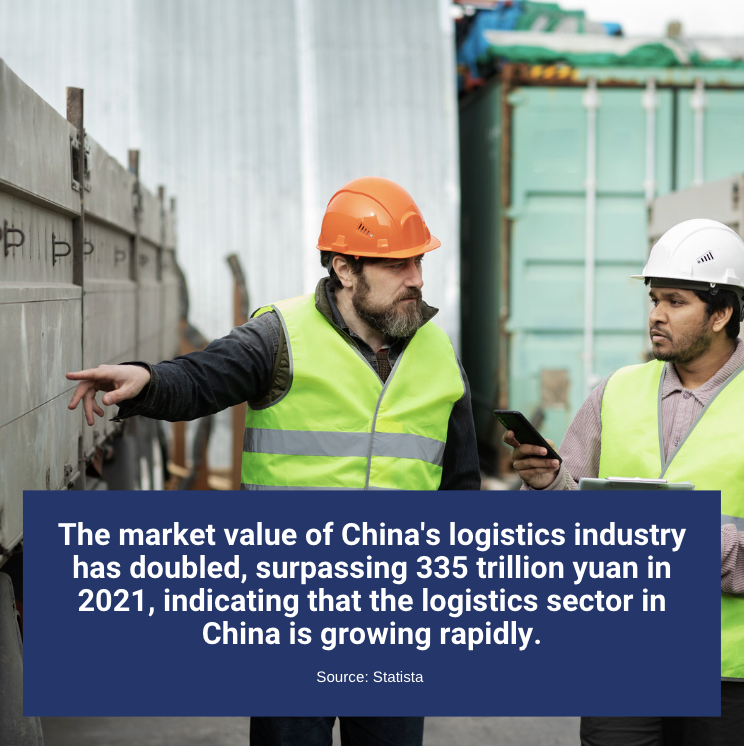
The historical logistics chart from the original article is retained below as context. It should not be interpreted as a current estimate of China’s logistics market.
Supply Chain Scale Is Not the Same as Supply Chain Performance
A large network can create competitive advantage, but it can also increase complexity.
Operations leaders need to understand how inventory, supplier performance, warehouse productivity, transportation, service levels and working capital interact rather than optimise each component independently.
This distinction becomes particularly important in Executive Search.
A candidate may have managed a very large logistics operation without personally improving it. Another executive from a smaller organisation may have redesigned the network, reduced inventory exposure, improved forecasting or built new capabilities from zero.
The size of the previous employer should therefore be treated separately from evidence of operational transformation.
E-Commerce Keeps Raising the Operations Leadership Bar in China
China’s digital commerce ecosystem continues to make fulfilment a strategic issue.
Online retail sales reached RMB15.9722 trillion in 2025, increasing 8.6%.
Online sales of physical goods reached RMB13.0923 trillion, accounting for 26.1% of total consumer retail sales.
For supply chain executives, this creates demanding expectations around inventory visibility, forecasting, fulfilment speed, returns, warehouse productivity and coordination between digital and physical channels.
The relevant leadership capability is therefore not simply e-commerce exposure. Executive Search should identify what the candidate personally changed in the operating model as channel complexity increased.
Cross-Border Operations Add Another Layer of Complexity
China’s supply chain leadership roles frequently extend beyond domestic operations.
International, Hong Kong, Macao and Taiwan express delivery volume reached 4.22 billion parcels in 2025, increasing 8.8%.
Cross-border operations can require leaders to coordinate suppliers, logistics providers, internal teams and customers across multiple jurisdictions.
They also introduce additional exposure to customs, trade policy, transportation disruption, supplier concentration and geopolitical risk.
For multinational organisations, senior supply chain executives may therefore need to connect Chinese manufacturing and logistics capabilities with regional or global network strategies.
What Executive Search Should Assess in Supply Chain Leaders in China
Network Design and Optimisation
Candidates should demonstrate how they have redesigned supply networks, warehouses, transportation or manufacturing flows to improve service, efficiency or resilience.
Inventory and Working Capital
Strong executives understand that inventory is not only an operational issue. It affects cash, service, risk and profitability.
Executive assessment should explore how candidates balance availability against working-capital exposure rather than simply targeting lower inventory.
Supply Chain Resilience
Relevant experience can include supplier diversification, contingency planning, alternative transport routes, dual sourcing or redesigning production footprints.
Data and Technology Judgement
Supply chain leaders increasingly work with forecasting platforms, control towers, automation, warehouse systems and AI-enabled planning tools.
The executive does not need to be the organisation’s strongest technologist, but should understand where digital investment materially improves operational decisions.
Supplier and Partner Management
China’s manufacturing and logistics ecosystems can involve extensive supplier and service-provider networks. Senior leaders need to understand supplier economics, performance, quality, negotiation and risk rather than manage relationships solely through procurement processes.
Cross-Functional Influence
Operations decisions affect Finance, Sales, Marketing, Technology and Customer Service. The strongest executives can explain operational trade-offs in commercial and financial terms and influence decisions outside their own function.
A Supply Chain Search May Need Talent from Adjacent Industries
Restricting a search to direct competitors can unnecessarily narrow the candidate universe.
Executives who have managed comparable operational challenges may sit in manufacturing, e-commerce, retail, transportation, industrial technology or third-party logistics businesses.
For example, a company seeking stronger forecasting and fulfilment capability may find a more relevant executive in an e-commerce business than in a traditional manufacturer.
A manufacturer seeking resilience may find relevant leadership in an organisation that has already redesigned a complex supplier network.
Market mapping should therefore follow the business problem rather than the sector label alone.
Supply Chain Leadership Should Connect Efficiency and Resilience
Efficiency and resilience can pull organisations in different directions.
Reducing inventory, concentrating suppliers or maximising asset utilisation may improve efficiency in stable conditions while increasing vulnerability when disruption occurs.
Adding capacity, alternative suppliers or safety stock can improve resilience while increasing cost.
The leadership skill is therefore not maximising one objective. It is understanding the economics of the trade-off and deciding which risks the organisation is prepared to accept.
This type of judgement should be tested explicitly during Executive Search rather than inferred from title or years of experience.
How Zavala Civitas Approaches Operations and Supply Chain Executive Search
Zavala Civitas begins by understanding the operational challenge the incoming executive needs to solve.
The mandate may involve international expansion, network redesign, digitalisation, cost improvement, sustainability, stronger analytics or improving resilience.
Our Executive Search methodology then combines market mapping, direct candidate identification, structured assessment and reference validation to determine which executives have personally managed comparable transformations.
The Operations & Supply Chain Management Executive Search practice supports organisations seeking senior leaders across operations, logistics, procurement, supply chain, data and related transformation mandates.
Frequently Asked Questions: Operations and Supply Chain Executive Search in China
Supply chain scale matters. The ability to improve it matters more.
Zavala Civitas supports organisations in identifying Operations and Supply Chain leaders capable of improving efficiency, resilience and performance in China.
Executive Search → Operations & Supply Chain → Contact Us →