
Why Spanish Boards Are Prioritizing Independent Advisors in 2025

The role of Board Advisory in Spain is evolving. For many companies, it’s no longer just about regulatory compliance—it’s about building stronger, more effective boards. As corporate governance standards tighten and investors expect more transparency, Spanish firms are rethinking how their boards operate, with independent advisors taking on a more central role. 

Regulations for Spanish Boards 

Spain’s Ley de Sociedades de Capital and the CNMV’s Good Governance Code have made one thing clear: board independence matters. Listed companies are now expected to ensure at least 40% of their directors are independent, aligning with EU standards. 

This shift is driving demand for board advisory services in Spain, particularly from firms looking to: 

  • Review their current structure. 
  • Identify independent directors. 
  • Align governance practices with international expectations. 

For many companies, especially those preparing for growth or seeking investors, strong governance is becoming a non-negotiable. 

From Compliance to Strategy in Spain 

For years, Spanish boards focused mainly on legal compliance. But that’s changing. Today, more companies are turning to external advisors not just for oversight, but for strategic input—whether on succession planning, international expansion, or navigating digital transformation. 

This is why Board Advisory in Spain now goes beyond checking boxes. It’s about adding business value, using governance as a tool to drive growth and manage risk. 

ESG and Diversity in Spanish Boards 

ESG has found its place on the agenda but turning that into action is another matter. Many boards lack experience in sustainability reporting or navigating stakeholder expectations around environmental and social governance. 

Board Advisory can help to: 

  • Understand their ESG responsibilities. 
  • Bring in independent directors with sustainability experience. 
  • Integrate ESG oversight into day-to-day governance—not just annual reports. 

At the same time, gender diversity is now more than a goal—it’s a regulatory requirement. By 2026, Spanish listed companies must have 40% women on their boards. This is accelerating change, but many firms still need guidance on how to make that shift effectively. 

Moving Beyond Traditional Networks in Spain

In Spain’s many family-owned businesses, board seats often went to trusted contacts or long-standing advisors. But as these companies grow and professionalize, there’s a growing realization: external perspectives matter. 

This is where Board Advisory services are stepping in, helping businesses: 

  • Introduce independent, non-executive directors. 
  • Balance continuity with fresh perspectives. 
  • Build boards capable of supporting long-term, sustainable growth. 
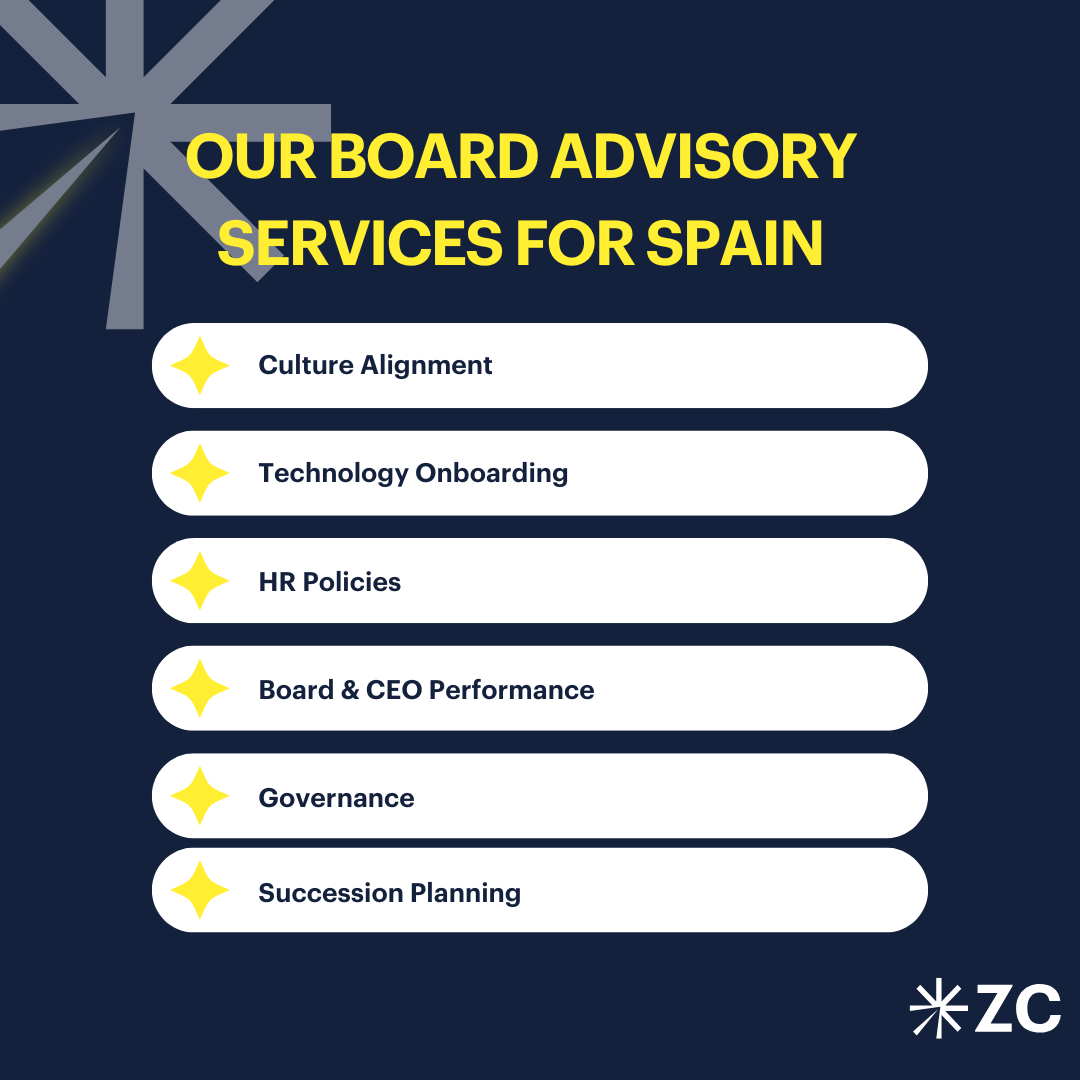
Zavala civitas board advisory services for spain

Why Board Advisory Matters in Spain 

Board advisory services are no longer just a formality—they’re a critical part of a company’s strategy. For Spanish firms, strengthening composition isn’t just about meeting regulatory targets. It’s about building leadership teams that can navigate change, drive growth, and withstand challenges. 

For that, working with experienced Board Advisory professionals in Spain is becoming a strategic decision—not a regulatory obligation. 

Learn more about our services clicking here: CEO & Board advisory Worldwide – Zavala Civitas

Board Advisory in Portugal: Key Differences Compared to Spain

While geographically close to Spain, Portugal’s corporate governance, cultural particularities, and business structures are distinct. In this article we explore what works in Portugal to build effective governance. The legal side: Shaping Board Advisory in Portugal Portugal’s corporate governance landscape is shaped by the Código de Governo das Sociedades, which

Read More

Board Advisory in Mexico: Enabling boards for strategic engagement

In a world where business challenges are becoming increasingly complex and interrelated, Board Advisory in Mexico is no longer an indulgence, it is a strategic imperative. Companies of all sizes are expected to have proactive governing bodies that lead organizations, not just supervise. Establishing the right governance structure, the right

Read More

Related posts

Leadership and Decision-Making in Asia-Pacific’s Age of AI 

From Technology Adoption to Strategic Accountability  Across the Asia-Pacific (APAC) region, artificial intelligence has moved beyond experimentation. What only a few years ago sat within innovation labs or IT functions has now reached the center of executive and board-level decision-making.  This shift is already measurable. Nearly 48% of companies in Asia now

Read More

Tomás Grimaldi becomes Partner at Zavala Civitas Executive Search 

Madrid, Spain – January 2026  Zavala Civitas Executive Search announces the promotion of Tomás Grimaldi to Partner, reinforcing the firm’s long-term commitment to leadership, growth, and equity partnership continuity.  Tomás joined Zavala Civitas initially as Finance Manager and has progressively taken on broader responsibilities across business development, executive search, and

Read More

Executive Development and Assessment in Portugal for Senior talent

In Portugal, the market is relatively small, executive mobility is limited, and reputations travel quickly. Many companies already have solid senior leaders in place.It’s not about whether these leaders are competent. The question is how to assist them in improving performance as they take on greater roles.  Most people have an area that they can

Read More

The Insider Paradox: Why APAC Boards Are Choosing Continuity Over Disruption 

In H1 2025, 83% of all new CEOs in APAC were internal promotions the highest ratio ever recorded and dramatically higher than Western markets.  This surge is not accidental, nor is it a sign of risk-aversion. It reflects a deeper leadership strategy shaped by the geopolitical uncertainty of the region, operational complexity, and the rising value

Read More
china business landscape

Executive Search in China: Local Leadership vs Global Executives 

Over the past ten years, many multinational companies in China have quietly changed how they think about leadership. The model of relying primarily on expatriate executives is no longer taken for granted.   Boards and CEOs are increasingly weighing the trade-offs between local Chinese executives and global leaders sent from headquarters.

Read More

Executive Search in Mexico: Leadership Demand Shaped by Nearshoring 

Over the past few years, Mexico has moved to the center of many global expansion strategies. Nearshoring has accelerated investment decisions, operational scale, and organizational complexity across the country. As a result, leadership hiring has shifted from being opportunistic to becoming a critical risk factor.  In this environment, Executive Search in Mexico is

Read More