
Last updated: August 13, 2026
AI is no longer a distant prospect. Automated contracts, due diligence completed in minutes, and AI-generated reports are now embedded in the daily operations of many law firms. Yet, as José María Alonso highlighted in a recent interview with us, this transformation presents a double-edged sword:
“AI is becoming crucial for processing large volumes of information, such as 1,000-page briefs and thousands of documents. This multiplies productivity but presents a challenge for training young lawyers, who may rely too heavily on these tools without developing the critical skills to analyse complex documents independently. It’s a difficult balance.”
The challenge, then, isn’t adopting AI — it’s using it without losing what makes a lawyer valuable: critical thinking and judgement. In this article, we look at how AI is impacting the legal sector, the risks it poses to training and judgement, and how firms can make practical use of it without compromising their core expertise.
Key Figures at a Glance
| Data point | Finding | Source |
|---|---|---|
| AI time savings per lawyer within 5 years | 12 hours per week | Thomson Reuters Future of Professionals Report |
| Additional billable time per U.S. lawyer annually (AI-enabled) | ~$100,000 | Thomson Reuters Future of Professionals Report |
| Primary risk of AI for junior lawyer development | Reduced exposure to complex analytical work before reasoning skills are formed | José María Alonso / Zavala Civitas Legal Advisory |
| Leading AI legal tools in active law firm use (2025) | Luminance, Kira Systems (due diligence); Harvey AI (drafting); Westlaw Precision, Lexis+ AI (research) | Market analysis, 2025 |
1. Risks to Legal Thinking, Quality, and Talent Development
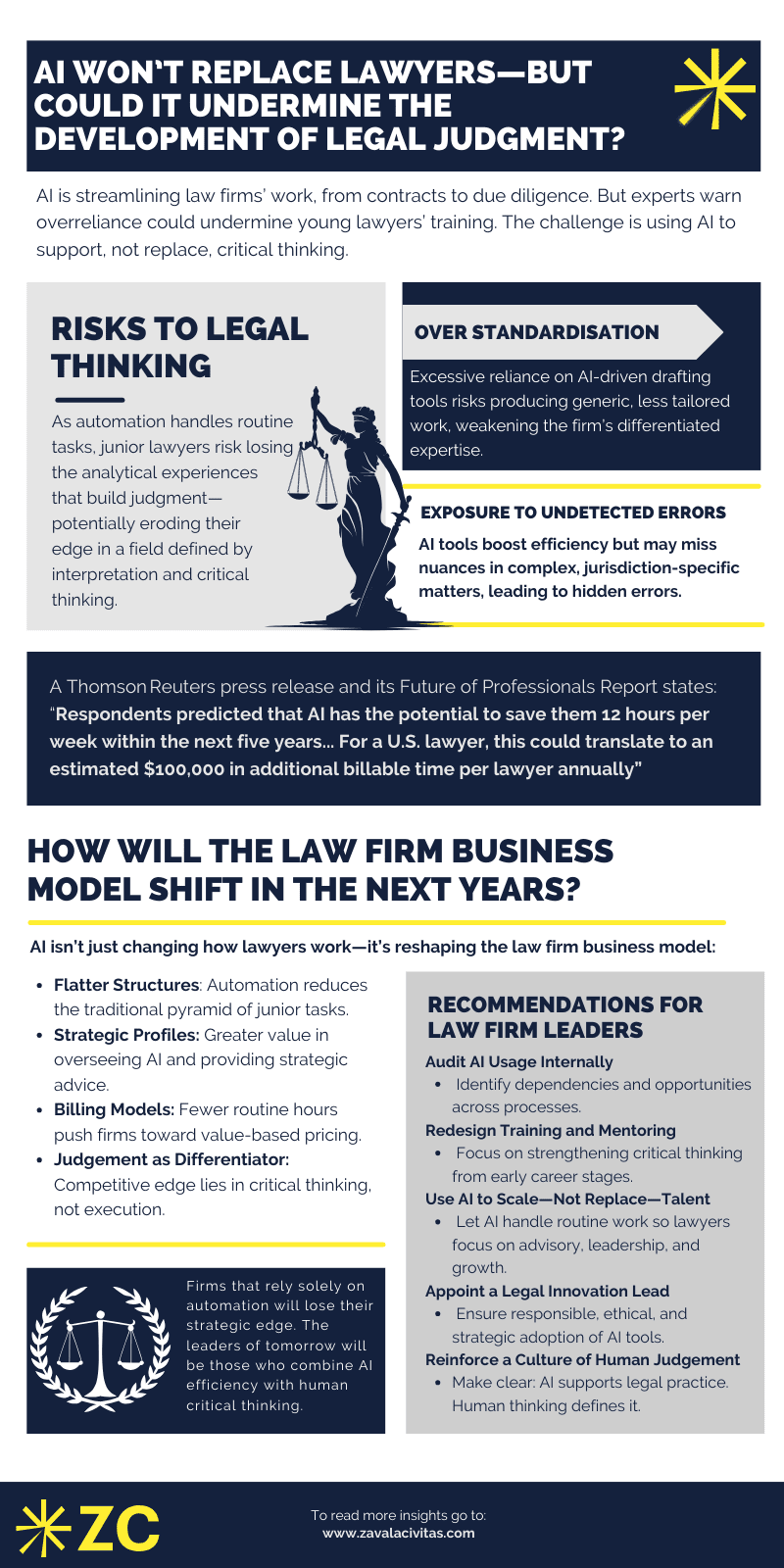
Critical thinking. As routine tasks become automated, there is a growing concern within the sector that junior lawyers are gaining less exposure to the complex, analytical work traditionally needed to build professional judgement. In a profession defined by judgement and interpretation, losing critical thinking means losing your competitive advantage.
Over-standardisation of legal advice. Excessive reliance on AI-driven drafting tools risks producing generic, less tailored work, weakening the firm’s differentiated expertise.
Increased exposure to undetected errors. AI tools, while efficient, can overlook nuances or misinterpret data — especially in complex, jurisdiction-specific matters — leading to undetected mistakes.
AI should remain a tool, not a replacement for reasoning. Protecting the differentiating value of your firm should be a priority.
2. Where AI Is Delivering Tangible Benefits in Law Firms
Used strategically, AI delivers clear, measurable results:
- Document Review (Due Diligence) — Tools like Luminance and Kira Systems analyse contracts and documents, identifying key risks at a scale and speed that human review cannot match.
- Advanced Legal Research — Platforms like Westlaw Precision and Lexis+ AI accelerate jurisprudence searches, surfacing relevant precedents across large databases in minutes.
- Drafting Contracts and Reports — With Harvey AI, firms generate first drafts of contracts, reports, and summaries that lawyers then review, supervise, and refine.
A Thomson Reuters Future of Professionals Report states clearly: respondents predicted that AI has the potential to save them 12 hours per week within the next five years — equivalent, for a U.S. lawyer, to an estimated $100,000 in additional billable time per lawyer annually.
3. How the Business Model Will Shift in the Next Years
AI isn’t just changing how lawyers work — it’s reshaping the law firm business model:
- Flatter Structures. Automating junior tasks erodes traditional pyramidal structures.
- Growing Importance of Strategic Profiles. Supervising AI and delivering strategic advice are becoming more valuable than execution.
- From Billable Hours to Value-Based Billing. Less time spent on routine tasks means firms must rethink pricing models and value propositions.
- Differentiation Through Judgement, Not Execution. AI commoditises delivery. The true competitive edge will lie in human thinking and strategic insight.
Tomorrow’s law firms won’t just need technologists. They’ll need hybrid legal leaders — lawyers who can supervise AI output, exercise independent judgement, and deliver strategic counsel that no model can replicate.
4. Strategic Recommendations for Law Firm Leaders
- Audit AI Usage Internally. Identify dependencies and opportunities across processes — including where AI may be removing formative learning experiences from junior lawyers.
- Redesign Training and Mentoring. Focus on strengthening critical thinking from early career stages. Intentionally withhold AI completion of tasks that build analytical independence.
- Use AI to Scale — Not Replace — Talent. Let AI handle routine work so lawyers focus on advisory, leadership, and growth activities that cannot be automated.
- Appoint a Legal Innovation Lead. Ensure responsible, ethical, and strategic adoption of AI tools — with accountability for its impact on training quality.
- Reinforce a Culture of Human Judgement. Make the firm’s position clear: AI supports legal practice. Human thinking defines it. This culture signal matters for recruitment, retention, and client trust.
Conclusion: AI Won’t Replace Lawyers — But It Could Replace Law Firms
Technology adoption is inevitable. But firms that rely solely on automation will lose their strategic edge. The leaders of tomorrow will be those who combine AI efficiency with human critical thinking — and who have built the organisational structures, training programmes, and leadership development culture to ensure that the next generation of lawyers is not more efficient at completing tasks, but more capable of exercising the independent judgement that clients will always need at the highest level.
To get in contact with our team click here.
Frequently Asked Questions: AI and the Development of Legal Judgement
Is your law firm building the leadership capable of navigating the AI transition?
Zavala Civitas supports law firms with executive search and governance advisory through our Legal practice, with Senior Advisor Beatriz Baker Araujo.
Legal & Professional Services →
CEO & Board Advisory →
Contact Us →