
Last updated: August 13, 2026
Innovation as a Structural Imperative
The legal sector has entered a stage where innovation is no longer about adopting technology or improving efficiency. It has become structural: the ability of a firm to anticipate, frame, and institutionalise new legal fields now defines its competitiveness.
Emerging topics such as Artificial Intelligence regulation, ESG litigation, cybersecurity, and data governance are evolving from short-term opportunities into sustainable, revenue-generating practice groups. But how do leading firms decide when a theme deserves to become a formal practice — and how do they build it sustainably?
Key Figures at a Glance
| Data point | Finding | Source |
|---|---|---|
| Fastest-growing legal practice areas globally (2024–2025) | AI & Data Governance, ESG Advisory, Cybersecurity, Sustainable Finance | Thomson Reuters Institute, 2025 |
| EU AI Act — compliance advisory demand trigger | Applies from August 2026 (high-risk AI systems) — major firms already advising on readiness since 2022 | European Commission, 2024 |
| ESG-related litigation globally | More than 2,000 climate-related cases filed globally by 2024 (doubling since 2017) | Grantham Institute / LSE, 2024 |
| Key indicators of a practice area worth institutionalising | Regulatory change + client demand + litigation patterns — all three must converge | Zavala Civitas — Beatriz Baker Araujo analysis |
I. From Signal to Strategy: Detecting Emerging Legal Fields
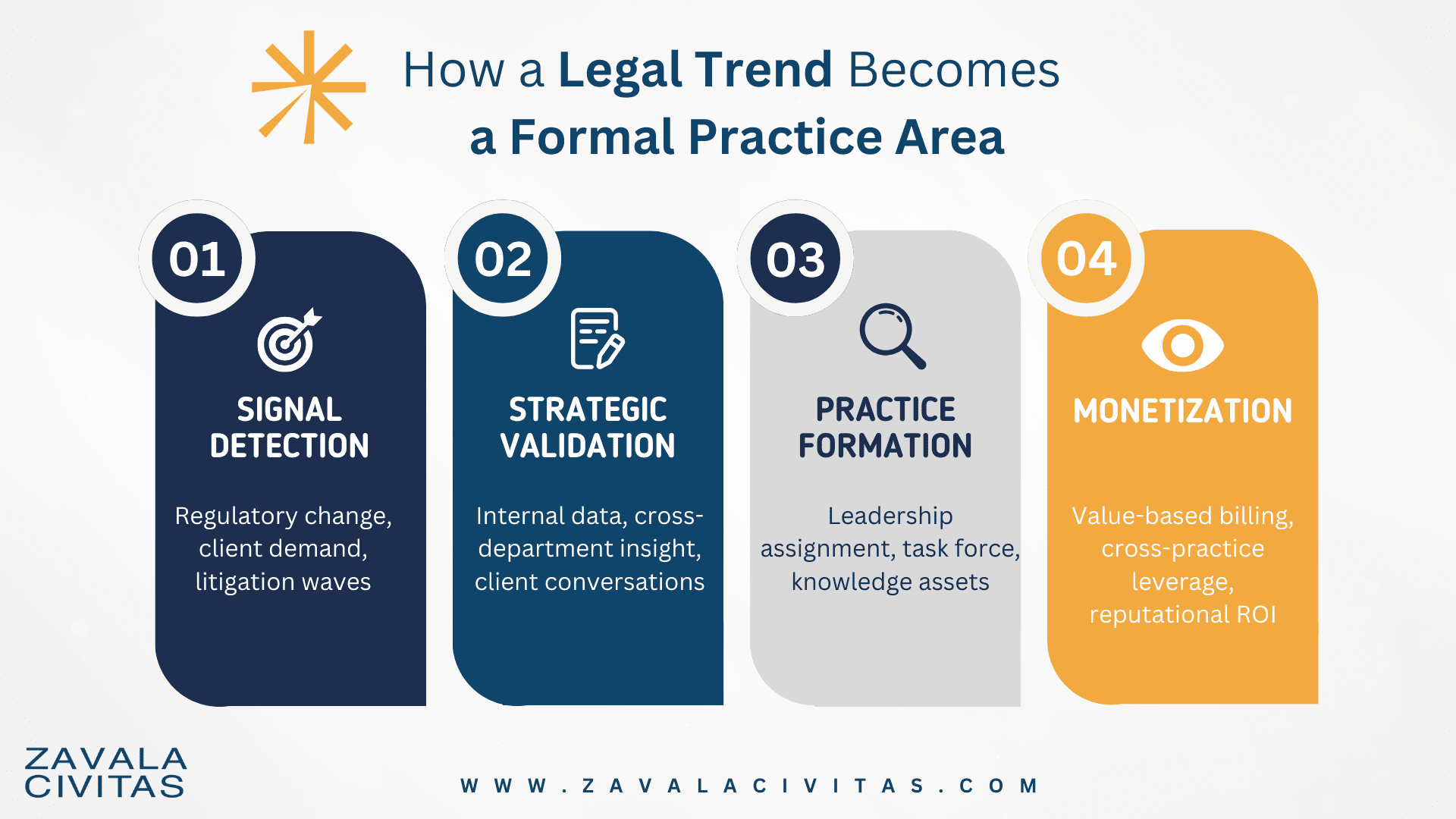
The creation of a new practice rarely begins with an internal brainstorming session. It typically starts with data-driven observation of client, market and regulatory signals:
- Regulatory change — upcoming frameworks like the European Union Artificial Intelligence Act, the Corporate Sustainability Reporting Directive (CSRD), or the convergence of global data-privacy laws.
- Client demand — institutional clients requesting integrated advice that crosses traditional practice boundaries.
- Litigation patterns — early class actions or enforcement waves that reveal systemic exposure.
Case insight:
Clifford Chance identified “AI regulatory risk” as early as 2021, forming a cross-practice team of technology, IP, and competition lawyers. By the time the AI Act draft was released, the firm was already advising multinational clients on compliance readiness.
II. Structuring the Practice: From Initiative to Profit Centre
Once relevance is validated, successful firms move rapidly to institutionalise the topic:
- Leadership assignment — appointing a partner to anchor the area both internally and externally.
- Task-force phase — assembling an interdisciplinary team integrating corporate, litigation, compliance, and policy expertise.
- Knowledge infrastructure — building alerts, case studies, webinars, and academic collaborations that reinforce authority.
Example:
Linklaters transformed its internal ESG working group into a formal ESG Advisory Practice in 2022, integrating lawyers from Corporate, Finance, and Real Estate. Within a year, ESG mandates represented a measurable share of new-business revenue, supported by consistent thought leadership and cross-practice collaboration.
III. Monetization and Value Creation Beyond the Billable Hour
Emerging practices demand innovation not only in subject matter but in how value is captured and measured.
- Value-based billing: Firms such as Herbert Smith Freehills apply outcome-based models for ESG compliance and AI-readiness projects, linking fees to milestones rather than hours.
- Cross-practice leverage: A cybersecurity advisory may begin within IT law but expand into disputes, insurance, and corporate risk.
- Internal ROI: Leading firms track not only direct revenue but reputational metrics — media citations, academic participation, and client referrals — to assess a practice’s strategic value.
IV. The Human and Intellectual Infrastructure Behind Innovation
New practice areas depend on knowledge leadership. Partners and senior associates who combine legal expertise with public visibility act as amplifiers of trust. They:
- Publish in regulatory journals or collaborate with think tanks.
- Join working groups shaping forthcoming legislation.
- Align emerging areas with the firm’s long-term narrative — sustainability, responsible innovation, or digital transformation.
Example:
Garrigues and Cuatrecasas have both built Climate Change & Sustainability teams that blend legal advisory with policy engagement, positioning themselves as key voices in Spain’s energy transition and ESG ecosystem.
V. Lessons from the Global Market
Many of the Magic Circle firms show that anticipation and cross-functional design are decisive in turning a regulatory question into a business line. US BigLaw tends to emphasise client segmentation, building sub-niches around highly regulated industries such as fintech and biotech. Iberian firms are now bridging both models — institutionalising new practices while maintaining the partner-driven relationship culture that clients value.
VI. Emerging Practice Areas in the Last Three Years
Over the past three years, global law firms have formalised a range of new practices aligned with regulatory and societal transformation:
- AI & Data Governance: Clifford Chance, Allen & Overy (2022) — dedicated groups advising on AI Act compliance, algorithmic accountability, and digital ethics.
- Climate Change & Energy Transition: Linklaters, Freshfields, Garrigues (2021–2023) — integrating ESG, renewables, and carbon-trading mandates.
- Cybersecurity & Incident Response: Herbert Smith Freehills, Baker McKenzie (2022) — supporting multinationals in data-breach prevention and crisis management.
- Sustainable Finance and Green Taxonomy: Allen & Overy, Cuatrecasas (2023) — advising financial institutions on EU green-bond standards and ESG disclosure.
- DEI & Corporate Ethics Advisory: DLA Piper, Hogan Lovells (2023) — guiding clients through emerging compliance and reputational frameworks.
These developments show how leading firms are not merely reacting to regulation but converting societal and technological shifts into structured, profitable business units.
Conclusion — Building the Firm of the Future
Innovation in law is not about reacting to change; it is about designing the structures that capture it and equip clients to navigate it in a timely and efficient manner. Firms that treat emerging legal fields as strategic assets — supported by governance, data, and clear leadership — are redefining how professional services evolve.
Together with our Senior Advisor Beatriz Baker, our board advisory and executive search teams support law firms in designing leadership structures that accelerate new-practice growth. If your organisation is navigating emerging fields or planning strategic hires, reach out to us here.
Frequently Asked Questions: Building Emerging Practice Areas in Law Firms
References
- Thomson Reuters Institute. 2025 Report on the State of the Legal Market. January 2025.
- Financial Times. Innovative Lawyers Europe 2024 — The Practice of the Future. FT Special Report, September 2024.
- The American Lawyer. Practice Growth and Emerging Fields Survey 2024. ALM Media, April 2024.
- Chambers.com International. AI, ESG and Cybersecurity Practices: Where Global Firms Are Investing. February 2024.
- Chambers & Partners. ESG Advisory and Data Protection Legal Guide 2024.
- Harvard Law School Center on the Legal Profession. Innovation and Practice Leadership in Global Law Firms. Working Paper No. 34, 2023.
- Grantham Institute / LSE. Global Trends in Climate Change Litigation 2024 Snapshot. 2024.
Is your firm building leadership around an emerging practice area?
Zavala Civitas supports law firms on executive search and governance advisory for new practice development, with Senior Advisor Beatriz Baker Araujo.
Legal & Professional Services →
CEO & Board Advisory →
Contact Us →