
The Best Executive Search Approach for Successful CEO Hiring

The best Executive Search approach to succed

The vast majority of new CEOs still come from within organizations: in 2020, 77% of new S&P 500 CEOs were internal Promotions. Identifying where CEO successors come from within the company allows us to be extra careful at our executive search for certain roles, because by doing it we might be hiring our future CEO.

Where in the company CEOs are most likely to come from?

How do we guarantee we are choosing the best possible candidates?

How to find the best search executive firm to do it?

First: where do most CEOs come from?

According to studies, the most promising candidates in your company may not be precisely where you expect.
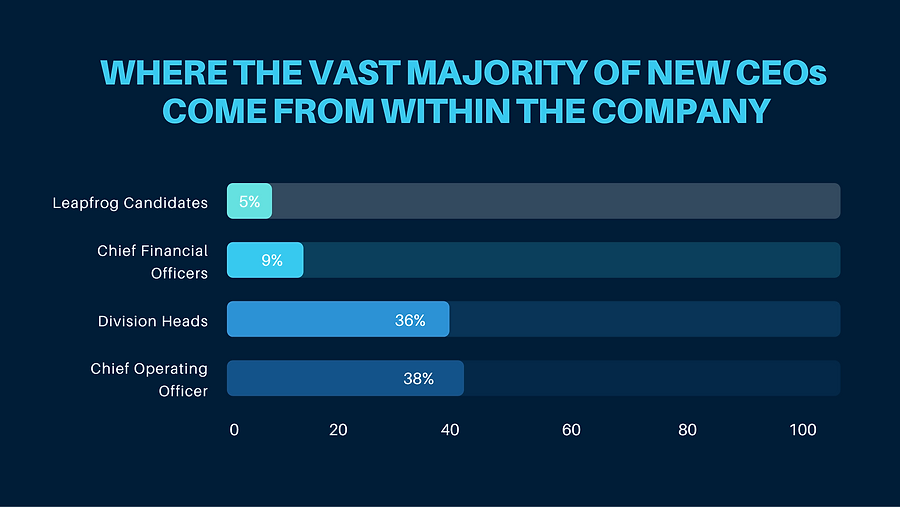
Chart showing why CEOs come from withing the company

Chief operating officers accounted for 38% of new CEOs in the S&P 500. Division heads were only two percentage points behind them, at 36%. Chief financial officers were next, at 9%. CFOs appeal to boards that want to ensure continuity, because they often serve as the right hand to the CEO.

Leapfrog candidates with the least significant representation in the study accounted for roughly 5% of new chief executives.

What is newsworthy is that the last common choice, the leapfrogs, had the highest share of CEOs in the top quartile of performance: 41%. Former division heads and COOs were next, at 27% and 25%, while the share of CFOs in the top quartile of performers was only 8%.

“Leapfrog CEOs” leaders appointed from one level below C-suited officers or division heads, with titles such as senior vice president and general manager, have the best odds to steering their firms into the top quartile performers.

Now we know where our future CEO is most likely to come from: how do we succeed at hiring executive search?

In a world in which finding the right candidates is a major factor in success and it is getting harder and harder every time because companies currently face an unprecedented number of change challenges and opportunities. At the same time, more companies than ever are now drawing from the same executive talent pool, which in itself has evolved and has fundamentally changing needs. As we have seen, the priorities and consequently the profiles of today’s executives have changed, and it is key that businesses recognize and acknowledge these changes in order to attract and retain the best executive talent.

Here is a generalist approach on how to perform an executive search:

  • Always understand what specific skills are critical for the role and use them to focus your recruitment process all the way
  • Keep an organized schedule for the process; set timelines and be prepared for unforeseen changes that may come up throughout the process.
  • Make sure the interviewing process is being kept focused and conducted naturally
  • Maintain open, clear, and respectful communication with candidates during the entire process.

One of the most important parts of this exercise is choosing your Executive Search Partner wisely, because an executive search firm can help you design a process that will effectively assess the candidates’ ability to embrace your mission and build upon the current success, ensuring they are ready from day one. 

Here is a helpful checklist your Executive Search team should have:

  1. Extensive expertise in your industry.
  2. Proven track record of representing companies with professionalism.
  3. Strong Executive Search strategy.
  4. A transparent talent search process.

If you want to find out more about our executive search services and how they can benefit your business, contact our Executive Search Firm Zavala Civitas, which is specialized in executive search in China. Click here.
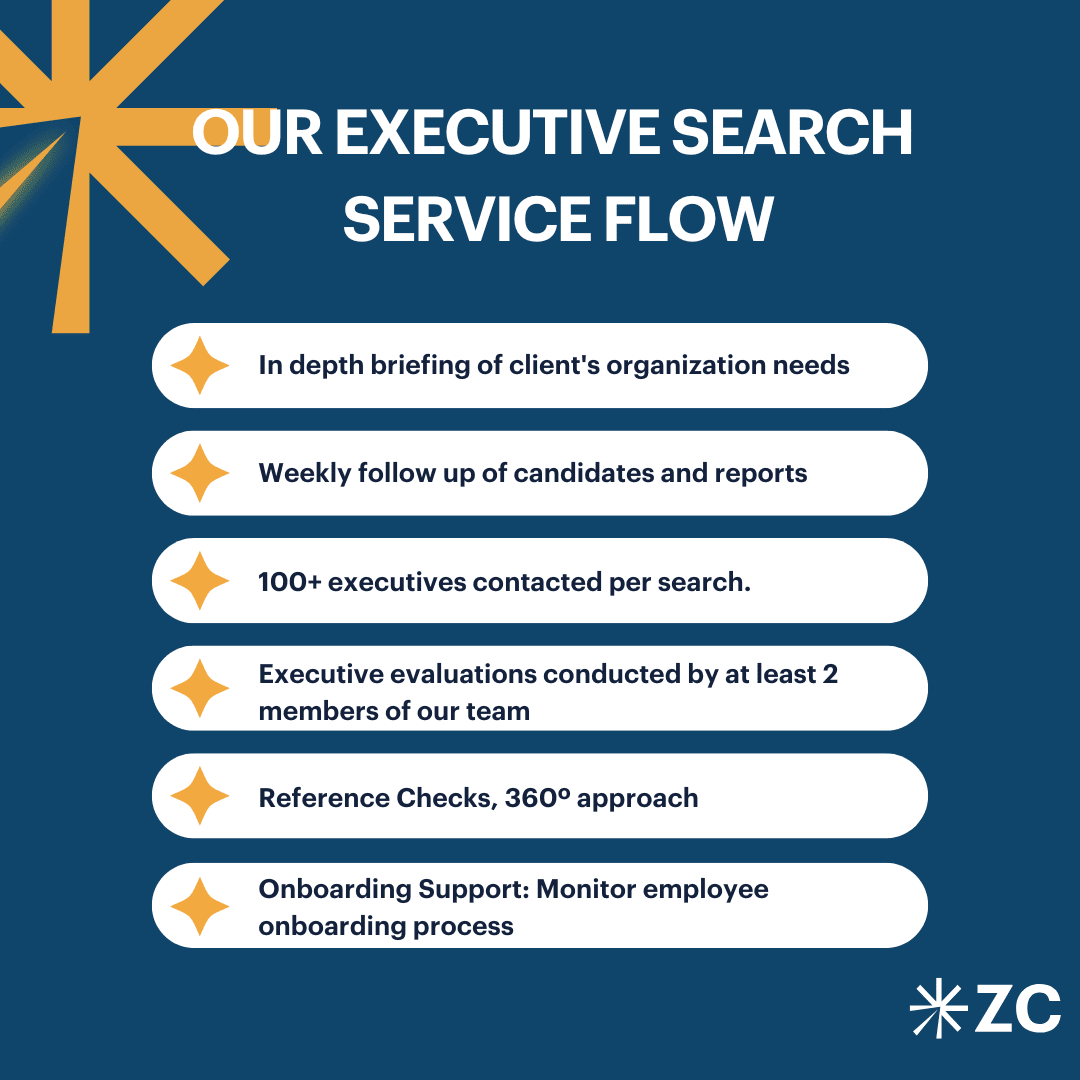
Zavala Civitas executive search methodology for China country

Bibliography

Harvard Business Review. Jan-Feb 2022. Web.https://www.forbes.com/sites/edwardsegal/2022/01/13/outside-ceo-candidates-outperform-in-house-choices-new-study/


Executive Development and Assessment in Portugal for Senior talent

In Portugal, the market is relatively small, executive mobility is limited, and reputations travel quickly. Many companies already have solid senior leaders in place.It’s not about whether these leaders are competent. The question is how to assist them in improving performance as they take on greater roles.  Most people have an area that they can

Read More

Executive Search in Mexico: Leadership Demand Shaped by Nearshoring 

Over the past few years, Mexico has moved to the center of many global expansion strategies. Nearshoring has accelerated investment decisions, operational scale, and organizational complexity across the country. As a result, leadership hiring has shifted from being opportunistic to becoming a critical risk factor.  In this environment, Executive Search in Mexico is

Read More

Executive Search in Portugal: Competing for Leadership in a Small Talent Market 

Portugal has become an increasingly attractive location for international businesses. While stability, talent quality, and quality of life are strong advantages, the senior talent pool is small, highly visible, and intensely competitive.   Because of this hiring in Portugal is about strategy. It involves managing scarcity, confidentiality, and long-term sustainability of

Read More

Related posts

Executive Development and Assessment in Portugal for Senior talent

In Portugal, the market is relatively small, executive mobility is limited, and reputations travel quickly. Many companies already have solid senior leaders in place.It’s not about whether these leaders are competent. The question is how to assist them in improving performance as they take on greater roles.  Most people have an area that they can

Read More

The Insider Paradox: Why APAC Boards Are Choosing Continuity Over Disruption 

In H1 2025, 83% of all new CEOs in APAC were internal promotions the highest ratio ever recorded and dramatically higher than Western markets.  This surge is not accidental, nor is it a sign of risk-aversion. It reflects a deeper leadership strategy shaped by the geopolitical uncertainty of the region, operational complexity, and the rising value

Read More
china business landscape

Executive Search in China: Local Leadership vs Global Executives 

Over the past ten years, many multinational companies in China have quietly changed how they think about leadership. The model of relying primarily on expatriate executives is no longer taken for granted.   Boards and CEOs are increasingly weighing the trade-offs between local Chinese executives and global leaders sent from headquarters.

Read More

Executive Search in Mexico: Leadership Demand Shaped by Nearshoring 

Over the past few years, Mexico has moved to the center of many global expansion strategies. Nearshoring has accelerated investment decisions, operational scale, and organizational complexity across the country. As a result, leadership hiring has shifted from being opportunistic to becoming a critical risk factor.  In this environment, Executive Search in Mexico is

Read More

Executive Search in Portugal: Competing for Leadership in a Small Talent Market 

Portugal has become an increasingly attractive location for international businesses. While stability, talent quality, and quality of life are strong advantages, the senior talent pool is small, highly visible, and intensely competitive.   Because of this hiring in Portugal is about strategy. It involves managing scarcity, confidentiality, and long-term sustainability of

Read More