
Executive Search in Brazil

Current economics of Brazilian Market:

Brazil has a GDP of $1.92 trillion in 2022 and it is the world’s 11th economy and the largest economy in Latin America.  Brazil’s service sector includes a diverse range of industries, including hospitality, financial services, retail sales, and professional services. The financial sector has particular significance in the country. It plays a key role in the financing of large projects, particularly mining and aerospace. 

Travel and tourism are key parts of the services sector, contributing significantly to revenues in the country. This includes revenues generated by hotels, travel agencies, airlines, restaurants and other directly associated activities. 

The development in these industries creates a constant demand for highly qualified executive talent. However, Brazil is falling behind in the dispute for talent. According to data from Fragomen in Brazil, a company specialized in immigration, only in 2022 the number of Brazilians who applied for a visa and residence for Portugal increased by 200%. For the United States, growth was 114%, and for Australia and New Zealand, it reached 567%. In the last ten years, this demand has been recorded, with the exception of the period of closed borders in the pandemic. 

Challenges of the executive search market in Brazil 

  1. Intense Talent Competition: The executive search market is highly competitive and extends beyond national borders, as Portuguese and US firms, as well as Nearshore players, are actively engaging in recruiting talent.  
  2. Impact of Nearshore Players: The entry of Nearshore players, traditionally hesitant to navigate Brazil’s bureaucratic and tax-heavy processes, adds a new dimension to the talent competition. These players, though previously uninterested, are now actively participating in the recruitment, intensifying the challenges faced by local recruiters. 
  3. Bureaucratic and Tax Hurdles: The country’s bureaucratic environment poses significant challenges for foreign companies looking to establish a presence in the country. Incorporating a business in Brazil is described as time-consuming, and there are complex legal restrictions that companies must handle. The tax system involves multiple levels of government, which further complicates the process for international investors. 
  4. Rising Wages: The demand for executive talent has led to an increase in wages, making it more challenging for companies to attract and retain skilled professionals. The average salaries have seen an upward trend.  
  5. Language Skills and Cultural Diversity: The country’s demographic history has resulted in individuals speaking multiple languages, including Italian, Spanish, and German. This cultural diversity can be both an advantage and a challenge for recruiters. 
  6. Perception of Brazil as a Challenging Market: Despite the potential and talent pool, the country is still perceived as a challenging market, both politically and bureaucratically. This perception, however, is changing, with a recognition that Brazil is becoming more digitized and is a crucial part of the strategy for the entire Latin American region. 
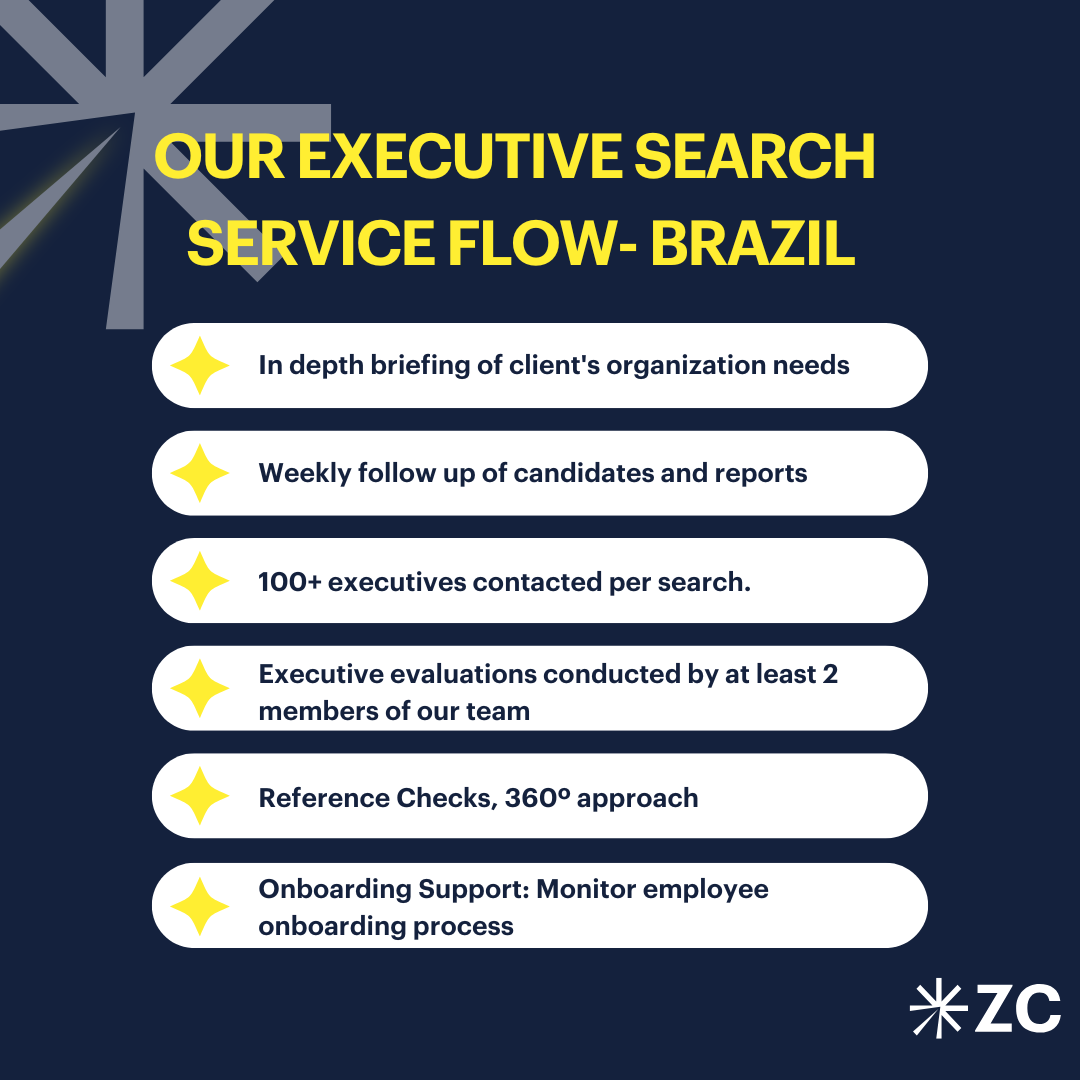
Zavala Civitas Executive Search service flow for the brazilian market

In Zavala Civitas, we have had a presence in the Brazilian market for over a decade with seasoned professionals and industry-specialized experts in finding executive and high-middle management talent.

If you find that executive search might be of interest, you can read more about our service flow and methodology or directly contact us to learn more firsthand. 

Executive Development and Assessment in Portugal for Senior talent

In Portugal, the market is relatively small, executive mobility is limited, and reputations travel quickly. Many companies already have solid senior leaders in place.It’s not about whether these leaders are competent. The question is how to assist them in improving performance as they take on greater roles.  Most people have an area that they can

Read More

Executive Search in Mexico: Leadership Demand Shaped by Nearshoring 

Over the past few years, Mexico has moved to the center of many global expansion strategies. Nearshoring has accelerated investment decisions, operational scale, and organizational complexity across the country. As a result, leadership hiring has shifted from being opportunistic to becoming a critical risk factor.  In this environment, Executive Search in Mexico is

Read More

Executive Search in Portugal: Competing for Leadership in a Small Talent Market 

Portugal has become an increasingly attractive location for international businesses. While stability, talent quality, and quality of life are strong advantages, the senior talent pool is small, highly visible, and intensely competitive.   Because of this hiring in Portugal is about strategy. It involves managing scarcity, confidentiality, and long-term sustainability of

Read More

Related posts

Executive Development and Assessment in Portugal for Senior talent

In Portugal, the market is relatively small, executive mobility is limited, and reputations travel quickly. Many companies already have solid senior leaders in place.It’s not about whether these leaders are competent. The question is how to assist them in improving performance as they take on greater roles.  Most people have an area that they can

Read More

The Insider Paradox: Why APAC Boards Are Choosing Continuity Over Disruption 

In H1 2025, 83% of all new CEOs in APAC were internal promotions the highest ratio ever recorded and dramatically higher than Western markets.  This surge is not accidental, nor is it a sign of risk-aversion. It reflects a deeper leadership strategy shaped by the geopolitical uncertainty of the region, operational complexity, and the rising value

Read More
china business landscape

Executive Search in China: Local Leadership vs Global Executives 

Over the past ten years, many multinational companies in China have quietly changed how they think about leadership. The model of relying primarily on expatriate executives is no longer taken for granted.   Boards and CEOs are increasingly weighing the trade-offs between local Chinese executives and global leaders sent from headquarters.

Read More

Executive Search in Mexico: Leadership Demand Shaped by Nearshoring 

Over the past few years, Mexico has moved to the center of many global expansion strategies. Nearshoring has accelerated investment decisions, operational scale, and organizational complexity across the country. As a result, leadership hiring has shifted from being opportunistic to becoming a critical risk factor.  In this environment, Executive Search in Mexico is

Read More

Executive Search in Portugal: Competing for Leadership in a Small Talent Market 

Portugal has become an increasingly attractive location for international businesses. While stability, talent quality, and quality of life are strong advantages, the senior talent pool is small, highly visible, and intensely competitive.   Because of this hiring in Portugal is about strategy. It involves managing scarcity, confidentiality, and long-term sustainability of

Read More