
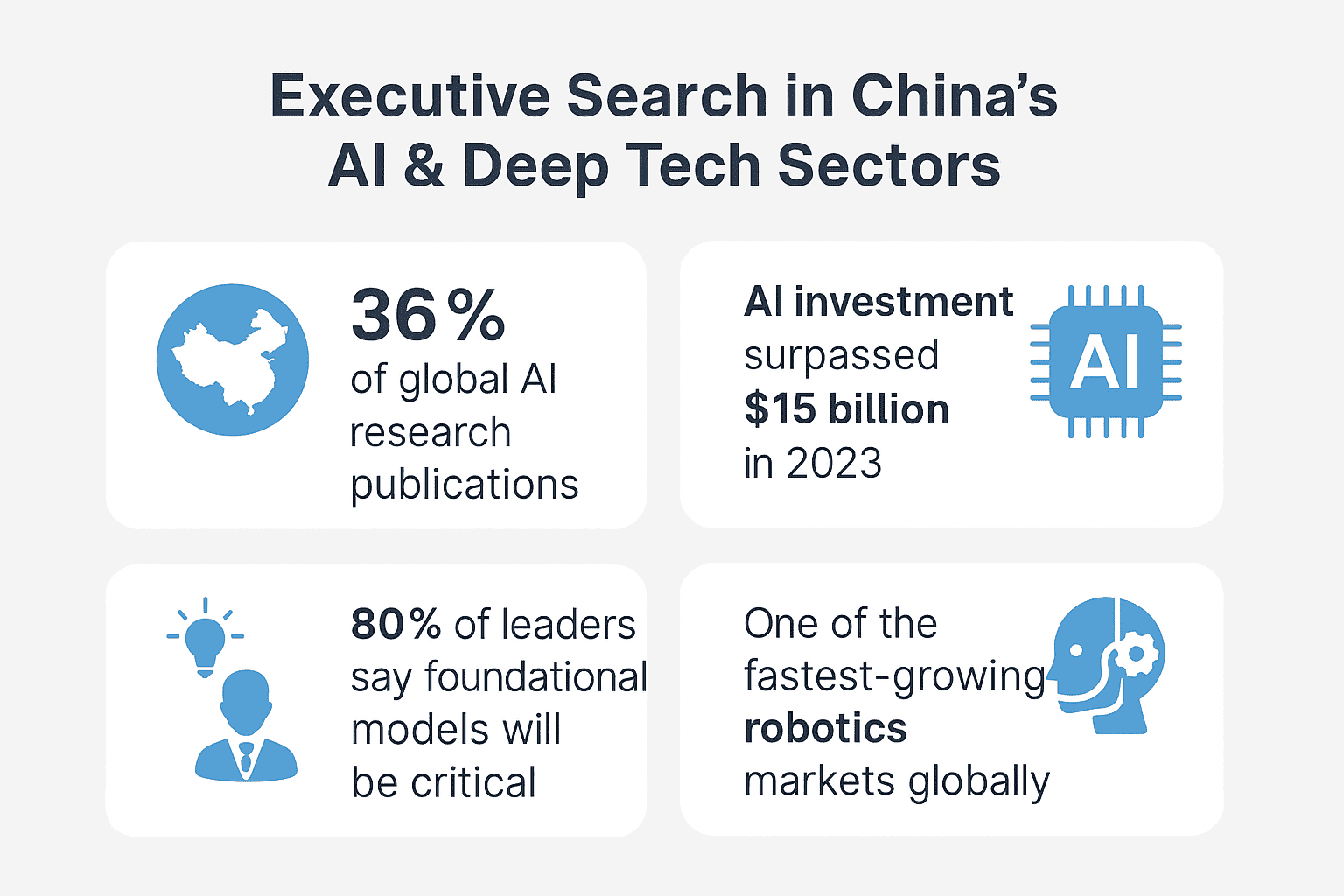
China has transformed into one of the most important centers of the world for the sector of artificial intelligence, automation as well as deep tech. The country has constructed a strong ecosystem of AI-related R&D, venture capital funding, and state-sponsored technology acceleration initiatives. As of the Stanford AI Index, China produces over 36% of the world %27s AI research publications, ranking in the top 3 countries in the world in AI.
This rapid expansion has created an intense demand for senior leadership capable of driving strategy, execution, innovation, and global-scale growth. As companies expand AI-driven products, smart manufacturing solutions, robotics platforms, and large-scale digital infrastructures, competition for executive talent in China’s technology sector has never been higher.
China’s AI & Deep Tech Boom: Why Leadership Needs Are Shifting
Companies operating in AI, robotics, automation, and advanced analytics now require a distinctly different type of executive—far beyond the traditional technology leadership profiles of the past decade.
The most in-demand leadership capabilities include:
- Proven experience scaling AI-driven products from concept to commercialization
- Strong understanding of machine learning, algorithm development, and data architecture
- Ability to lead large engineering teams across China, APAC, and global hubs
- Experience navigating the region´s regulatory, compliance, and cybersecurity environment
- Cross-functional leadership across product, R&D, engineering, and business units
- Deep exposure to cloud, automation, robotics, IoT, semiconductors, or smart manufacturing
- Capability to build high-performing multicultural teams and manage global stakeholders
- Strategic mindset to translate research into scalable business solutions
Executives with this hybrid combination of technical depth + commercial leadership remain extremely scarce.
Why the Competition for AI Leadership in China Is Intensifying
Several forces are converging to make the region one of the most competitive markets for senior technology talent:
- Government investment in AI and deep tech continues to rise sharply
- AI companies are moving from research phase to commercial scale, requiring seasoned executives
- Global companies competing for the same skill sets, particularly in automation and robotics
- Data governance and cybersecurity regulations require high sophistication from leadership
- Chinese companies expanding globally require leaders with international management experience
- The shortage of senior leaders with AI-specific expertise is widening year after year
As a result, CEOs across the country report increased difficulty filling critical roles such as Chief Technology Officer, VP Engineering, VP AI, Head of Data Science, and Chief Product Officer.
Executive Search: Key Leadership Roles in Highest Demand in China’s AI Sector
The following roles are among the most sought-after in China’s high-tech landscape:
- Chief Technology Officer (CTO)
- Chief AI Officer / Head of AI Research
- VP of Engineering
- VP of Data Science / Machine Learning
- Director of Robotics & Automation
- Head of Cloud Infrastructure
- Director of Cybersecurity & Data Governance
- General Manager (for global AI companies expanding locally)
- Product leaders specialized in AI solutions, automation, and analytics
Executive Search demand for strong engineering leadership is also rising in semiconductors, smart manufacturing, autonomous driving, and industrial automation.
Executive Expectations in China’s Deep Tech Market
Senior AI and technology leaders have become increasingly selective. Their decisions are influenced by:
- Meaningful ownership or long-term incentives
- Clear product and technology roadmaps
- Strong alignment with global headquarters
- Investment in R&D and engineering capabilities
- Competitive compensation and transparent performance metrics
- Opportunities to lead cross-border innovation initiatives
- Stability of funding and long-term strategy
AI executives often evaluate not only the salary and role scope but also the technical credibility of the organization and its innovation potential.
Key Market Data to Watch (China 2024–2025)
- China generated 36% of global AI research publications (Stanford AI Index)
- AI investment in China surpassed $15 billion in 2023 (CB Insights)
- China has filed over 29,000 AI-related patents—second only to the United States
- Over 80% of business leaders in China say foundational AI models will be essential to their strategies in the next 3–5 years (Accenture)
- 77% of Chinese executives believe AI will reshape operations across all data types
- The region is one of the fastest-growing robotics and automation markets globally
These trends signal accelerated demand for leaders capable of guiding large-scale transformation, innovation, and commercialization.
About Zavala Civitas Executive Search
At Zavala Civitas Executive Search, we help global and Chinese organizations identify and attract senior leaders capable of driving innovation in AI, robotics, automation, and advanced technology. Our expertise in high-tech executive search allows us to connect companies with the visionary leadership required to build, scale, and compete in China’s rapidly evolving tech landscape.
Contact us to discuss your executive hiring needs in China’s AI and deep tech sectors or learn more about our executive search process here.