
Executive Search in Mexico’s Industrial & Manufacturing Sector 

Key Takeaway: Mexico attracted a record ~$41 billion in foreign direct investment in the first nine months of 2025 — driven by nearshoring manufacturing. Industrial wages in nearshoring regions are now 15–20% above the national average. The investment is moving faster than the executive talent capable of leading it.

Last updated: August 13, 2026

Mexico has become one of the most strategic industrial platforms in North America. Driven by nearshoring, supply chain reconfiguration, and US–Mexico trade integration, the country is experiencing sustained expansion in manufacturing investment.

Executive search in Mexico’s industrial and manufacturing sector requires identifying leaders capable of scaling operations, managing cross-border structures, and aligning with international governance standards.

In this environment, leadership selection directly impacts operational resilience and long-term competitiveness.

Key Figures at a Glance

Data point Figure Source
Mexico FDI Jan–Sep 2025 (record) ~$41B USD (+15% vs same period 2024) Secretaría de Economía / AIG, 2025
Nearshoring investment in Mexico over 5 years USD 46 billion Mexico Nearshoring Analysis, 2025
Manufacturing wages in nearshoring regions vs national average 15–20% above national average Nearshoring market analysis, 2025
Mexico total industrial exports in 2024 $617B USD (+10.5% CAGR since 2018) INEGI / Banco de México, 2025

Mexico’s Industrial & Manufacturing Landscape

Growth is concentrated in:

  • Monterrey and the northern corridor
  • Bajío manufacturing cluster
  • Automotive and advanced manufacturing hubs
  • Logistics and distribution platforms

The region hosts family-owned groups, multinational manufacturing subsidiaries, private equity-backed platforms, and US and European companies relocating operations. This diversity increases leadership complexity.

Mexico’s industrial clusters are geographically defined — and so is the talent that leads them. A Plant Director with 20 years in Monterrey’s steel and heavy manufacturing ecosystem does not have the same network or labour relations experience as a COO who has scaled automotive operations in the Bajío. Effective executive search in Mexico’s industrial sector starts with understanding which cluster the mandate draws from, not what the job title says.

Why Industrial Executive Search Requires Sector Depth

1. Operational Scalability
Executives must manage production expansion, supply chain integration, and cost optimisation under margin pressure.

2. Cross-Border Governance
Many industrial platforms report to US or European headquarters. Leaders must operate within international compliance and reporting structures.

3. Workforce and Labour Management
Manufacturing environments require strong labour relations expertise and structured operational discipline.

Generic recruitment models fail to capture these dynamics. This sector requires direct market mapping of competitors, discreet outreach to senior operators, and governance alignment assessment.

Critical Roles in Demand

Industrial leadership demand remains strong for:

  • CEOs of manufacturing platforms
  • COOs driving operational scale
  • CFOs with cross-border financial oversight
  • Plant Directors with advanced manufacturing expertise
  • Board members with industrial governance background

As nearshoring accelerates, leadership gaps become strategic risks.

Nearshoring and Leadership Risk

Mexico’s integration with the United States under regional trade frameworks intensifies operational expectations. Executives must coordinate with US headquarters, ensure compliance with international standards, manage supply chain volatility, and lead culturally diverse teams.

This narrows the effective senior talent pool. Selecting the wrong leader in a capital-intensive environment can delay operational expansion and reduce investor confidence.

With nearshoring investment reaching USD 46 billion over five years and manufacturing wages in key regions running 15–20% above the national average, the pressure on plant-level and regional leadership is structural — not cyclical. Each new facility that opens needs a Plant Director, a COO, and eventually a Country Manager. The pipeline of new plants is outpacing the pipeline of executives ready to lead them at the standards that US and European headquarters demand.

Our Approach

At Zavala Civitas, our partner-led executive search model focuses on:

  • Strategic mandate alignment with shareholders
  • Deep competitor mapping across industrial platforms
  • Direct executive access
  • Governance and cultural assessment
  • Structured onboarding follow-up

We approach mandates as long-term leadership architecture decisions, not transactional recruitment exercises.

Zavala Civitas: Five-Phase Methodology for Mexico Industrial Search

Our process for industrial and manufacturing mandates in Mexico follows five structured phases:

  1. Alignment meeting: defining the industrial cluster, type of facility, US or European reporting structure, and the specific operational challenge the executive must solve — whether scaling production, integrating a new line, or managing cross-border governance.
  2. Psychometric evaluation: using PAPI by Cubiks Talogy to assess aptitude, leadership style, and compatibility with high-pressure operational environments and cross-cultural management.
  3. Structured competency interview: approximately two hours, focused on specific plants managed, production volumes, labour relations decisions, and coordination with international headquarters.
  4. 360º reference verification: a minimum of four sources across superiors, peers, and direct reports, with attention to reputation within the relevant industrial cluster.
  5. Executive report: includes a Contrast Profile with a fit percentage, a Leadership Report, and an integration plan for the first 100 days.
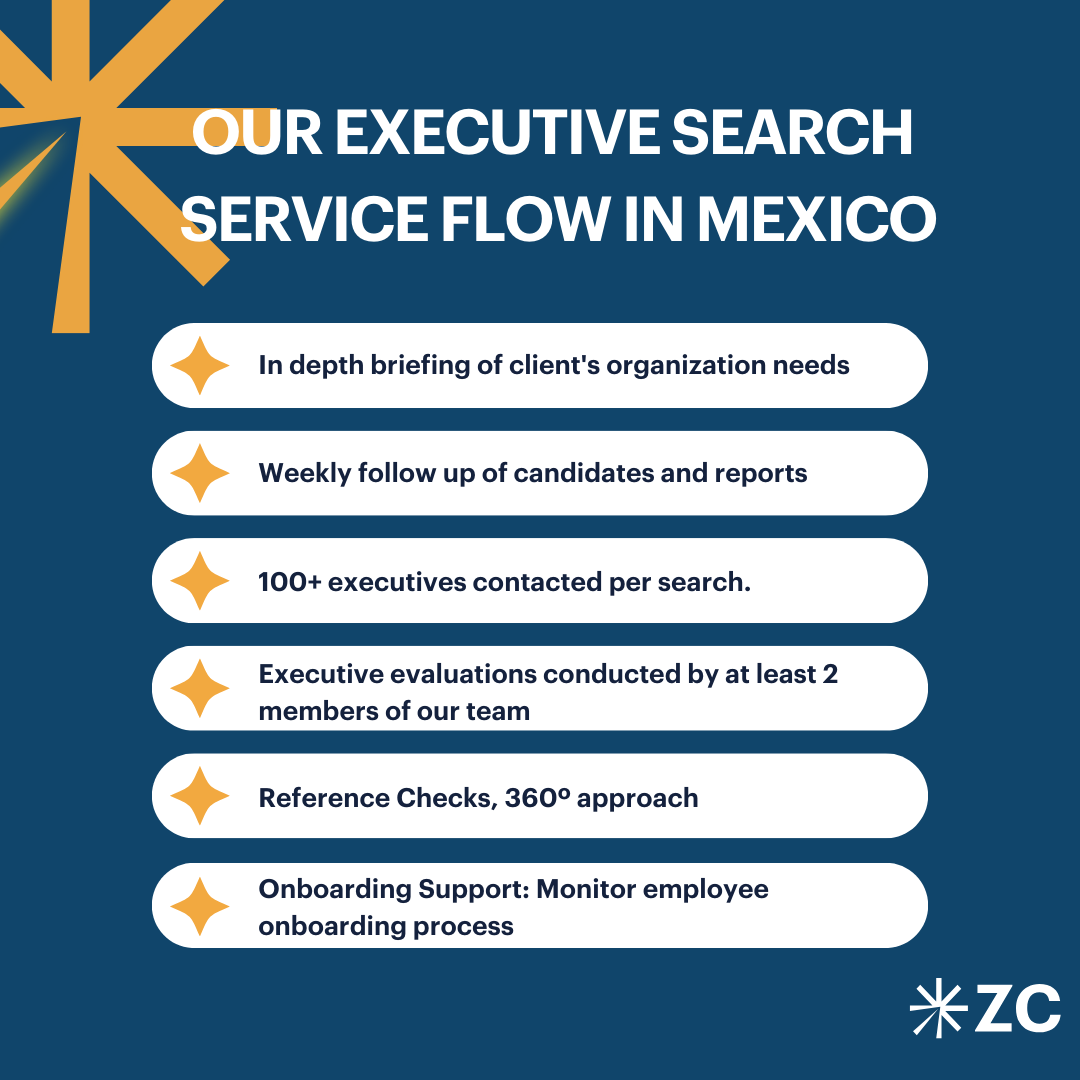
Executive search process Zavala Civitas — Mexico industrial sector

Frequently Asked Questions: Executive Search in Mexico’s Industrial Sector

Why is executive search in Mexico’s industrial sector particularly demanding?
Because nearshoring has accelerated investment faster than leadership development. With USD 46 billion in nearshoring capital deployed over five years and a record $41B in FDI in the first nine months of 2025 alone, the number of new facilities opening requires leadership that the local talent market has not yet produced at the same rate.
How does Mexico’s regional structure affect which executives are available?
Significantly. The Monterrey corridor, the Bajío cluster, and the northern border each have distinct industrial profiles, labour markets, and executive ecosystems. A COO with deep Bajío automotive experience does not necessarily have the relationships or operational fluency needed in a Monterrey steel or logistics platform. Effective sourcing must begin with the right cluster.
What makes a manufacturing executive suitable for nearshoring environments?
The ability to operate simultaneously in two governance realities: the local operational context — labour relations, supply chain management, regulatory compliance in Mexico — and the international reporting expectations of the US or European headquarters. Executives who can only operate in one register are a poor fit for cross-border platforms.
Why do the most capable plant directors in Mexico rarely respond to job postings?
Because they are already managing critical operations with high internal demand and multiple external approaches. The most capable operators in Mexico’s industrial clusters are known within their ecosystem, consistently recruited, and rarely consider a move unless the approach is credible, the mandate is precisely defined, and the opportunity represents a clear advancement in scope or visibility.
What methodology does Zavala Civitas apply to industrial mandates in Mexico?
A five-phase process: alignment on industrial cluster, facility type, and US/European reporting structure; psychometric evaluation using PAPI by Cubiks Talogy; structured competency interview focused on production management, labour relations, and cross-border governance; 360º reference verification with a minimum of four sources; and an executive report with a fit percentage and 100-day integration plan. With a 92% closing rate across completed mandates.

Looking for industrial leadership in Mexico?

Zavala Civitas maps Mexico’s industrial clusters directly. 92% closing rate across completed mandates.


Executive Search →
Industrial →
Contact Us →

Financial services building in Germany

Executive Search in Brazil for Financial Services

Key Takeaway: The White House targeted Brazil’s Pix payment system in April 2026, calling it a barrier to US payment companies. Brazil’s Central Bank fired back, defending Pix as a matter of payments sovereignty. At the same time, the collapse of Banco Master, the largest banking fraud in Brazilian history,

Read More

Executive Search Brazil: Education & Non-Profit

Financial sustainability is the central challenge for 66% of Brazilian non-profit organisations. This finding comes from the “Panorama das ONGs: capítulo Brasil” report. The report was published by IDIS, the Institute for the Development of Social Investment, in partnership with the Charities Aid Foundation (CAF), in February 2026. It forms

Read More

Executive Search in Mexico for Luxury, Retail and Consumer

Nearshoring is the practice of companies relocating manufacturing closer to the US market to shorten supply chains. This practice has reshaped consumer economics in specific regions of Mexico. Nearshoring investment has reached USD 46 billion over five years. This investment has raised manufacturing wages 15% to 20% above national averages,

Read More

Related posts

Executive Search China: Industrial Sector

Key Takeaway: Beijing has launched a nationwide “anti-involution” (反内卷) campaign to address destructive price wars and overcapacity across multiple industrial sectors at once, not just renewables. Electrical machinery and equipment, communications equipment, and medical products all show 29% to 34% of firms losing money in 2024-25. Goldman Sachs estimates Chinese

Read More
Financial services building in Germany

Executive Search in Brazil for Financial Services

Key Takeaway: The White House targeted Brazil’s Pix payment system in April 2026, calling it a barrier to US payment companies. Brazil’s Central Bank fired back, defending Pix as a matter of payments sovereignty. At the same time, the collapse of Banco Master, the largest banking fraud in Brazilian history,

Read More
law leaders working

Executive Search in Mexico for Legal and Professional Services

Key Takeaway: Mexico’s 2024 judicial reform introduced popular election of judges and magistrates, with implementation beginning in 2025. This has accelerated a shift toward arbitration as the preferred dispute-resolution method in commercial contracts, as companies seek predictability an elected judiciary cannot yet guarantee. Combined with nearshoring-driven M&A activity and the

Read More

Executive Search in Italy for Industrial

Key Takeaway: Turin’s automotive cluster invested roughly €2.8 billion in electrification between 2024 and 2026. Over the same period, regional automotive employment fell by more than 3,200 positions. Fewer than 20% of local engineering graduates hold the specific battery, power electronics, and embedded software skills employers are actually hiring for.

Read More

Executive Search in Portugal for Financial Services

Key Takeaway: French banking group BPCE is investing €6.4 billion to acquire Novo Banco and building a 20,000 square metre campus in Lisbon, alongside a 2,500-strong tech hub already operating in Porto. This single deal is creating demand for highly specialised roles in risk analytics, structured finance, and digital-asset compliance

Read More
Legal gavel and books

Executive Search Canada: Legal & Professional Services

Key Takeaway: Lawyers aged 55 and older now make up roughly 31% of the Canadian legal profession. Yet 55% of law firms report having no formal succession plan in place. Combined with 86% of legal employers already struggling to find skilled talent, this creates a leadership transition risk most firms

Read More