
Last updated: August 17, 2026
As the demands on leadership continue to change, many organisations are rethinking how they identify and promote senior talent. The traditional executive search model — focused on previous job titles, academic credentials, and years of service — no longer reflects what is required for success. A recent global survey found that 62% of executives believe a candidate’s résumé often fails to reflect their true capabilities — sometimes overlooking potential, and other times overestimating readiness.
This is why a growing number of organisations are embracing a skills-based hiring approach — especially for critical leadership roles. Rather than relying solely on where someone has been or what their résumé includes, skills-based hiring asks: what can this person do today, and what could they do tomorrow?
Key Figures at a Glance
| Data point | Finding | Source |
|---|---|---|
| Executives who say CVs often fail to reflect true capabilities | 62% | Global executive survey |
| Leaders with high learning agility vs. peers in promotion probability | 5× more likely to be promoted to senior roles | Global leadership research |
| HR leaders shifting from role-based to skills-based workforce planning | 74% of HR leaders surveyed | Global HR research |
| CEOs going through formal leadership assessment before being hired | ~90% — behavioural evidence now standard in CEO selection | Executive assessment industry data |
Why Traditional Executive Search Is Falling Short
Résumés reflect the past, but leadership today is about readiness for what comes next. With core skills evolving faster than ever, experience alone no longer signals capability. According to recent global research, 89% of leadership development professionals say preparing for the future of work means investing in skill-building, and 54% of organisations are actively prioritising reskilling and upskilling as a response to persistent leadership and capability gaps. Leaders with high learning agility are 5× more likely to be promoted into senior roles — yet this trait rarely appears on a CV.
What It Means to Hire for Skills
Skills-based hiring does not mean ignoring experience — it means looking past surface credentials to evaluate the real capabilities a person brings: their decision-making under pressure, strategic insight, collaborative ability, resilience, and capacity to learn.
This is especially powerful in executive search, where so much of a role’s impact depends on context-specific challenges. Instead of asking whether a candidate has held a specific title, the focus shifts to whether they have demonstrated the necessary leadership behaviours to solve the organisation’s unique challenges. The candidate who has not held the title but has demonstrably solved the problem at adjacent scale — in a different sector, or as a functional lead rather than a P&L owner — is precisely who skills-based hiring surfaces.
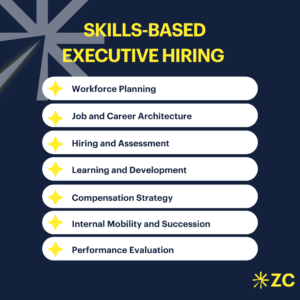
Seven Ways to Operationalise Skills-Based Executive Hiring
1. Workforce Planning. Replace generic headcount planning with capability mapping. Define which leadership skills your business needs now and in the near future, and identify whether to build, hire, or contract for those capabilities. 74% of HR leaders say their organisations are shifting from role-based to skills-based workforce planning, recognising that traditional headcount models no longer align with the pace of business change.
2. Job and Career Architecture. Redefine executive roles around business-critical capabilities rather than hierarchy. This opens new pathways to leadership for candidates with adjacent or non-linear career histories — and better reflects how work is actually evolving. A candidate who has not followed the canonical career path to a role is not necessarily underprepared. They may be differently prepared — which is precisely the assessment question.
3. Hiring and Assessment. Use structured behavioural interviews, executive simulations, and competency-based evaluation frameworks to assess future potential — not just historical performance. Nearly 90% of CEOs now go through formal leadership assessments before being hired, as organisations increasingly rely on behavioural evidence, not just track records, to predict success in new contexts.
4. Learning and Development. Build agile leadership pipelines by identifying adjacent skills, fostering cross-functional exposure, and enabling stretch roles. Focus on learning velocity as a predictor of success in evolving roles. At Zavala Civitas, we place a strong emphasis on learning agility and growth trajectories — our Talent 7 assessment helps organisations not only evaluate current capabilities but also understand how leaders will evolve and scale with the demands of the role.
5. Compensation Strategy. Reward leaders for high-impact skills — not just job level. This enables strategic use of compensation budgets to retain critical capabilities and attract forward-ready talent. More than 75% of public companies now include long-term incentive schemes (LTIs) as a core part of executive compensation, aligning rewards with future-focused capabilities like innovation, digital transformation, and resilience.
6. Internal Mobility and Succession. Promote based on readiness and capabilities, not tenure or current role alone. A skills-first lens makes succession planning more data-driven, equitable, and aligned with long-term strategy — and it surfaces internal candidates who would be systematically undervalued by a tenure-first model.
7. Performance Evaluation. Expand performance reviews to include skill application and growth. Assess how leaders deploy their capabilities, develop others, and contribute to long-term business agility — not just whether they met the targets that were set when the role was defined for a market that has since changed.
An Illustrative Example
Consider Elise, a senior regional director at a mid-market retail brand. Though she did not hold a C-level title, she had led enterprise-wide digital change, revitalised talent strategy, and improved EBITDA performance by double digits. Her career path was not traditional — but her capabilities were exactly what a global lifestyle brand needed in its Chief Commercial Officer.
Recognising her value required looking beyond her résumé and understanding her leadership skill set in context. A traditional executive search might have missed her. A skills-first approach did not.
Looking Ahead: Executive Search for a New Era
As organisations face mounting pressure to innovate, transform, and future-proof their businesses, the ability to identify executive talent based on skills and potential — not just on papers — will become a decisive competitive differentiator.
Skills-based hiring does not reject experience. It reframes how value is recognised. It puts capability, adaptability, and impact at the centre of leadership decisions — exactly where they belong.
Contact us to find the right leadership talent for your organisation.
Frequently Asked Questions: Skills-Based Executive Search
Rethinking how you identify executive talent?
Zavala Civitas integrates skills-based assessment into every executive search mandate through our Talent 7 framework. 92% closing rate.