
Executive Search in the USA: Overcoming Key Challenges

Key Takeaway: The U.S. has a GDP exceeding $28 trillion, a PE market at $1.2 trillion, and CEO turnover at 12.5% — an 8-year high. In this environment, executive search is not just a recruitment service. It is the mechanism through which organisations access the leadership capable of managing cost, driving innovation, and building the resilience the market demands simultaneously.

Last updated: August 13, 2026

The U.S. market is currently navigating a complex environment. Economic challenges — including persistent inflationary pressures, elevated interest rates, and geopolitical risks — are creating difficulty for companies across every industry. In these conditions, securing the right executive talent is imperative. This is where specialised executive search firms become critical.

U.S. Bureau of Labor Statistics data indicates distinct gaps in the job market — particularly at leadership level in sectors including technology, where executives with AI and cybersecurity expertise remain acutely scarce. McKinsey research confirms that companies with diverse executive teams consistently outperform their peers — making inclusion a performance variable, not a compliance exercise.

Key Figures at a Glance

Data point Figure Source
U.S. GDP >$28 trillion (world’s largest economy) Bureau of Economic Analysis, 2025
U.S. CEO turnover rate in 2025 12.5% — highest in 8 years Spencer Stuart / Conference Board, 2025
U.S. Private Equity market size (2025) $1.2 trillion — 2nd record in history PitchBook, 2025
Financial outperformance of companies with diverse executive teams 25% more likely to outperform peers McKinsey, Diversity Wins

Opportunities with Executive Search in the U.S.

It is clear that the demands of talent acquisition in the current U.S. environment are significant. Businesses have become more selective with hiring, looking for candidates who have a proven track record in complex, fast-moving environments. To succeed, executive search firms need to:

  • Respond to change: Companies must be provided with leaders who can manage costs while promoting innovation, as well as increase a firm’s resilience — especially in the U.S. market where competitiveness is a globally recognised reality.
  • Increase focus on strategic talent management: It is essential that senior executives are aligned with the company vision — not just the immediate operational mandate.
  • Use technical innovation: AI-powered tools and data analytics are increasingly valuable for identifying ideal candidates from larger and more complex talent pools.
  • Emphasise diversity and inclusion: Creating a diverse leadership group is now a strategic performance requirement — supported by McKinsey data showing a 25% financial outperformance advantage.

These challenges come with significant opportunities. The restructuring and optimising of organisational leadership is increasing the need for specialised executive search services. Firms that can offer well-designed strategies to answer complex leadership needs are the competitive ones in the United States.

The U.S. executive search market’s primary challenge in 2025 is not identifying candidates — it is identifying the right candidates before three other organisations with the same brief do. With CEO turnover at a 12.5% eight-year high and 33% of incoming CEOs being external hires, the demand for senior leadership that does not exist in internal pipelines has created a structural urgency in the market. The organisations that partner with a search firm early — before the vacancy is open — are consistently the ones that access the best candidates before those candidates are already in an advanced stage with a competing organisation.

How Executive Search Firms Can Assist U.S. Businesses

Our company analyses the U.S. market and the relevant challenges a business may encounter, identifying the leadership opportunities that match. We have developed a specialised talent acquisition strategy that:

  • Identifies and engages prime candidates: Through our networks and industry knowledge, we connect clients to senior executives across the United States and globally — including candidates who are not on the market but are open to the right conversation.
  • Provides advisory partnership: We work with clients to define the requirements of executive roles and the criteria that will determine success in the specific organisational and market context.
  • Preserves cultural integration: We select executive candidates who best suit our client’s company culture and strategic direction — not just their functional brief.
  • Improves efficiency: We manage the full search process from initial market mapping to final placement — reducing the time and internal resources required while increasing the precision of the outcome.
The $1.2 trillion U.S. PE market is creating a specific and growing executive search demand that standard corporate search processes are not designed to meet. Portfolio CEOs, CFOs, and COOs for PE-backed companies need executives who understand value creation timelines, KPI governance, investor reporting, and the specific accountability structures that institutional ownership requires. Those profiles overlap only partially with the corporate executive pool. The PE search requires a different talent map, a different assessment framework, and a different understanding of what success looks like in year one versus year three of the hold period.

Executive Search in the U.S.: Partnering for Success

Our executive search clients aim to successfully navigate an ever-changing U.S. market because it presents their businesses with elite professionals. With Zavala Civitas, our clients can focus on building stable and dynamic leadership teams — supported by expert guidance that allows them to shift their focus from the search process to the strategic direction that the right leadership will enable.
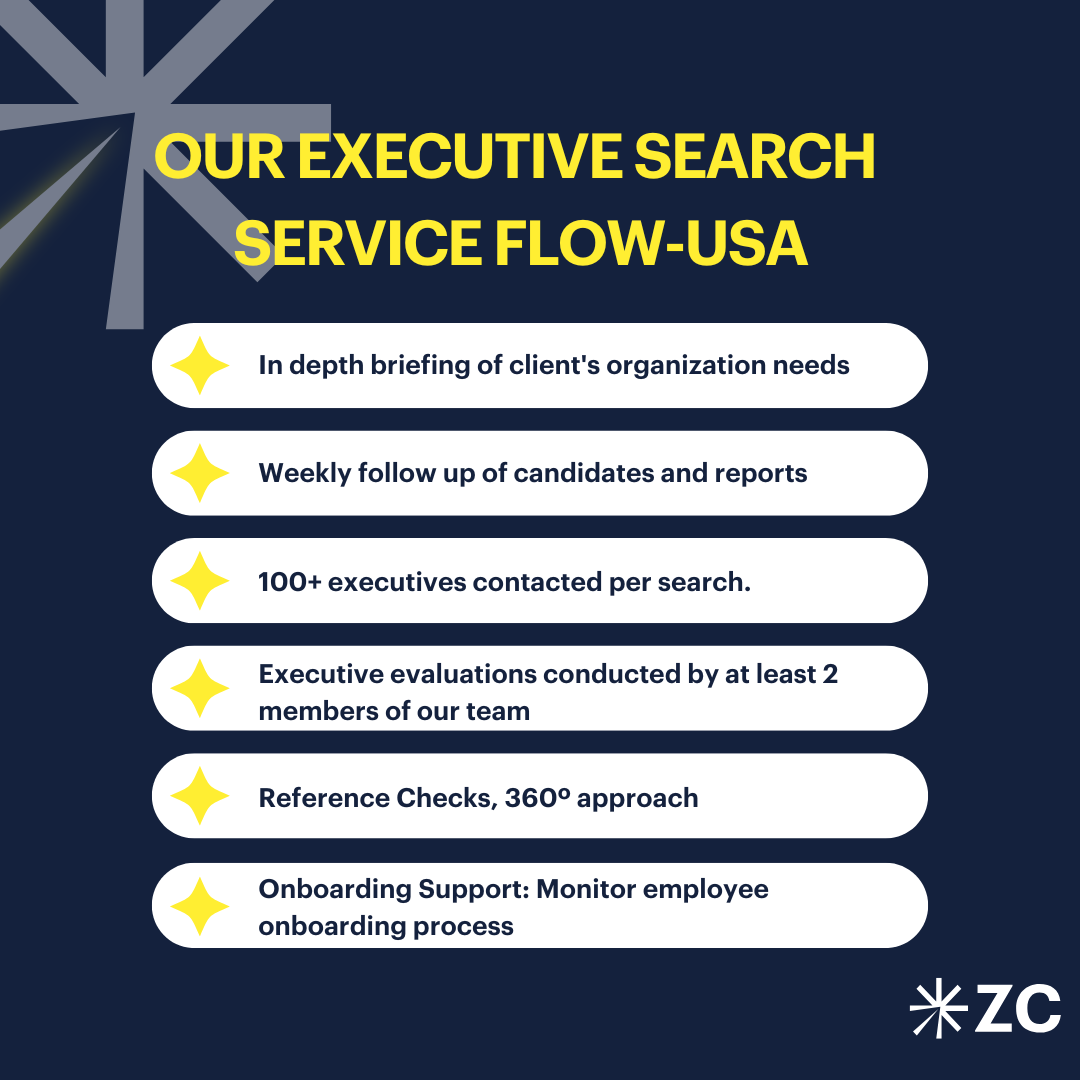
Executive search service flow for the United States — Zavala Civitas

Zavala Civitas is here to help you thrive amidst market complexity in the U.S. Learn more about our executive search services.

Frequently Asked Questions: Executive Search in the U.S. — Overcoming Key Challenges

Why is the U.S. executive search market more competitive in 2025 than in previous years?
Because CEO turnover at 12.5% — the highest in eight years — combined with 33% of incoming CEOs being external hires means that the demand for senior leadership that does not exist in internal pipelines has created structural urgency. Simultaneously, the $1.2 trillion PE market is generating volume of mandates at portfolio company level that would not have existed five years ago. The supply of candidates has not scaled at the same pace as the demand — producing a market where the timing and quality of the search approach are more decisive than at any previous point.
What makes AI and cybersecurity executive searches specifically difficult in the U.S. market?
Because the profiles that fill these roles are simultaneously the most technically specialised and the most commercially mobile in the market. A CISO or Chief AI Officer who has genuine operational experience managing a security programme at scale, or building and deploying AI in a commercial environment, is receiving multiple approaches from organisations with larger equity packages and more technically exciting mandates. The first credible conversation — not the most structured process — is what determines who has access to the candidate.
How does diversity and inclusion affect executive search strategy in the U.S. in 2025?
McKinsey’s 25% financial outperformance advantage for diverse executive teams has shifted D&I from a values statement to a performance variable for U.S. boards. This means that search mandates increasingly require diverse shortlists — not as a compliance addendum after the talent map is built, but as a founding criterion that shapes which networks are accessed. The search firms that consistently produce diverse shortlists are those that built diverse networks before the mandate required them.
What does the U.S. PE market’s $1.2 trillion scale mean for executive search?
It means that a significant share of U.S. executive search mandates now require candidates assessed against PE governance standards — KPI discipline, value creation accountability, investor reporting fluency, and the ability to make decisions within a defined exit horizon. That profile is fundamentally different from corporate executive search, and it requires a different talent map, assessment framework, and understanding of what success looks like in year one versus year three of the hold period.
How does Zavala Civitas approach executive search for U.S. businesses facing market complexity?
Through a partner-led, confidential process that maps the full U.S. talent pool by sector and geography — accessing passive candidates who are not on the market — and assesses cultural fit, strategic alignment, and PE governance readiness alongside functional competency. For international companies building U.S. presence, we integrate cross-border cultural fluency into both the search and the assessment. With a 92% closing rate across completed mandates.

Navigating executive search challenges in the U.S.?

Zavala Civitas provides partner-led, confidential executive search for U.S. and international organisations. 92% closing rate.

Executive Search →
Private Capital →
Contact Us →

Executive Search China: Industrial Sector

Key Takeaway: Beijing has launched a nationwide “anti-involution” (反内卷) campaign to address destructive price wars and overcapacity across multiple industrial sectors at once, not just renewables. Electrical machinery and equipment, communications equipment, and medical products all show 29% to 34% of firms losing money in 2024-25. Goldman Sachs estimates Chinese

Read More

Executive Search in Italy for Industrial

Key Takeaway: Turin’s automotive cluster invested roughly €2.8 billion in electrification between 2024 and 2026. Over the same period, regional automotive employment fell by more than 3,200 positions. Fewer than 20% of local engineering graduates hold the specific battery, power electronics, and embedded software skills employers are actually hiring for.

Read More

Executive Search in Portugal for Financial Services

Key Takeaway: French banking group BPCE is investing €6.4 billion to acquire Novo Banco and building a 20,000 square metre campus in Lisbon, alongside a 2,500-strong tech hub already operating in Porto. This single deal is creating demand for highly specialised roles in risk analytics, structured finance, and digital-asset compliance

Read More

Related posts

Trabajo en remoto en los despachos de abogados

Autora: Beatriz Baker Araujo Senior Advisor, Zavala Civitas El debate sobre el trabajo presencial y remoto en los despachos de abogados lleva años activo, pero no ha madurado. Las posiciones se han endurecido desde 2020, y las conversaciones suelen discurrir entre dos polos: socios que invocan la cultura, el mentoring

Read More

Executive Search China: Industrial Sector

Key Takeaway: Beijing has launched a nationwide “anti-involution” (反内卷) campaign to address destructive price wars and overcapacity across multiple industrial sectors at once, not just renewables. Electrical machinery and equipment, communications equipment, and medical products all show 29% to 34% of firms losing money in 2024-25. Goldman Sachs estimates Chinese

Read More
Financial services building in Germany

Executive Search in Brazil for Financial Services

Key Takeaway: The White House targeted Brazil’s Pix payment system in April 2026, calling it a barrier to US payment companies. Brazil’s Central Bank fired back, defending Pix as a matter of payments sovereignty. At the same time, the collapse of Banco Master, the largest banking fraud in Brazilian history,

Read More
law leaders working

Executive Search in Mexico for Legal and Professional Services

Key Takeaway: Mexico’s 2024 judicial reform introduced popular election of judges and magistrates, with implementation beginning in 2025. This has accelerated a shift toward arbitration as the preferred dispute-resolution method in commercial contracts, as companies seek predictability an elected judiciary cannot yet guarantee. Combined with nearshoring-driven M&A activity and the

Read More

Executive Search in Italy for Industrial

Key Takeaway: Turin’s automotive cluster invested roughly €2.8 billion in electrification between 2024 and 2026. Over the same period, regional automotive employment fell by more than 3,200 positions. Fewer than 20% of local engineering graduates hold the specific battery, power electronics, and embedded software skills employers are actually hiring for.

Read More

Executive Search in Portugal for Financial Services

Key Takeaway: French banking group BPCE is investing €6.4 billion to acquire Novo Banco and building a 20,000 square metre campus in Lisbon, alongside a 2,500-strong tech hub already operating in Porto. This single deal is creating demand for highly specialised roles in risk analytics, structured finance, and digital-asset compliance

Read More