
HR Technologies: The Future of Executive Search

Digital transformation has rapidly reshaped HR practices, leading to groundbreaking changes in how talent and employee experience are managed. Tools like artificial intelligence (AI), machine learning (ML), personalized development platforms, and cybersecurity solutions are changing every aspect of the HR sector. In this article we explore the top technology trends shaping the future of HR management as well as the strategic role of HR in executive search and talent acquisition.

Artificial Intelligence and Machine Learning in Executive Search

AI and ML algorithms are changing how executive recruitment is managed by analyzing data to identify patterns and optimize hiring decisions. Advanced HR platforms such as Phenom, Oracle Cloud HCM, SeekOut, and Businessolver analyze not only recruitment trends and skill gaps but also assess social and emotional competencies to select leaders best suited for the development of organizations. It is expected in the following years that these tools will become increasingly sophisticated, enhancing precision and efficiency in executive hiring.

In order to predict gaps and help companies to secure the right type of talent and leadership. Companies using AI and ML in recruitment see up to a 40% faster hiring process and a 30% boost in accuracy, streamlining executive talent acquisition by quickly identifying high-potential candidates (LinkedIn, Deloitte)

Personalized Executive Development Platforms for Continuous Growth

Technology plays a crucial role not only in hiring but also in continuous executive development. Personalized learning platforms use AI to tailor training programs to individual needs, identifying skill gaps and providing relevant content for ongoing learning. Platforms like YouTube, edX, and Udacity are replacing traditional methods, improving corporate development strategies.

In the future, these platforms may integrate virtual and augmented reality, offering immersive learning experiences that enhance executive skills in a dynamic environment. With 83% of business leaders now adopting flexible and dynamic development models, personalized platforms are essential in competitive workplaces.

Skills-Based Talent Sourcing for Broader Access to Executive Talent

A skills-based approach, rather than focusing solely on credentials or specific roles, expands the talent pool, enabling organizations to pinpoint the ideal candidate for executive roles. This model prioritizes skills and potential over academic degrees or specific experience, aligning talent more effectively with organizational needs. Tools like Reejig, retrain.ai, Microsoft, and Cornerstone support this shift by identifying top talent based on demonstrated skills and potential, adding strategic value to executive search efforts.

For example, rather than only focusing on a specific  degree, a company might seek candidates with demonstrated leadership skills in crisis management, broadening access to diverse, high-potential talent who excel in critical areas that are needed.

Predictive Talent Management for Proactive Decision-Making in Executive Search efforts

Predictive analytics makes talent management more strategic, especially at the executive level. Advanced predictive tools enable companies to forecast future talent needs, identify high-potential leaders, and pinpoint areas requiring reinforcement.

This process uses data on employee performance, engagement, and career progression to spot patterns, allowing organizations to make proactive decisions that improve retention, succession planning, and onboarding. For example, predictive analytics can help forecast executive retirements and identify internal candidates who, with the right development, could fill these roles seamlessly. 

Remote Work and Hybrid Models Enabled by Advanced Technology

The rise of remote work has accelerated development in tools that improve collaboration and productivity in virtual environments. Unified communication platforms, cloud-based project management, and AI-powered time management tools streamline hybrid and remote work models, offering flexibility for distributed executive teams. Advanced technology ensures seamless interaction and optimized workflow, crucial for remote executive management and talent retention. 

The global market for remote collaboration tools, driven by platforms like Microsoft Teams, Slack, and Zoom, is set to reach $50.5 billion by 2030 with a growth rate of over 12%. A 2023 McKinsey survey shows 87% of employees prefer remote work at least once weekly, and 58% of executives report improved team performance with hybrid models, highlighting broad support for flexible work. 

Diversity and Inclusion Enhanced by Technology

Diversity and inclusion have become strategic imperatives for HR, particularly in executive search. Advanced technology reduces bias in hiring processes, assesses workforce diversity, and fosters an inclusive environment. AI analyzes behavioral patterns to identify and address potential challenges in diversity, promoting a balanced workforce. With 78% of business leaders citing diversity and inclusion as competitive advantages, companies that prioritize these initiatives stand out in executive talent acquisition and employer branding. 
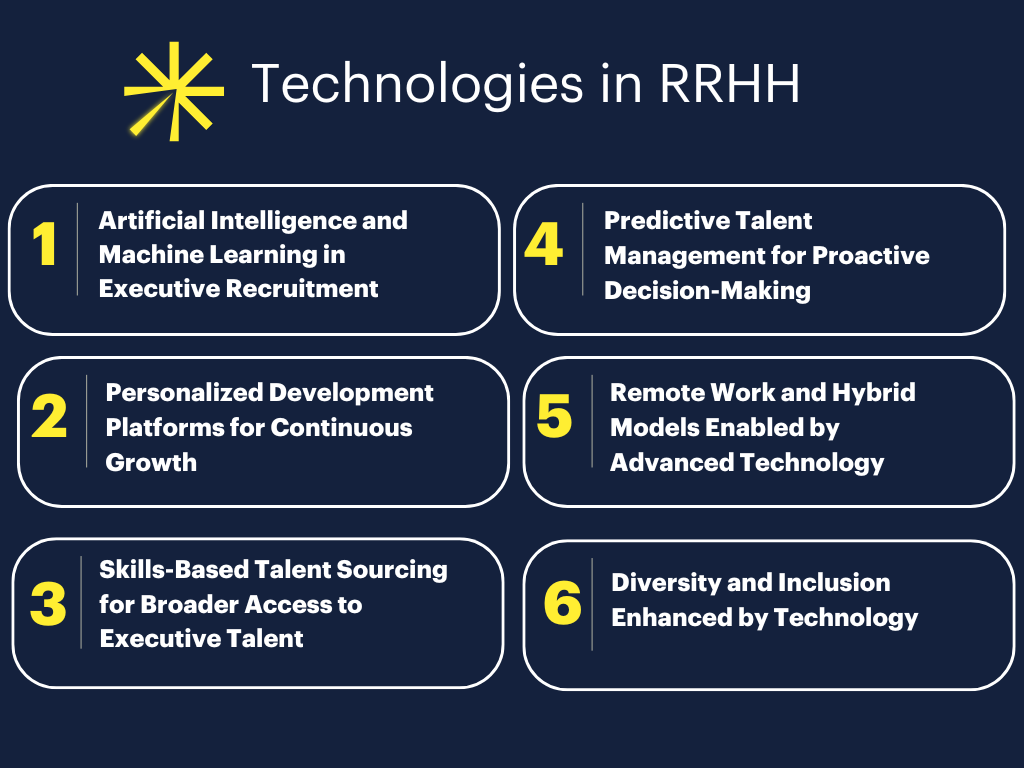
Executive search technologies trends

Conclusion on HR technologies

Organizations that proactively adopt HR technology trends will be better positioned to stay competitive. Recognizing that HR manages a company’s most valuable asset—its people—is essential. The continuous evolution of technology in HR and executive search promises a dynamic and impactful future.

Click here to get in contact with us. 


Picture of Pedro Gasset de Leyva

Pedro Gasset de Leyva

Pedro Gasset brings over a decade of experience in business development and executive placements, specializing in C-level partnerships, consultative sales, and complex negotiations.

Executive Search in Mexico: Leading Sectors Shaping Demand 

Over the last few years, Mexico swiftly garnered international investment, earning it the title of one of the fastest-growing countries in capturing global foreign direct investments.   This scenario creates new talent opportunities.  Most Executive Search firms in Mexico have modified their approach from simply filling highest roles in an organization to competing for the extremely limited pool of qualified executive talent for all roles in all sectors.  The demand isn’t even  It is very much concentrated.  Where Demand is Actually Growing  Mexico’s hiring executive pressure is unequal across all sectors. Some sectors are faster and are pulling talent from other sectors. Manufacturing is the clearest example.  With nearshoring, Mexico is becoming a strategically important center for the supply chain for North America. This is due to the fact that international companies are relocating and/or expanding their operations in Mexico. This is supported by McKinsey & Company.  The growth of a business is dependent on its leadership. Companies are in need of quickly scalable plant directors, operations managers, and supply chain executives. Such profiles are deficit.  Executive Search Energy and Infrastructure: Complexity at Scale  There is the highest demand for executive talent within the energy and infrastructure sectors.  Major projects and regulatory complexities, as well as lengthy investments, require leaders who are comfortable with uncertainty in all the essential domains, not just the technical. This includes stakeholder

Read More

Executive Search in Spain: Talent Gaps and Leadership Trends 

The Spanish talent market is perceived to be mature and easy to operate in. This makes some sense from afar. There is a solid network of business centers, a developing international business presence, and a considerable pool of experienced talent.  Problems arise when businesses attempt to recruit senior executives.  In Spain, executive search is shifting from talent arbitrage to understanding the true gaps and the reasons behind their expansion.  Where the Talent Gaps Are Actually Emerging  Spain may appear to have many senior professionals, but the issues here are more complex.  The problem is not the experience, but the type of experience that is most required by the different companies.  As per McKinsey & Company, the nature of change of senior leadership roles in Europe is at a much quicker pace than the nature of change in the senior leadership roles in the talent pool. Executives are required who are able to be strategic, also have the ability to execute, and be the change agent.  That blend is still too little. This is especially the case in Spain in the industries that are shifting the fastest—energy transition, infrastructure, and technology. There are many executives who have strong functional experience, but far fewer who have held positions to manage large, complex transformations, or to operate internationally in complex situations.  This results in the mismatch between the hopes of the companies and the actual situation in the labor market.  The Shift from Stability to Transformation Leadership  For many years, leadership in Spain emphasized operational stability and incremental change.  This is not enough anymore.  At present, companies expect executives to manage change and uncertainty, and lead in multiple dimensions simultaneously, including at the same time digital transformation, new business models, and the increased need for operational efficiency. 

Read More

Executive Search in the United States: Private Equity and Portfolio Leadership  

According to McKinsey’s Global Private Markets Review the United States remains the largest private equity market globally. It accounts for nearly half of global PE deal value.    Unlike traditional recruiting, Executive Search in the U.S. private equity-backed environments is much more complex.  In PE platforms, leadership is directly tied to value creation, EBITDA expansion,

Read More

Related posts

Leadership in the Middle East: Why Fit Matters More Than Origin 

As companies in the Middle East scale and institutionalize, the long-standing debate around local versus international leadership in the Middle East is largely outdated. The real issue today is alignment: whether the leadership profile fits the business challenge the organization is facing.  Too often, leadership appointments are driven by assumptions: that international executives

Read More

The Role of Compliance Officers in Strategic Decision-Making

Over the past decade, the role of compliance functions within organizations has progressed significantly. Traditionally, compliance was responsible primarily for ensuring the company’s compliance with regulation, particularly that Relations to bribery and corruption.  They developed codes of conduct, supplier due diligence process and the like and were responsible for ensuring compliance with these by employees of

Read More

Executive Search in Mexico: Leading Sectors Shaping Demand 

Over the last few years, Mexico swiftly garnered international investment, earning it the title of one of the fastest-growing countries in capturing global foreign direct investments.   This scenario creates new talent opportunities.  Most Executive Search firms in Mexico have modified their approach from simply filling highest roles in an organization to competing for the extremely limited pool of qualified executive talent for all roles in all sectors.  The demand isn’t even  It is very much concentrated.  Where Demand is Actually Growing  Mexico’s hiring executive pressure is unequal across all sectors. Some sectors are faster and are pulling talent from other sectors. Manufacturing is the clearest example.  With nearshoring, Mexico is becoming a strategically important center for the supply chain for North America. This is due to the fact that international companies are relocating and/or expanding their operations in Mexico. This is supported by McKinsey & Company.  The growth of a business is dependent on its leadership. Companies are in need of quickly scalable plant directors, operations managers, and supply chain executives. Such profiles are deficit.  Executive Search Energy and Infrastructure: Complexity at Scale  There is the highest demand for executive talent within the energy and infrastructure sectors.  Major projects and regulatory complexities, as well as lengthy investments, require leaders who are comfortable with uncertainty in all the essential domains, not just the technical. This includes stakeholder

Read More

Executive Search in Spain: Talent Gaps and Leadership Trends 

The Spanish talent market is perceived to be mature and easy to operate in. This makes some sense from afar. There is a solid network of business centers, a developing international business presence, and a considerable pool of experienced talent.  Problems arise when businesses attempt to recruit senior executives.  In Spain, executive search is shifting from talent arbitrage to understanding the true gaps and the reasons behind their expansion.  Where the Talent Gaps Are Actually Emerging  Spain may appear to have many senior professionals, but the issues here are more complex.  The problem is not the experience, but the type of experience that is most required by the different companies.  As per McKinsey & Company, the nature of change of senior leadership roles in Europe is at a much quicker pace than the nature of change in the senior leadership roles in the talent pool. Executives are required who are able to be strategic, also have the ability to execute, and be the change agent.  That blend is still too little. This is especially the case in Spain in the industries that are shifting the fastest—energy transition, infrastructure, and technology. There are many executives who have strong functional experience, but far fewer who have held positions to manage large, complex transformations, or to operate internationally in complex situations.  This results in the mismatch between the hopes of the companies and the actual situation in the labor market.  The Shift from Stability to Transformation Leadership  For many years, leadership in Spain emphasized operational stability and incremental change.  This is not enough anymore.  At present, companies expect executives to manage change and uncertainty, and lead in multiple dimensions simultaneously, including at the same time digital transformation, new business models, and the increased need for operational efficiency. 

Read More

Executive Search in China: The Complexity of Hiring Executives

China is one of those markets where opportunities are easy to find but the right leaders are not.  many international firms, executive recruitment in China becomes challenging for one simple reason: the market does not act as they expect. What works for Europe or the US, tends to break down here.  Recruiting

Read More

Executive Search in the United States: Private Equity and Portfolio Leadership  

According to McKinsey’s Global Private Markets Review the United States remains the largest private equity market globally. It accounts for nearly half of global PE deal value.    Unlike traditional recruiting, Executive Search in the U.S. private equity-backed environments is much more complex.  In PE platforms, leadership is directly tied to value creation, EBITDA expansion,

Read More