
From Technology Adoption to Strategic Accountability
Across the Asia-Pacific (APAC) region, artificial intelligence has moved beyond experimentation. What only a few years ago sat within innovation labs or IT functions has now reached the center of executive and board-level decision-making.
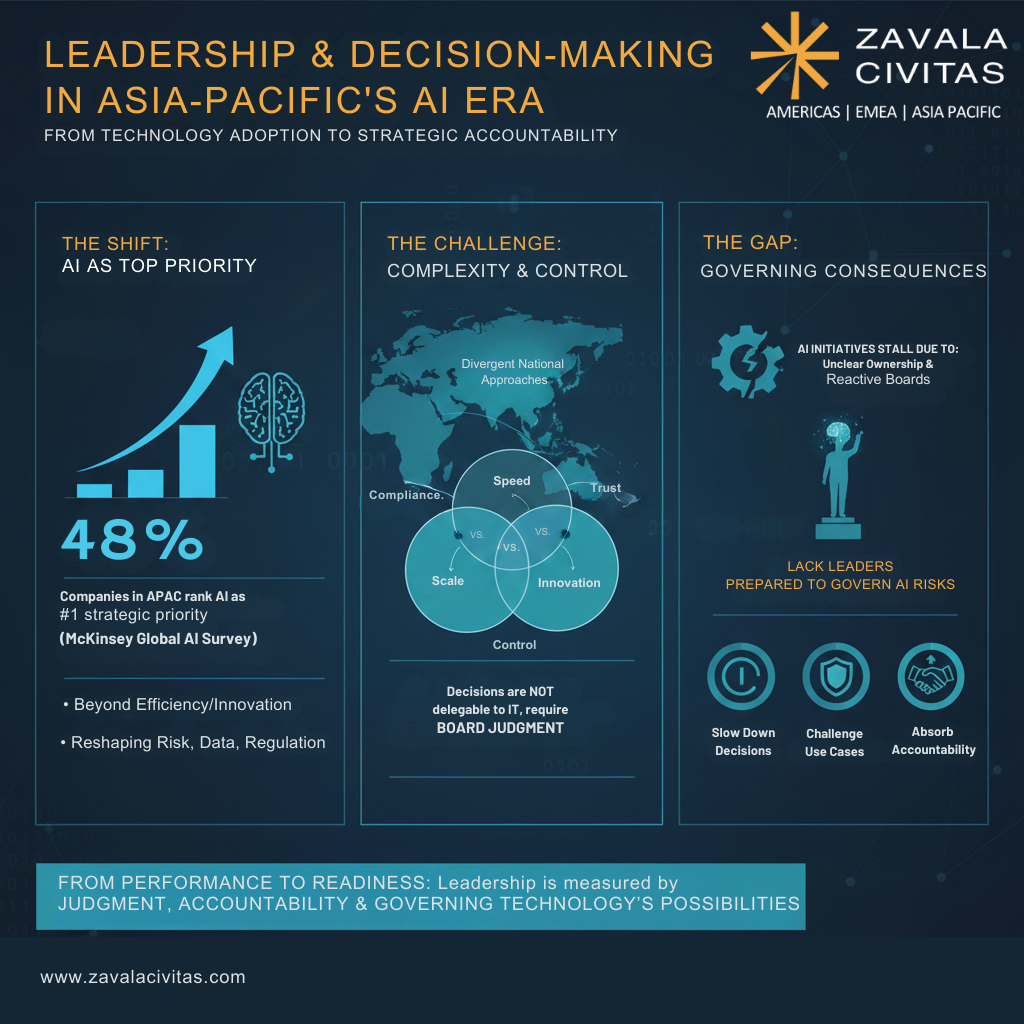
This shift is already measurable. Nearly 48% of companies in Asia now rank AI as their top strategic priority for the next three years, placing it ahead of traditional growth initiatives and even cybersecurity concerns, according to McKinsey’s Global AI Survey – Asia-Pacific Insights. This is not a signal of technological enthusiasm. It is a signal of consequence.
In APAC, AI is no longer pursued primarily for efficiency or innovation. It is prioritized because it reshapes risk exposure, data sovereignty, regulatory compliance, and corporate reputation. As a result, AI strategy has ceased to be a functional discussion and has become a matter of leadership judgment and fiduciary responsibility.
When AI becomes a leadership decision
Asia-Pacific presents a uniquely complex environment for AI-led decision-making. Divergent national approaches to data localization, rising geopolitical tensions and uneven regulatory maturity across markets are forcing organizations to rethink how and where AI operates.
Hybrid and sovereign cloud models are becoming increasingly common. Yet the real challenge leaders face is not architectural. It is decisional.
Every meaningful AI choice involves trade-offs: speed versus control, scale versus compliance, innovation versus trust. These are no longer trade-offs that can be delegated to technology teams. They require executives and increasingly boards capable of governing long-term consequences rather than optimizing short-term performance.
Many boards only discover weaknesses in AI governance after a regulatory issue, a reputational incident or public backlash. At that point, leadership readiness is no longer a strategic discussion. It becomes damaged by control.
Why AI transformations stall
Despite growing investment, many AI initiatives across APAC struggle to deliver sustained value. The reason is rarely the technology itself.
What consistently undermines progress is unclear ownership. AI strategies are sponsored but not governed. Risks are acknowledged but not explicitly owned. Boards are informed yet remain largely reactive rather than directive.
Even where CEOs personally assume responsibility for AI agendas, formal decision-making frameworks often lag behind the pace of adoption. Without clear accountability, organizations move fast but expose themselves faster.
The real leadership gap
The core challenge facing APAC organizations is not a lack of digital capability. It is a lack of leaders prepared to govern AI consequences.
Decisiveness is often mistaken for readiness. In reality, effective AI leadership requires the ability to slow decisions down when downstream risk is irreversible, to challenge attractive use cases that compromise sovereignty or trust, and to absorb accountability when automated systems fail.
These capabilities are difficult to identify through performance metrics alone. Many high-performing executives have never been tested in decisions where legal, ethical and geopolitical risks converge yet these are precisely the decisions AI now brings to the surface.
From performance to readiness
As AI becomes embedded in core business and governance decisions, boards must confront a harder question.
Past success does not guarantee future readiness. Delivering results in stable environments does not predict how leaders will behave when AI-related decisions carry regulatory, reputational and societal consequences that cannot be unwound.
If a critical AI decision had to be made tomorrow one with long-term implications for the organization does the board know who is truly ready to lead it?
In Asia-Pacific’s age of AI, leadership is no longer measured by adoption speed or technological ambition, but by judgment, accountability and the ability to govern what technology makes possible.