
Last updated: August 13, 2026
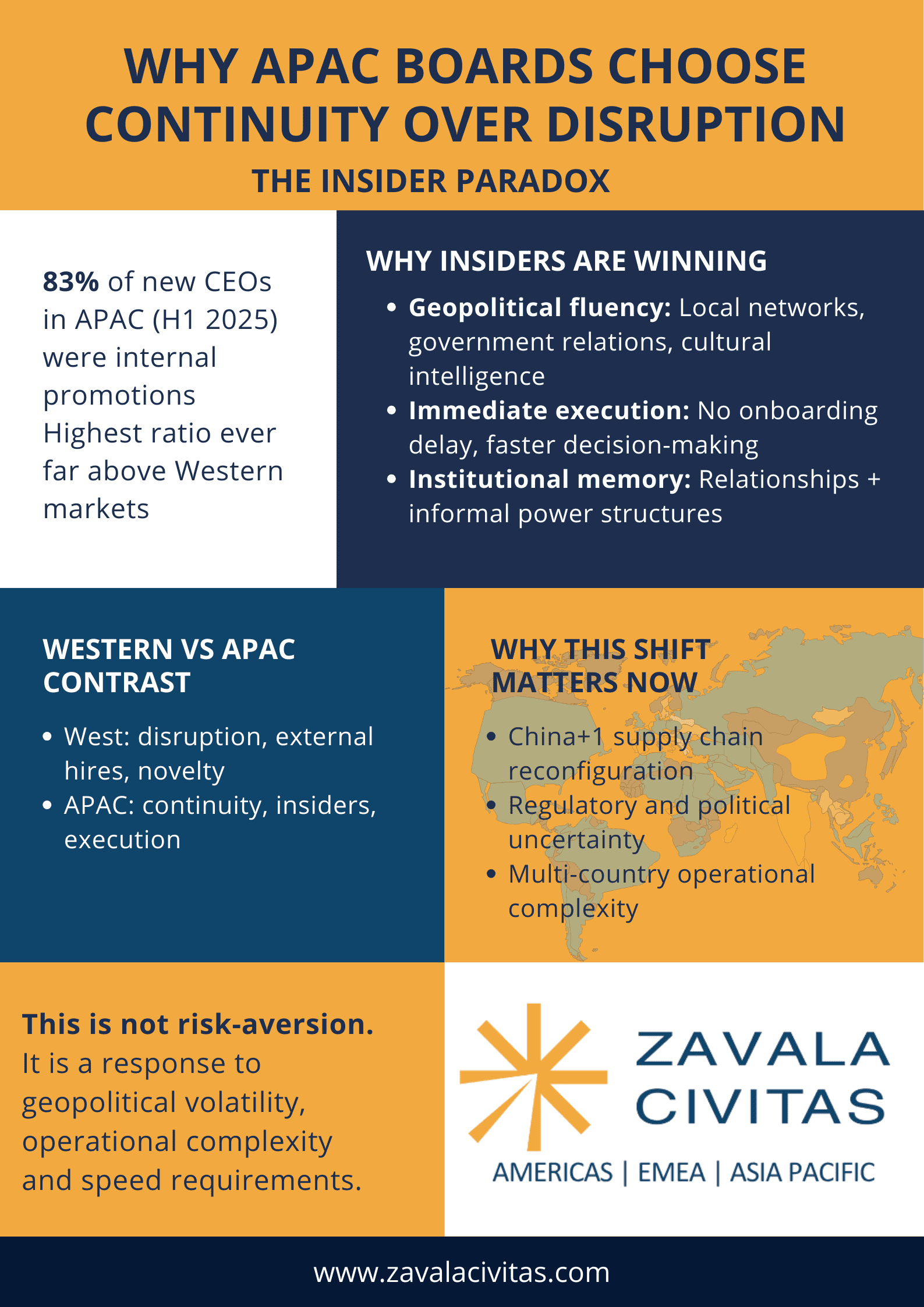
In H1 2025, 83% of all new CEOs in APAC were internal promotions — the highest ratio ever recorded and dramatically higher than Western markets. This surge is not accidental, nor is it a sign of risk-aversion. It reflects a deeper leadership strategy shaped by the geopolitical uncertainty of the region, operational complexity, and the rising value of institutional memory. APAC organisations are discovering that in an unpredictable environment, succession can secure continuity.
Key Figures at a Glance
| Data point | Figure | Source |
|---|---|---|
| APAC new CEO appointments from internal promotions (H1 2025) | 82.5% — highest on record | Russell Reynolds Associates, H1 2025 |
| APAC new CEOs who were first-time leaders (full year 2025) | ~94% | Russell Reynolds Associates, 2026 |
| CFO as pathway to CEO in APAC internal successions | ~26% of cases | Russell Reynolds Associates, H1 2025 |
| APAC internal promotions vs global average (full year 2025) | 73% APAC vs 68% global | Russell Reynolds Associates, 2026 |
The Data Behind the Insider Shift
For years, global leadership narratives have celebrated the transformative power of external hires. Yet APAC companies are increasingly finding that “outsider disruption” does not always translate well in markets defined by cultural nuance, regulatory sensitivity, and multi-layered stakeholder ecosystems. The data is clear: Most APAC Boards now believe insiders deliver better outcomes than external CEOs. Compared to Western markets where external CEO appointments remain far more common, APAC’s pivot signals that Boards value execution, integration speed, and contextual intelligence over novelty. In short, insiders know how to lead without destabilising.
— Maria Angeles Bosch, Managing Director APAC, Zavala Civitas
Why the Insider Profile Is Winning in APAC
- Geopolitical Volatility Requires Predictability. With China+1 strategies reshaping supply chains, governments increasing scrutiny, and regulatory environments shifting rapidly, APAC Boards are prioritising leaders who already understand the geopolitical terrain. Insiders bring familiarity with local networks, government relations and cultural dynamics that would take an external CEO years to build — time organisations cannot afford.
- Operational Resilience Beats Theoretical Transformation. In industries such as manufacturing, logistics, consumer goods, and energy, execution speed determines competitive advantage. External hires often require a significant onboarding period before they become effective. Insiders, however, can act immediately — informed by relationships, organisational rhythm and a clear understanding of operational realities. Transformation in 2025 is no longer about radical disruption. It is about precision, stability and momentum — areas where insiders outperform.
- Institutional Memory Has Become a Strategic Asset. APAC organisations are relationship-heavy and deeply interconnected. Much of the real organisational power sits in informal networks, long-term client relationships and cultural continuity. Institutional memory — once dismissed as “legacy” — is now a strategic advantage. Boards increasingly see insiders as the leaders who can move the business forward without compromising stability.
Implications for External Candidates
External talent is not irrelevant — but the standards have evolved. To compete with insider readiness, external candidates must demonstrate:
- Cross-market fluency across key APAC regions
- Evidence of resilience in volatile environments
- Ability to integrate fast into relationship-led cultures
- Sensitivity to stakeholder ecosystems unfamiliar to Western-based leaders
Boards no longer reward disruption for its own sake. They reward leaders who can strengthen continuity while expanding capability.
Guidance for Boards and Succession Committees
This shift highlights a new reality: If insiders are the preferred successors, organisations must become far more proactive in preparing them. A modern APAC succession strategy requires a dual pipeline:
- High-potential internal leaders with structured development plans
- External candidates used for benchmarking and market calibration
Boards should prioritise:
- Identifying potential successors 3–5 years before transition
- Using assessments to map strengths, gaps and derailers early
- Providing P&L exposure, multi-country assignments and crisis-management experience
- Treating external candidates as pressure testers, not default alternatives
The greatest succession risk today is not failing to attract outsiders — it is failing to prepare insiders.
What This Means for APAC Executives
For ambitious leaders, the message is clear: The strongest path to CEO in APAC is internal progression. To rise as credible insider successors, executives must demonstrate:
- Strategic range that goes beyond operations
- Cross-market experience (SEA + China + India exposure)
- Ability to navigate complexity without destabilising the organisation
The leaders who balance contextual depth with strategic clarity will define the next generation of APAC CEOs.
Closing Insight
APAC is entering a pro-insider leadership era. Boards are not rejecting transformation — they are ensuring it happens without unnecessary disruption. In a world where uncertainty is constant, the most valuable leaders are those who provide continuity, clarity and operational intelligence. The next CEO of many APAC organisations is already inside the company today. The real question is whether Boards are preparing them deliberately and early enough to take the helm.
Frequently Asked Questions: APAC Succession Planning and Insider CEO Appointments
Is your board preparing its next CEO deliberately and early enough?
Zavala Civitas advises APAC boards on succession strategy, leadership assessment, and executive search.

Maria Bosch
Strategic HR Executive with 20+ years of global experience across APAC and EMEA, advising Boards and C-suite leaders on talent and succession. Former BCG, McKinsey and Oliver Wyman, with deep expertise in workforce transformation and APAC industrial relations.