
Last updated: August 13, 2026
The retirement of a single senior partner can cost a law firm millions in lost revenue. A global study by Thomson Reuters showed that more than 60% of corporate clients would consider following their trusted lawyer if that lawyer moved to another firm. Yet despite this risk, few firms worldwide have clear succession planning protocols in place.
Succession is one of the most sensitive and overlooked issues in the legal sector. The future of entire practices often depends on the decisions of one individual. For CEOs and Boards, retirement and succession is a governance priority — not an administrative transition.
Key Figures at a Glance
| Data point | Finding | Source |
|---|---|---|
| Corporate clients who would follow a trusted lawyer to another firm | 60%+ | Thomson Reuters Institute |
| Clifford Chance mandatory partner retirement age | 63 years — forcing structured handovers years in advance | Clifford Chance partnership policy |
| Primary consequence of unmanaged partner succession | Client attrition + internal disputes + associate departures | Zavala Civitas / Thomson Reuters analysis |
| What succession planning protects in law firms | Client loyalty, institutional knowledge, leadership continuity, and revenue | Zavala Civitas Legal Practice Advisory |
The Magnitude of the Challenge
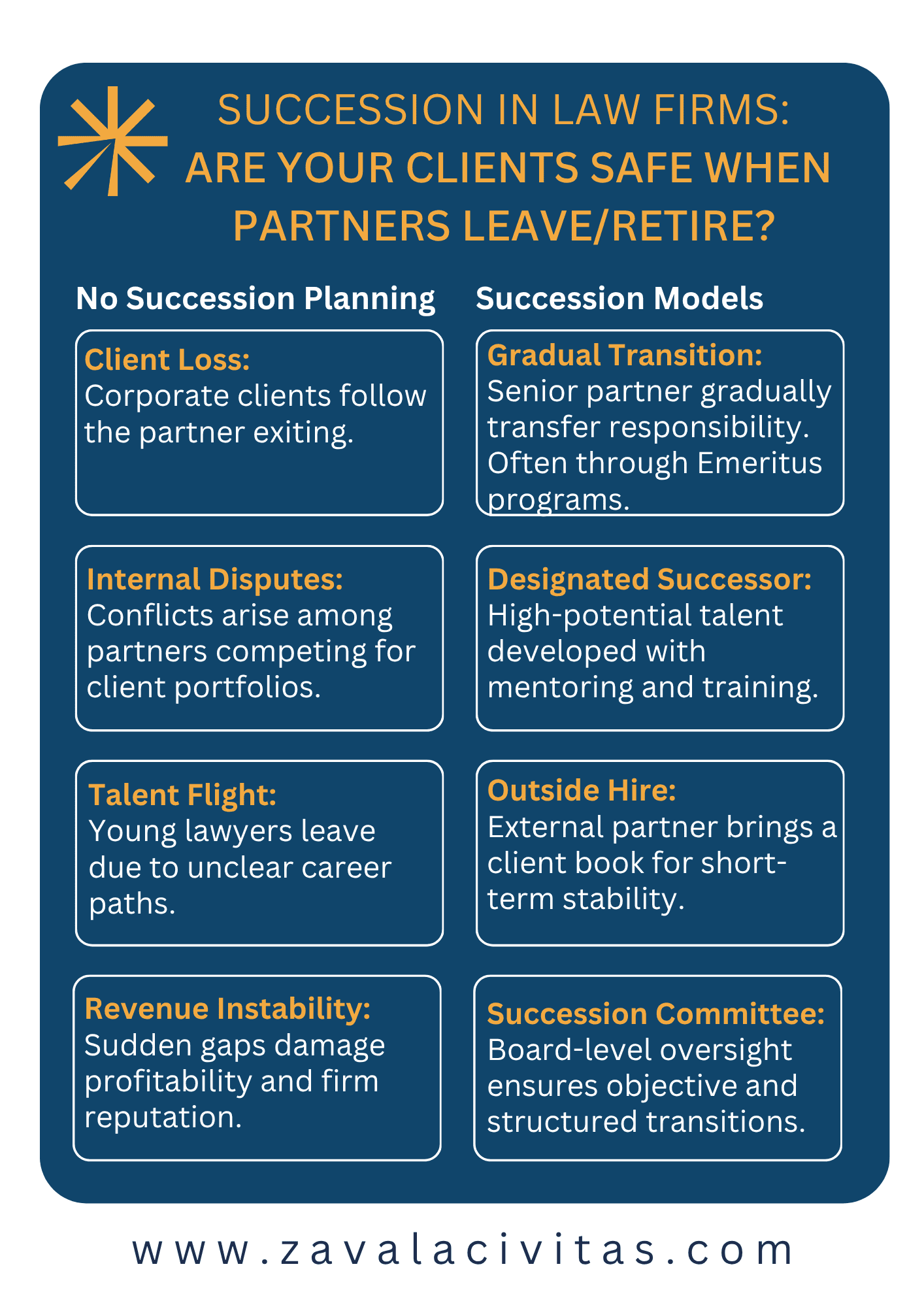
Across Europe, Latin America, and Asia, many law firms face the same reality: senior partners are approaching retirement age, but no institutional protocols exist to manage this transition. Business models remain highly personalistic, built on reputations and individual client relationships. When a partner retires or exits, the consequences can be severe:
- Clients frequently follow the departing partner to another firm.
- Internal disputes may arise between candidates competing for the same portfolio clients.
- Some firms attempt to solve the issue by hiring a new partner who may not fit the organisational culture — and send a message that internal candidates aspiring to the partner role were not good enough.
- Younger lawyers leave when they see no clear career path.
Without structured succession planning, what should be a predictable process becomes a structural weakness. Law firms that cultivate an institutional culture — where clients are treated as assets of the firm, not of individuals — are far better positioned to secure continuity.
Models of Succession Planning in Law Firms
- Gradual transition: Senior partners progressively introduce successors to clients, share responsibility, and eventually transfer commercial leadership before stepping into an advisory role.
- Designated successor: High-potential associates are identified early and developed over years. This requires more than technical expertise; it demands early succession planning to prepare future partners in business development, leadership, and client management.
- Outside hire: When internal pipelines are weak, firms bring in external partners with a client book. This can provide short-term stability but does not resolve the underlying issue of succession planning.
- Succession committees: Common in Anglo-American firms, these structures ensure objectivity and collective oversight in transitions.
- Partner emeritus: Senior partners who have formally retired from equity or employment but continue contributing through mentorship, strategic counsel, or select client engagements. This model preserves institutional memory while creating space for new leadership.
International Lessons
In Magic Circle firms, succession planning is institutionalised. Many firms enforce mandatory retirement ages, usually between 60 and 65. For example, Clifford Chance requires partners to step down at 63, forcing structured handovers years in advance. Large US firms often rely on succession committees to supervise these transitions, while also implementing mentoring programmes to prepare younger partners to inherit client relationships.
Clients in these markets expect continuity, not disruption. They see the law firm as the institution delivering service, not just the individual lawyer. This cultural and structural difference is why leading Anglo-American firms have avoided some of the shocks that other regions still face.
Talent as the Key Driver
Succession planning is about preparing leaders who can manage clients and develop business. It is designed to protect the firm, manage risk, and ensure long-term success and revenue. This requires systematic identification of talent, objective assessment of leadership potential, and targeted development programmes:
- Assessment centres help identify strengths and gaps.
- Structured mentoring accelerates learning and builds trust with clients.
- Business development training ensures successors can generate revenue, not only manage cases.
Retention is also critical: losing the very associates who could be future successors undermines any plan. For boards, this means investing not only in today’s leaders but in tomorrow’s.
Conclusion and Strategic Implications
The message for CEOs and Boards is clear: succession planning cannot be left to chance. It must be managed as a strategic priority, integrated into governance, and supported by objective processes that protect both client loyalty and leadership continuity in the legal industry.
At Zavala Civitas, we help firms design succession planning strategies that are objective, culturally adapted, and focused on securing both client loyalty and the next generation of leaders. Retirement is inevitable — whether it strengthens or weakens the firm depends on how the transition is managed. Click here to contact us.
Frequently Asked Questions: Succession Planning in Law Firms
Is your firm’s succession strategy protecting its most valuable client relationships?
Zavala Civitas supports law firms with governance design, leadership assessment, and succession strategy through our Legal practice advisory.
CEO & Board Advisory →
Legal & Professional Services →
Contact Us →