Key Takeaway: 51% of companies have no identified CEO successor (Stanford GSB). 70% of global executives acknowledge they are unprepared for abrupt leadership changes (Deloitte). Replacing a high-performing C-level executive can cost up to €400,000. Succession planning is not a contingency exercise — it is a proactive investment in leadership continuity that pays its highest return when it begins before the transition is visible.
Last updated: August 13, 2026
On the last webinar we presented, which I had the pleasure of co-presenting with Javier Alonso Solá, we explored the essential principles of effective succession planning. We explored the common challenges organisations face as well as the reasons it must be integrated into any long-term strategic agenda aiming to ensure leadership continuity and resilience.
Key Figures at a Glance
| Data point |
Finding |
Source |
| Companies with no identified CEO successor |
51% |
Stanford Graduate School of Business |
| Global executives who acknowledge being unprepared for abrupt leadership changes |
70% |
Deloitte |
| Higher 2-year retention rate for internally promoted leaders vs. external hires |
+25% |
Gartner |
| Full cost of replacing a high-performing C-level executive |
Up to €400,000 (recruitment + integration + disruption + mis-hire risk) |
Industry research / Zavala Civitas analysis |
Key Facts on Succession Planning
- 51% of companies have no identified CEO successor (Stanford GSB).
- 70% of global executives acknowledge they are unprepared for abrupt leadership changes (Deloitte).
- Internally promoted leaders demonstrate a 25% higher retention rate over two years (Gartner).
- Nevertheless, only 22% of organisations have a formal succession plan for the COO role — revealing a considerable disconnection between perceived importance and actual implementation.
The 22% figure for COO succession planning is the most instructive of these statistics — not because the COO role is more important than the CEO, but because it reveals the gap between stated intention and actual implementation. Most boards will readily agree that succession planning matters. Far fewer have done the work at C-1 and C-2 levels. The COO is frequently the organisation’s operational backbone and the most likely internal CEO successor. Organisations that have not formally assessed COO succession readiness have not done succession planning — they have done CEO succession theatre.
The Hidden Costs of Executive Departures
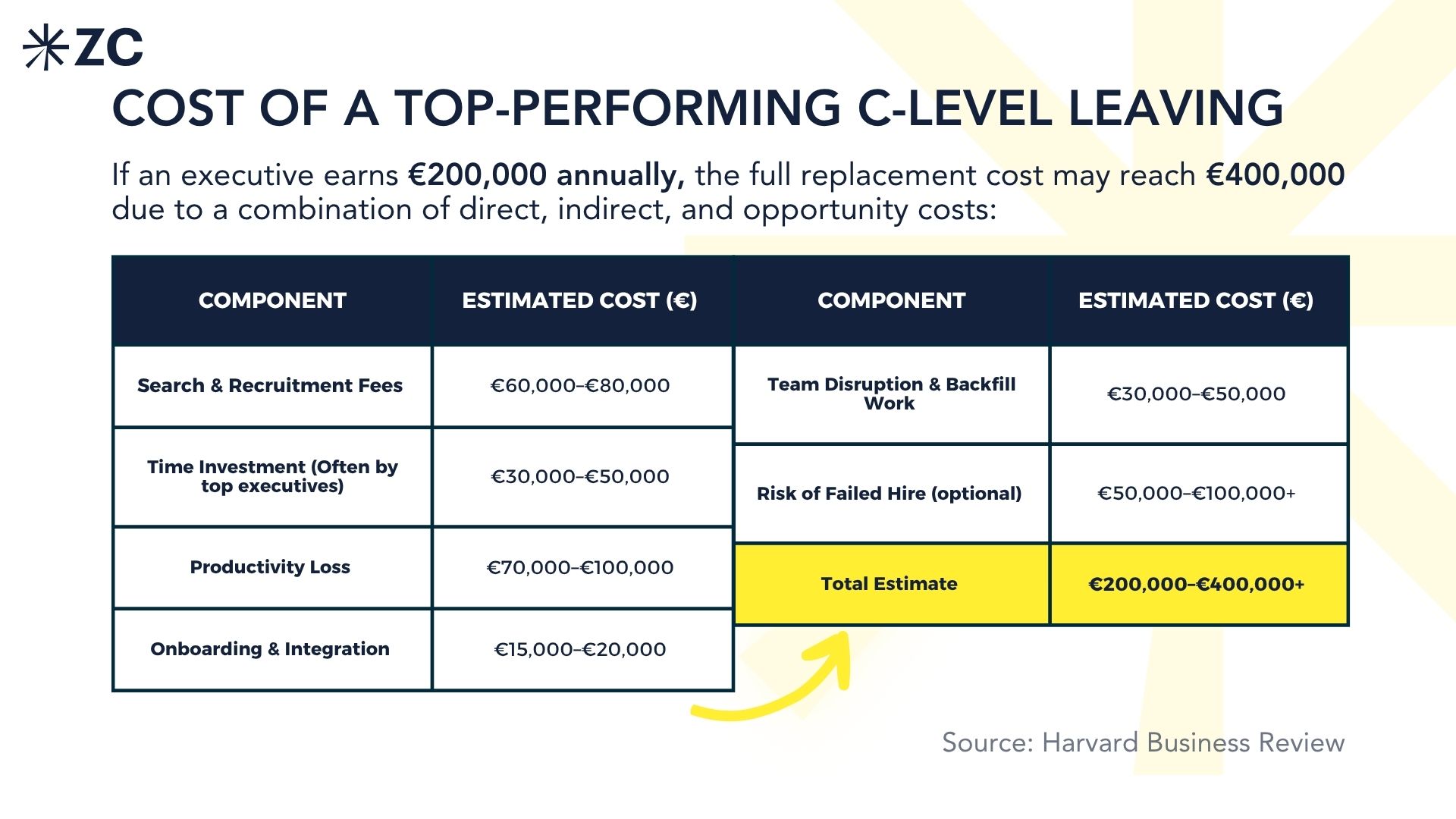
Replacing a high-performing C-level executive can entail costs of up to €400,000 when recruitment, integration, operational disruption, and mis-hire risks are taken into account. As we highlighted during the webinar, unexpected leadership transitions can have a significant impact on both business performance and the broader economic stability of the organisation.
Beyond the C-Suite: A Broader Perspective
Succession planning should not be confined to the top tier of leadership. As Javier Solá noted, “C-1 to C-3 positions form the operational core of any organisation.” Overlooking succession in these layers can lead to structural fragility and executional gaps that are often more disruptive than a CEO transition — precisely because they are less visible and less prepared for.
Frequent missteps in succession planning:
- Confusing ownership with leadership: Emotional ties may obscure rational talent decisions — particularly in family-owned businesses where the successor question is also a relationship question.
- Focusing on a sole successor: Overdependence on a single candidate increases strategic vulnerability. If that candidate leaves, declines, or proves unready, the organisation has no fallback.
- Limited board engagement: Effective succession planning requires active governance oversight — not annual agenda items but ongoing calibration.
Recommended Practices for Succession Planning
- Begin early: Succession must be embedded in performance metrics and reviewed periodically — not initiated when a transition is imminent.
- Define success profiles: Establish objective, role-specific benchmarks to assess candidate readiness for the next role, not the current one.
- Develop internal talent: Offer high-potential employees diverse, stretch assignments that build readiness for the complexity of leadership roles above them.
- Promote exposure: Encourage future leaders to engage with boards and senior leadership forums — building the relationships and visibility that legitimate their authority before the transition occurs.
Evaluating the Success of a Succession Plan
- Readiness assessments and leadership potential matrices (e.g. 9 Box Grid)
- Average time to fill senior roles (optimal range: 30–60 days)
- Long-term retention rates of promoted executives (% of promotions that stay within the first 3 years)
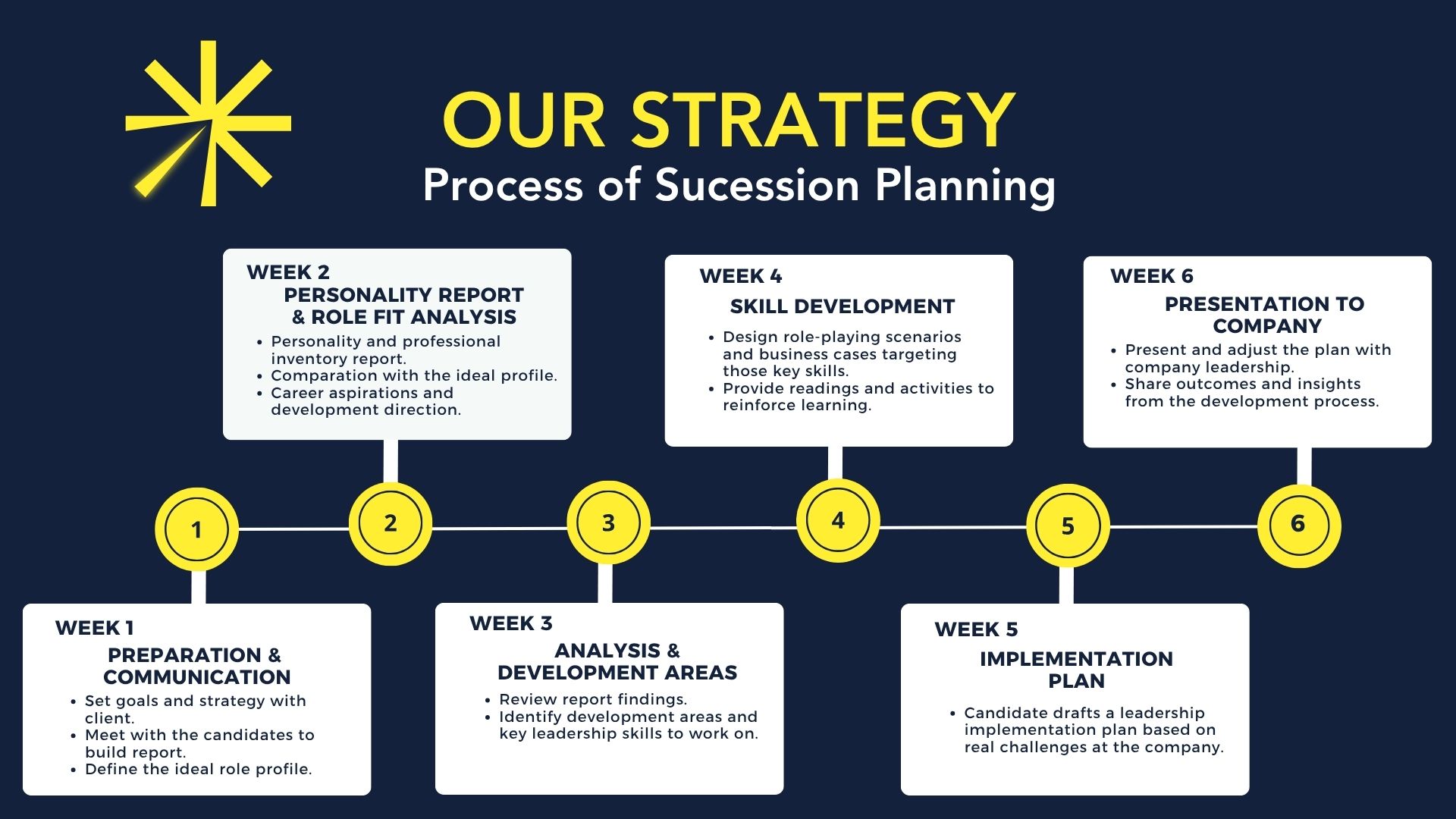
If your organisation is among the 49% of businesses without a CEO succession plan, Javier and I outlined a six-week methodology combining behavioural assessments, strategic business simulations, and implementation plans for the future. This structured process equips potential successors with both foresight and executional acumen.
Succession planning should not be viewed as a contingency exercise, but rather as a proactive investment in the continuity, resilience, and adaptability of leadership. As Javier aptly remarked, “Succession is not a risk to manage — it is a responsibility to lead.” Organisations that act early and deliberately will be best positioned to sustain performance across generations.
Click here to get in contact with us.
Frequently Asked Questions: Strategic Succession Planning
Why do 51% of companies have no identified CEO successor — and what does that signal about how boards treat succession?
It signals that succession is treated as a contingency rather than a strategic process. Boards that acknowledge succession’s importance but have not identified a successor have typically deferred the conversation because it requires discussing the current CEO’s departure — a conversation that feels premature when leadership is performing well and politically sensitive when it is not. The 51% figure persists because the consequence of not planning is invisible until the moment it becomes a crisis. At that point, it is too late to plan — and the cost begins immediately.
Why does internal succession produce 25% better retention outcomes than external hiring?
Because internal successors already have the cultural capital, the relationship network, and the institutional knowledge that external hires must build from scratch. The 18–24 months that an external CEO typically needs to match the performance of a well-prepared internal successor represents a genuine productivity gap — not a transition period. Internal successors who have been formally assessed and developed through a succession programme do not start from zero. They start from context — which is the most valuable asset any leader can have in the first 12 months of a new role.
Why is COO succession planning more neglected than CEO succession — and why does that matter?
Because CEO succession gets board attention by virtue of the role’s visibility, while COO succession happens below the board’s natural line of sight. With only 22% of organisations having a formal COO succession plan, most are one unexpected departure away from losing their primary operational leader with no structured successor and no development pipeline. In organisations where the COO is the natural internal CEO candidate, COO succession is also CEO succession — and the two plans should be designed together.
What is the 9 Box Grid and why is it the most widely used succession readiness tool?
The 9 Box Grid maps employees on two dimensions: current performance (vertical axis) and future potential (horizontal axis), creating a 3×3 matrix that helps organisations visualise where their leadership pipeline candidates currently sit. Its value is not the tool itself — it is the structured conversation it requires between HR leaders, business unit heads, and the board about specific individuals. That conversation surfaces disagreements about readiness, development needs, and succession timelines that would not emerge from informal discussions or annual review cycles.
How does Zavala Civitas approach succession planning for organisations that have not yet started?
Through a structured six-week programme combining stakeholder alignment on success profiles for key roles, behavioural assessment and readiness evaluation of internal candidates, strategic business simulations to test successor judgment under the specific conditions the role will face, development planning for candidates identified as high-potential but not yet ready, and board reporting to ensure governance accountability for the succession roadmap. The programme is designed to produce an actionable plan in six weeks — not a multi-year strategy document.