Last updated: August 17, 2026
The Current Business Landscape and Need for Board Advisory in Italy
Italy, the Eurozone’s third-largest economy, has continued to navigate a challenging recovery with GDP growth estimated at 0.5% for 2024. Business confidence is improving, while consumer sentiment remains cautious and the overall economic outlook is mixed.
What is the key structural obstacle for Italian companies? Low productivity — partly because of the entrenched affinity for nepotism in board and executive appointments, and relatively few leadership decisions made on the basis of merit. Studies estimate that poor selection practices are responsible for a 16% productivity loss at the whole-economy level, and even more acutely for small to medium businesses, where family firms are disproportionately responsible for limited value creation.
Uncertainty driven by the radical transformation in organisations, ongoing regulatory scrutiny regarding their ESG position, and persistent gender disparity in leadership teams is creating governance complexity that goes well beyond simple compliance for Italian companies.
Key Figures at a Glance
| Data point | Figure | Source |
|---|---|---|
| Italy GDP growth in 2024 | +0.5% | Italian Ministry of Economy / Eurostat |
| PE and M&A deal volume in Italy (full year 2024) | €56.4 billion (+83% YoY) | AIFI / PwC, 2025 |
| Minimum female representation required on Italian listed company boards | 40% | Consob / Italian Corporate Law |
| Productivity loss attributable to non-meritocratic hiring practices in Italy | -16% at whole-economy level | Bank of Italy / academic research |
Top Challenges for Board Advisory in Italy Today
Governance gaps. There are increased levels of shareholder engagement advancing firms to be accountable for proactive disclosures on board composition and executive pay, yet many Italian firms continue to lack the transparency and independence that institutional investors and PE partners require. Partisan politics exert pressure on leadership structures of state-owned enterprises, and gender parity continues to be a structural challenge — as illustrated by the ongoing debate around Cassa Depositi e Prestiti (CDP) and its obligation toward 40% female representation within the governing body.
Inertia. Many Italian family-owned firms continue to rely on their own advisory networks and do not seek external advisory talent — missing the critical urgency of transformations that may be necessary for their long-term competitiveness.
Digital and ESG skill gaps. Boards and senior leadership teams fail to identify individuals who are subject matter experts in digital strategy, AI, sustainability, and corporate innovation — governance roles that are increasingly non-optional in the modern operating environment.
Executive Search: A Key Driver of Board Advisory Success in Italy
Despite the challenges, there are significant opportunities for board advisory in Italy — especially with the guidance of specialised talent partners.
Board modernisation. Executive search can introduce talent with experience in technology, ESG, and corporate restructuring — areas where Italian boards are underrepresented and where the capability deficit is most visible to investors.
Gender diversity requirements. Italy has stringent gender board quotas for listed companies (40% minimum female). Executive search enables organisations to identify and appoint qualified female leaders, strengthening their reputation, ensuring compliance, and aligning with the regulatory framework.
Booming private equity. The PE and M&A market in Italy grew 83% in 2024 to €56.4 billion in deal value (AIFI/PwC). As private capital continues to flow into Italian organisations, the need for board members with experience in PE governance, fast-scaling industries, and value creation accountability is growing rapidly.
Meritocracy as competitive advantage. Executive search allows companies to locate the best independent leadership candidates beyond relationship networks — creating a pathway that uses data, performance indicators, and structured evaluation rather than legacy relationships.
By the Numbers: What Is Fuelling the Need for Board Advisory in Italy
- GDP growth for 2024: +0.5% — below expectations, underlining the urgency of governance-driven productivity improvement.
- PE and M&A deal value (full year 2024): €56.4 billion (+83% YoY) — creating acute demand for PE-literate board members.
- Gender quota on Italian listed company boards: 40% minimum female — a legal requirement, not a target.
- Effect of non-meritocratic hiring on productivity: -16% at whole-economy level.
What Executive Search Can Deliver for Board Advisory in Italy
- Talent mapping: Locating independent directors with expertise in technology, sustainability, and digital transformation — beyond the traditional Italian board advisory network.
- Diversity and inclusion: Enabling organisations to fulfil their legal obligations and enhance their decision-making by ensuring the board has genuinely diverse perspectives at the table.
- PE and M&A experience: Identifying board members who understand the governance requirements of fast-paced, investment-driven environments — where value creation timelines and accountability structures are fundamentally different from family-owned operations.
- Crisis-ready governance: Introducing talent with backgrounds in strategic planning and crisis management, enabling boards to navigate turbulence with the preparation that the current economic environment demands.
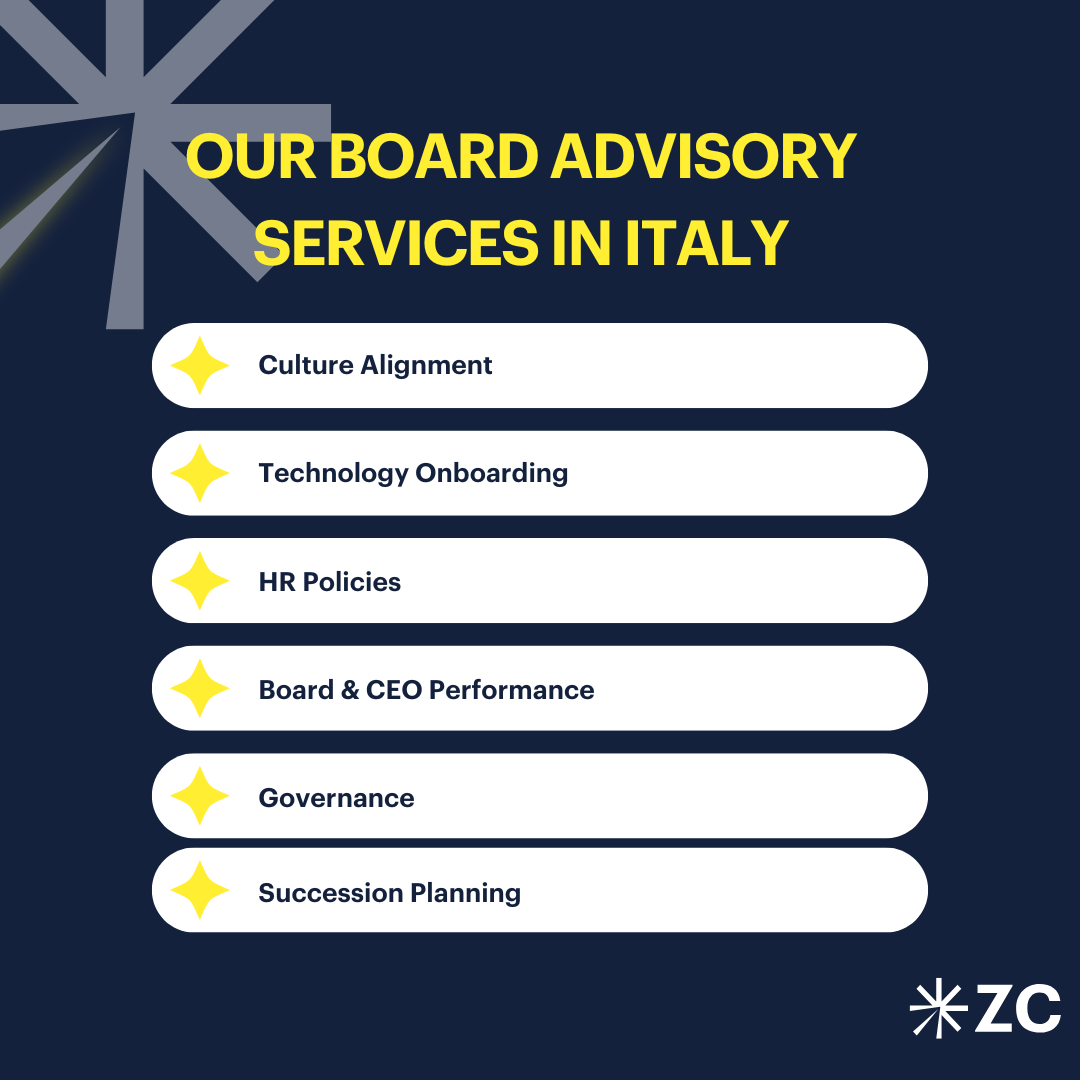
Italy’s economic complexity, dynamic regulatory situation, and urgent need to digitalise have created the conditions for modern, effective board advisory to deliver its highest value. The right executive search firm goes beyond adding names to a list — it builds future-ready, independent leadership structures that drive real impact.
Click here to get in contact with us.
Frequently Asked Questions: Board Advisory in Italy
Strengthening board governance in Italy?
Zavala Civitas supports Italian companies and PE-backed organisations with independent director search and board advisory. 92% closing rate.