Last updated: August 13, 2026
The role of Board Advisory in Spain is evolving. For many companies, it is no longer just about regulatory compliance — it is about building stronger, more effective boards. As corporate governance standards tighten and investors expect more transparency, Spanish firms are rethinking how their boards operate, with independent advisors taking on a more central role.
Key Figures at a Glance
| Data point | Figure | Source |
|---|---|---|
| Minimum independent director ratio required for Spanish listed companies | 40% | CNMV Good Governance Code |
| Female board representation requirement for Spanish listed companies (2026) | 40% minimum by 2026 | Spanish Corporate Law / CNMV |
| Share of Spanish companies that are family-owned | 92.4% — the primary context for board advisory demand | Instituto de la Empresa Familiar (IEF), 2025 |
| PE investment in Spain (2025) | €7,015 million (+11.5% YoY) — intensifying governance professionalisation demand | SpainCap, 2026 |
The Regulatory Framework Shaping Board Advisory in Spain
Spain’s Ley de Sociedades de Capital and the CNMV’s Good Governance Code have made one thing clear: board independence matters. Listed companies are now expected to ensure at least 40% of their directors are independent, aligning with EU standards.
This shift is driving demand for board advisory services in Spain, particularly from firms looking to review their current structure, identify independent directors with genuine sectoral expertise, and align governance practices with international investor expectations.
For many companies — especially those preparing for growth, seeking PE investment, or expanding internationally — strong governance is becoming non-negotiable. The board composition question is no longer “do we comply?” but “do we have the right people to navigate what comes next?”
From Compliance to Strategy: How Spanish Boards Are Evolving
For years, Spanish boards focused mainly on legal compliance. But that is changing. Today, more companies are turning to external advisors not just for oversight, but for strategic input — whether on succession planning, international expansion, or navigating digital transformation.
Board Advisory in Spain now goes beyond checking boxes. It is about adding business value, using governance as a tool to drive growth and manage risk — particularly for the 92.4% of Spanish businesses that are family-owned and managing generational transitions alongside business strategy simultaneously.
ESG and Gender Diversity: Two Simultaneous Governance Imperatives in Spain
ESG has found its place on the Spanish board agenda — but turning commitment into governance action is another matter. Many boards lack experience in sustainability reporting or navigating stakeholder expectations around environmental and social governance under the EU’s CSRD mandatory reporting framework.
Board Advisory helps organisations understand their ESG responsibilities, identify independent directors with sustainability expertise, and integrate ESG oversight into day-to-day governance — not just annual reports.
At the same time, gender diversity is now a regulatory requirement in Spain: listed companies must achieve 40% female board representation by 2026. This is accelerating change, but many firms still need guidance on how to make that shift effectively — identifying and appointing qualified female independent directors who meet the substantive governance standard, not just the numerical one.
Moving Beyond Traditional Networks: Board Advisory for Spanish Family Businesses
In Spain’s many family-owned businesses, board seats have historically gone to trusted contacts or long-standing advisors. But as these companies grow, professionalise, or come under PE governance, there is a growing recognition: external, independent perspectives matter — and personal network appointments are not producing them.
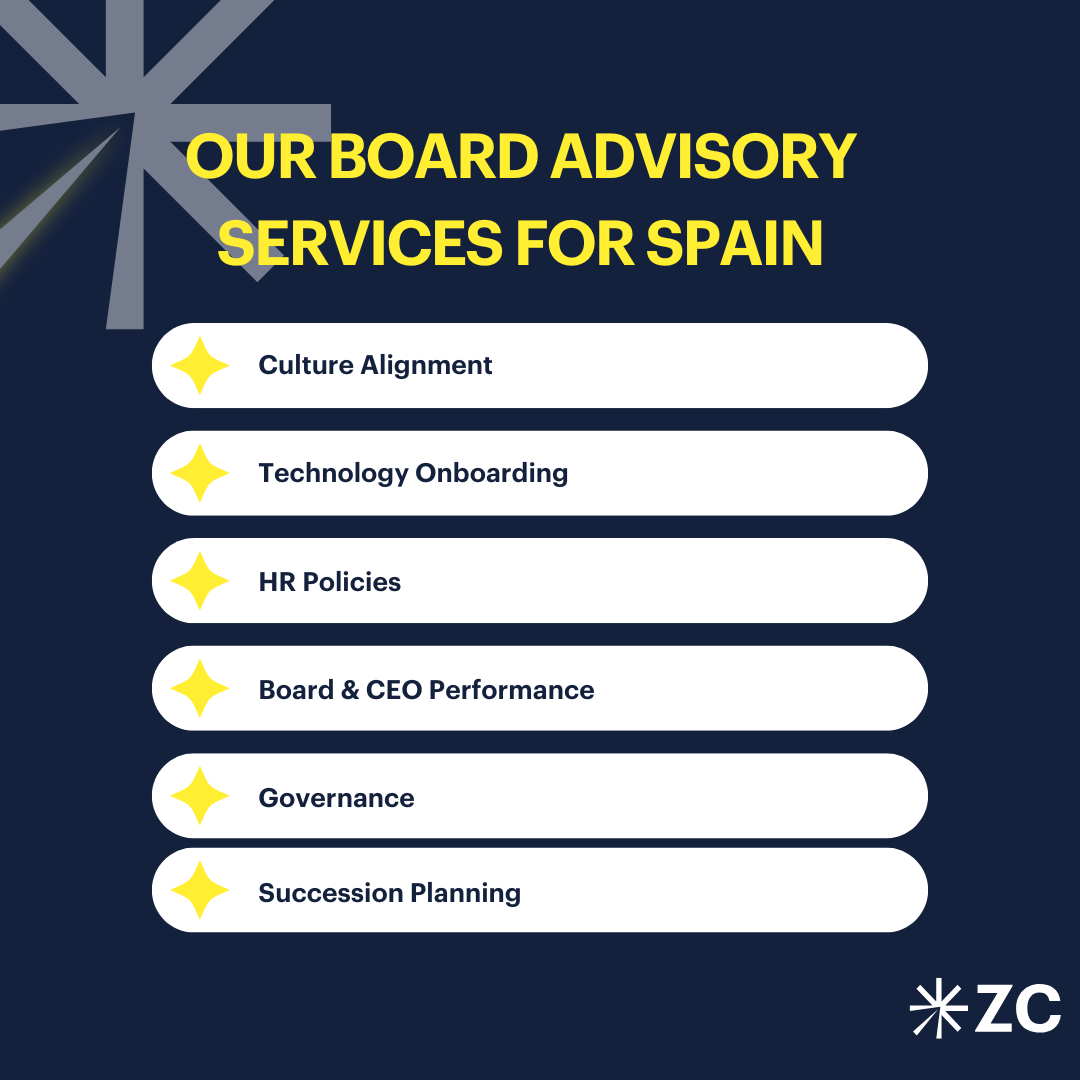
Board Advisory services are helping businesses introduce genuinely independent, non-executive directors, balance continuity with fresh strategic perspectives, and build boards capable of supporting long-term, sustainable growth beyond the founding generation.
Why Board Advisory Matters in Spain in 2025 and Beyond
Board advisory services are no longer just a formality — they are a critical part of a company’s governance strategy. For Spanish firms, strengthening board composition is not only about meeting regulatory targets. It is about building leadership structures that can navigate generational transitions, attract institutional capital, manage ESG obligations, and sustain long-term competitive advantage.
Working with experienced Board Advisory professionals in Spain is increasingly a strategic decision — not a regulatory obligation.
Frequently Asked Questions: Board Advisory in Spain — Independent Advisors
Strengthening your board in Spain?
Zavala Civitas has operated in Spain since 1971. Independent director search, governance advisory, succession planning. 92% closing rate.