Board Advisory in Mexico: Responsibilities and Challenges 

Key Takeaway: Only 18% of board members in Mexico are women (IMCO, 2023) and over 60% of Mexican corporate boards lack formal succession planning (PwC Mexico) — yet companies with board advisory show 23% higher ROI on executive decisions (Korn Ferry). Mexico’s nearshoring wave has brought $41 billion in FDI in the first nine months of 2025 alone. The governance infrastructure must match the capital.

Last updated: August 13, 2026

The past few years have not been easy for business in Mexico — political instability, economic fluctuations, and the broader disruption of the global operating environment have made it difficult for companies to remain relevant at national and international level.

As the country’s economy adapts to these complex circumstances, the demand for Board Advisory services has never been higher. Precise leadership at the helm of an organisation — and the governance structure that makes that leadership accountable — has become a strategic priority rather than a governance formality.

Key Figures at a Glance

Data point Finding Source
Women as share of board members in Mexico Only 18% IMCO, 2023
Mexican corporate boards lacking formal succession planning 60%+ PwC Mexico
ROI improvement on executive decisions with board advisory +23% Korn Ferry
Mexico FDI Jan–Sep 2025 (record) ~$41 billion USD (+15% YoY) — intensifying governance demands Secretaría de Economía / AIG, 2025

The Current State of Mexico’s Business Landscape

Mexico’s economy has been under pressure from both domestic and international factors — fluctuating oil prices, trade uncertainties, and the legacy of pandemic disruption. In 2023, Mexico’s GDP growth was 1.7%, down from previous forecasts, indicating a recovery path that required careful navigation at both the executive and governance levels. Political uncertainty under successive administrations has added complexity: businesses have navigated shifting regulations and unpredictable fiscal policies in a market where strategic decisions have consequences that span multiple regulatory cycles.

By 2025, however, Mexico’s FDI has accelerated significantly — driven by nearshoring, energy transition investment, and the USMCA opportunity. The governance challenge has evolved from managing uncertainty to managing the scale and complexity of rapid growth. That is a different board requirement — and one that the governance structures built for the previous decade are not always equipped to meet.

Mexico’s nearshoring wave — $41 billion in FDI in the first nine months of 2025 alone — is arriving at companies whose governance structures were built for a different scale of operation. When a Mexican manufacturer’s international client base grows from three customers to thirty in 24 months, the board oversight required for that level of customer concentration risk, currency exposure, and international regulatory complexity is fundamentally different from what a family-owned business advisory model was designed to provide. The capital is scaling. The governance is not keeping pace. Board advisory that closes that gap is not a luxury — it is the mechanism through which the FDI investment actually delivers the returns it was deployed to produce.

The Role of Board Advisory in Mexico

Considering these challenges, many Mexican businesses are seeking board advisory services to gain guidance on navigating economic turbulence and making strategic decisions. Board advisory encompasses governance advice, strategic direction, financial oversight, and risk management — delivered by board members who bring genuine independence and the specific expertise the organisation’s current mandate requires.

In today’s uncertain environment, boards need leaders who understand not only the local market but also have international experience and the ability to address global challenges — including the specific governance expectations of the international investors and multinational partners that Mexico’s FDI wave is bringing. Research indicates that organisations with well-equipped boards are more likely to experience long-term success — and the Korn Ferry data showing a 23% improvement in executive decision ROI from board advisory reflects this directly.

Challenges Facing Mexican Businesses and Board Advisors

  • Political and economic volatility: Political shifts and economic fluctuations pose ongoing risks. Executives need to adapt quickly to changes in trade agreements such as USMCA, the 2024 judicial reform that introduced elected judges, and local regulatory evolution — all of which require board members with genuine regulatory fluency, not just general strategic experience.
  • Talent shortage: Mexico is experiencing a shortage of qualified professionals in high-demand industries — particularly bilingual senior leadership in manufacturing and technology. Finding the right talent for board roles is crucial, especially in a competitive environment where international investors are now competing for the same profiles as domestic boards.
  • Digital transformation: Many companies in Mexico are struggling to keep pace with digitalisation. Board members who genuinely understand digital transformation — as practitioners who have built and governed technology organisations, not as general executives who have approved digital budgets — can guide companies through this shift and ensure they remain competitive.
  • Corporate governance: Despite progress, many companies in Mexico still face challenges related to governance and transparency. With only 18% of board seats held by women and over 60% of boards lacking formal succession planning, the governance gap is both measurable and addressable through structured board advisory.

How Executive Search Firms Help with Board Advisory in Mexico

  • Attracting the right talent: With the shortage of qualified professionals, executive search firms help organisations identify leaders with the right skill sets for advisory roles — including those with experience in governance, risk management, digital transformation, and PE governance standards that international investors increasingly require.
  • Global perspective: Executive search firms provide access to a pool of global talent, including internationally located Mexican executives who bring international governance experience combined with local market credibility — a combination that is particularly valuable for companies navigating the intersection of family business culture and institutional investor expectations.
  • Filling critical gaps: Whether a company needs a financial expert, a technology specialist, or a governance advisor with ESG credentials, executive search firms identify individuals who fit specific board needs — ensuring the appointment closes a capability gap rather than fills a seat.
  • Building strong governance: Executive search firms guide companies in building diverse boards with a range of experiences — improving corporate governance, strengthening business strategy, and positioning the company for the investment relationships that Mexico’s economic trajectory is making available.
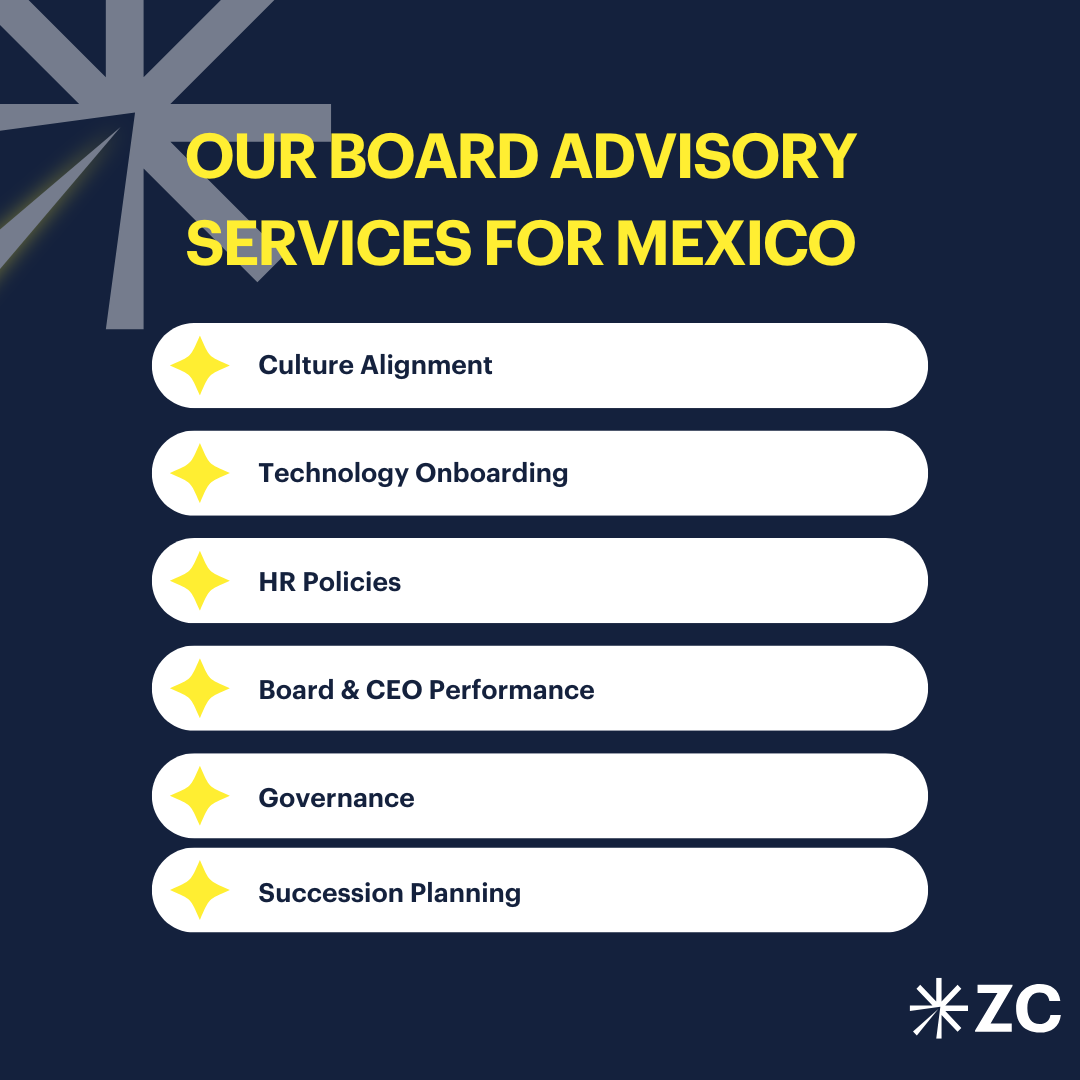
Board advisory steps for Mexican businesses — Zavala Civitas

The 60%+ of Mexican corporate boards that lack formal succession planning were not built for the operating environment of 2025. They were built for a time when the CEO transition was a family decision, not a governance event, and when the board’s primary function was to satisfy regulatory requirements rather than to challenge management assumptions. The PE investment flowing into Mexico — and the international institutional partnerships that Mexico’s nearshoring position is creating — require boards that are genuinely independent, strategically capable, and actively engaged in succession planning. Building that board through active executive search is the governance investment that converts Mexico’s economic opportunity into durable organisational capability.

As Mexican businesses face a range of challenges, board advisory services are becoming essential for long-term success. With the support of executive search firms, companies can navigate the complexities of Mexico’s economic and political landscape by securing top-tier leaders for their boards — turning challenges into opportunities for growth.

Click here to get in contact with us.

Frequently Asked Questions: Board Advisory in Mexico — Responsibilities and Challenges

Why does Mexico’s nearshoring boom specifically intensify board governance requirements?
Because the governance structures built for a domestic family business at a previous scale are not equipped to oversee the risk profile of a company managing $500M in international manufacturing contracts with US and European multinationals as clients. The board oversight required — for customer concentration risk, currency exposure, international regulatory compliance, and investor reporting — is fundamentally different from what traditional Mexican family board models were designed to provide. The capital is scaling; the governance must follow.
Why do 60%+ of Mexican corporate boards lack formal succession planning?
Because in the traditional Mexican family business governance model, succession was managed as a family decision rather than a governance process — requiring discussions about mortality, generational change, and the possibility that the best next leader might not be within the family. Those conversations need an external catalyst and a structured process that most family boards have not yet built. Board advisory that facilitates those conversations before urgency makes them necessary is the proactive investment that protects the business at its most vulnerable transition moment.
What does the 23% ROI improvement from board advisory actually reflect in the Mexican context?
It reflects the improvement in executive decision quality when the board introduces independent scrutiny into decisions that were previously made within a closed family or management circle. In Mexico’s concentrated ownership structures, the board and ownership often overlap — which reduces the likelihood that strategic assumptions will be genuinely challenged. An independent director with relevant sectoral expertise and no ownership interest produces the quality of deliberation that generates the 23% improvement. It is not oversight compliance. It is better decisions.
What specific profile does Mexico’s PE investment wave require from independent board directors?
Executives who combine PE governance experience — KPI discipline, value creation accountability, investor reporting, exit horizon decision-making — with genuine understanding of Mexico’s family business culture, regional market dynamics, and the specific regulatory evolution that the 2024 judicial reform and USMCA trade environment are producing. That profile bridges institutional accountability and local market credibility in a combination that is genuinely scarce and requires active search to access.
How does Zavala Civitas approach board advisory responsibilities and challenges in Mexico?
Through active independent director search calibrated to the company’s ownership structure and strategic mandate, succession planning that facilitates the family governance conversation before urgency makes it reactive, governance diagnostics identifying specific capability gaps against current investor and regulatory requirements, and board development for family businesses navigating their first institutional governance transition. With a 92% closing rate across completed executive search mandates.

Addressing board advisory responsibilities and challenges in Mexico?

Zavala Civitas provides board advisory and independent director search for Mexican businesses. 92% closing rate.

CEO & Board Advisory →
Executive Search →
Contact Us →

Why Spanish Boards Are Prioritizing Independent Advisors in 2025

Key Takeaway: Spain’s CNMV Good Governance Code requires listed companies to maintain at least 40% independent directors — and by 2026, 40% female board representation. With 92.4% of Spanish companies being family-owned and PE investment at €7,015 million in 2025, the demand for independent advisors who combine governance credibility with

Read More

Board Advisory in Portugal: Key Differences Compared to Spain

Key Takeaway: Spain mandates 40% independent directors for listed companies and has legally required gender board quotas. Portugal’s Código de Governo das Sociedades is a voluntary framework — governance is adopted by choice, not by enforcement. Both markets are evolving, but the mechanisms that drive board professionalisation are structurally different,

Read More

Related posts

Trabajo en remoto en los despachos de abogados

Autora: Beatriz Baker Araujo Senior Advisor, Zavala Civitas El debate sobre el trabajo presencial y remoto en los despachos de abogados lleva años activo, pero no ha madurado. Las posiciones se han endurecido desde 2020, y las conversaciones suelen discurrir entre dos polos: socios que invocan la cultura, el mentoring

Read More

Executive Search China: Industrial Sector

Key Takeaway: Beijing has launched a nationwide “anti-involution” (反内卷) campaign to address destructive price wars and overcapacity across multiple industrial sectors at once, not just renewables. Electrical machinery and equipment, communications equipment, and medical products all show 29% to 34% of firms losing money in 2024-25. Goldman Sachs estimates Chinese

Read More
Financial services building in Germany

Executive Search in Brazil for Financial Services

Key Takeaway: The White House targeted Brazil’s Pix payment system in April 2026, calling it a barrier to US payment companies. Brazil’s Central Bank fired back, defending Pix as a matter of payments sovereignty. At the same time, the collapse of Banco Master, the largest banking fraud in Brazilian history,

Read More
law leaders working

Executive Search in Mexico for Legal and Professional Services

Key Takeaway: Mexico’s 2024 judicial reform introduced popular election of judges and magistrates, with implementation beginning in 2025. This has accelerated a shift toward arbitration as the preferred dispute-resolution method in commercial contracts, as companies seek predictability an elected judiciary cannot yet guarantee. Combined with nearshoring-driven M&A activity and the

Read More

Executive Search in Italy for Industrial

Key Takeaway: Turin’s automotive cluster invested roughly €2.8 billion in electrification between 2024 and 2026. Over the same period, regional automotive employment fell by more than 3,200 positions. Fewer than 20% of local engineering graduates hold the specific battery, power electronics, and embedded software skills employers are actually hiring for.

Read More

Executive Search in Portugal for Financial Services

Key Takeaway: French banking group BPCE is investing €6.4 billion to acquire Novo Banco and building a 20,000 square metre campus in Lisbon, alongside a 2,500-strong tech hub already operating in Porto. This single deal is creating demand for highly specialised roles in risk analytics, structured finance, and digital-asset compliance

Read More