
The Chief Sustainability Officer (CSO) has evolved from a specialist sustainability role into a potential strategic leadership position connecting environmental and social priorities with business strategy, risk, operations, governance and increasingly corporate reporting.
However, creating the title alone does not make sustainability strategic. The impact of a CSO depends on the mandate, authority and organizational access attached to the role.
Recent academic research distinguishes between substantive Chief Sustainability Officer appointments, where the executive has meaningful organizational influence, and more symbolic appointments. The research found stronger environmental outcomes and lower greenwashing associated with substantive CSO roles.
When Should a Company Appoint a Chief Sustainability Officer?
Not every company requires a dedicated C-suite sustainability position. In some organizations, sustainability responsibilities can remain distributed across the CEO, CFO, legal, risk, operations, strategy or other functions.
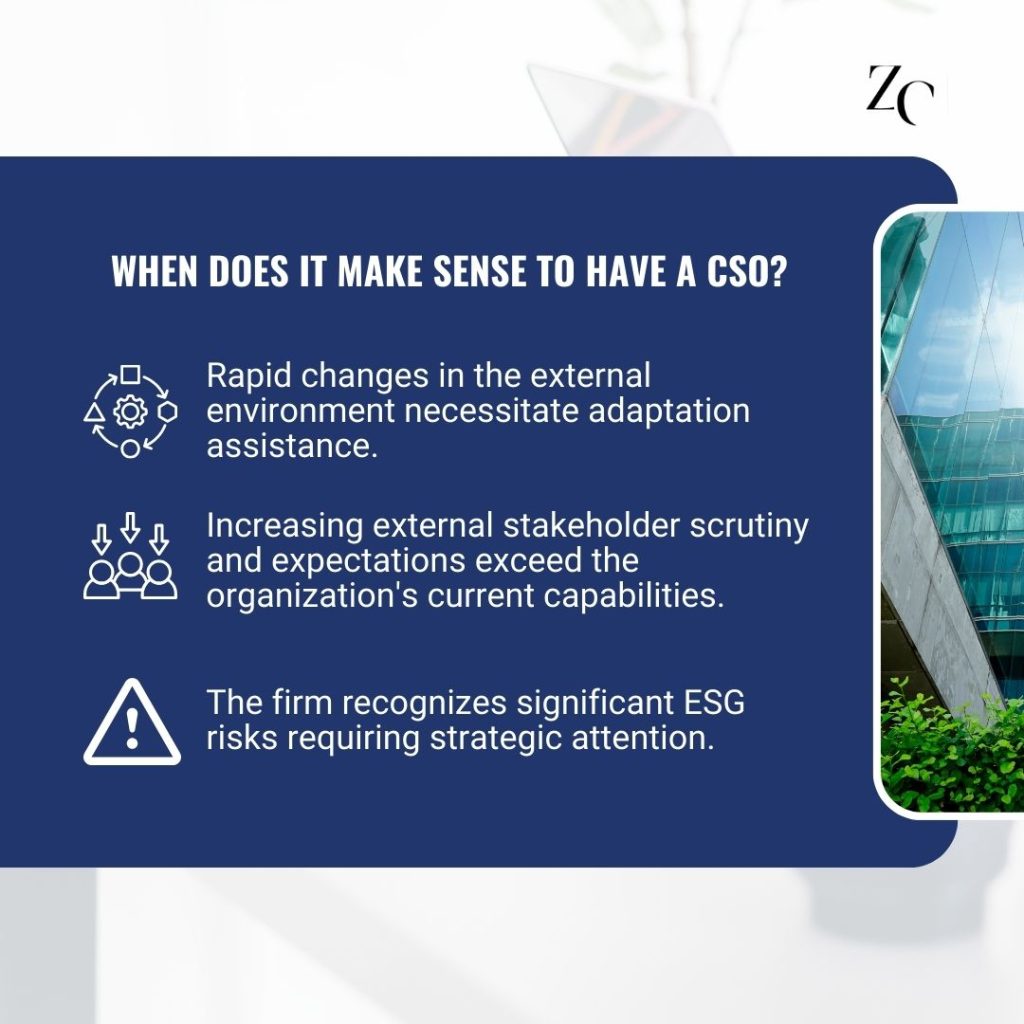
A dedicated CSO becomes more relevant when sustainability issues are sufficiently material and complex to require coordinated executive ownership.
Typical conditions include:
- Sustainability-related risks or opportunities materially affect business strategy.
- The organization operates across several jurisdictions with different reporting or regulatory requirements.
- Customers, investors, boards or other stakeholders require greater transparency and accountability.
- Sustainability initiatives affect several functions simultaneously, including finance, operations, procurement, product and supply chain.
- The organization has public sustainability or transition commitments requiring measurable implementation.
- Existing responsibility is fragmented across functions without clear executive accountability.
Core Responsibilities of a Chief Sustainability Officer
1. Translate External Change Into Business Implications
A CSO needs to understand how climate, resource constraints, regulation, investor expectations, technology and other sustainability-related developments may affect the organization.
The value of this analysis lies in translating external developments into decisions the business can use rather than simply monitoring sustainability trends.
2. Integrate Sustainability Into Corporate Strategy
A senior sustainability leader should help connect sustainability priorities with corporate strategy, capital investment, product decisions, operating models and risk management.
Research published in 2025 also describes the CSO as an organizational leader responsible for integrating sustainability policies into corporate goals and building actionable frameworks for implementation.
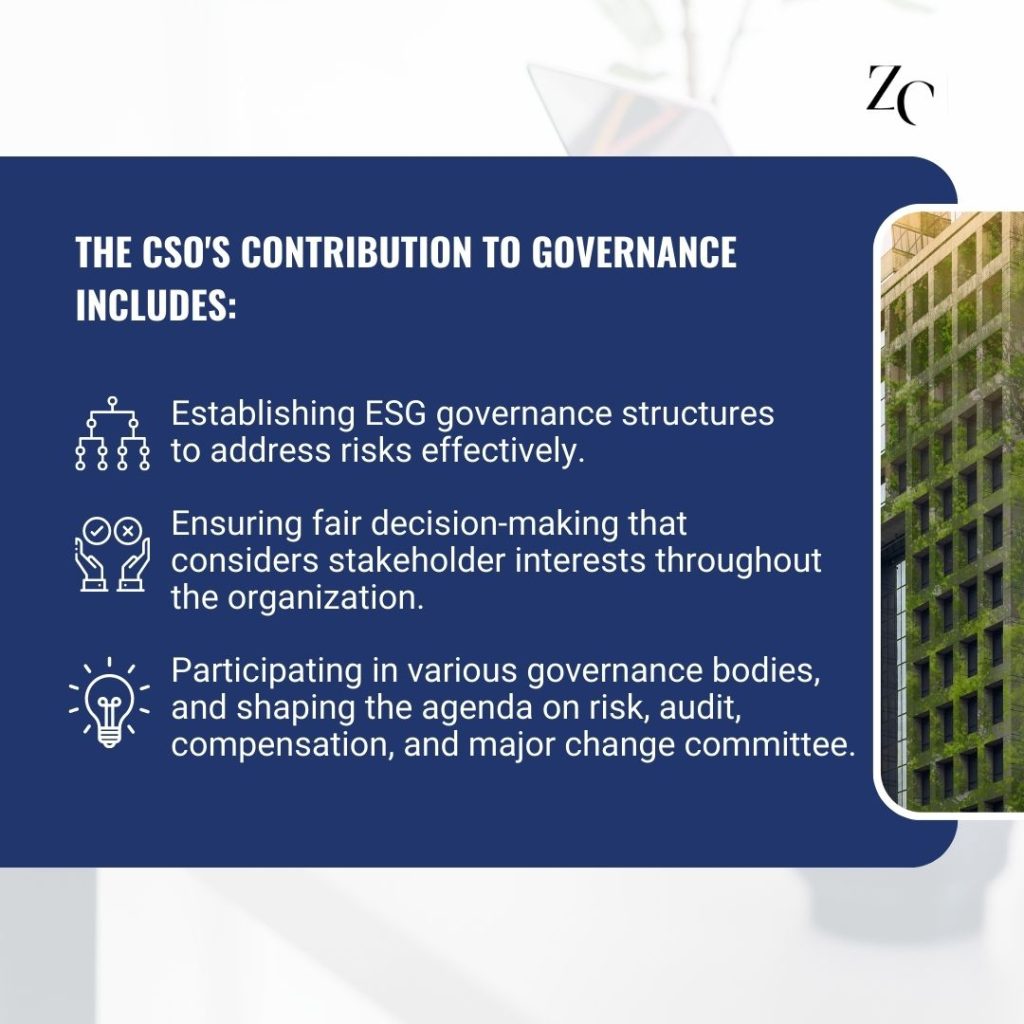
3. Establish Governance and Accountability
Sustainability objectives often span several business units and therefore require clear ownership, decision rights and escalation mechanisms.
The CSO may work with the board, executive committee, finance, legal, risk, operations, procurement and business-unit leaders to ensure that sustainability responsibilities do not remain isolated within a specialist team.
4. Connect Reporting With Decision-Making
Sustainability reporting is increasingly linked with strategy, risk and corporate data governance.
The World Economic Forum notes that Chief Sustainability Officers are increasingly expected to integrate financial and non-financial data and move sustainability reporting beyond a compliance exercise into broader business decision-making.
Source: World Economic Forum, How Sustainability Reporting Should Shape Corporate Strategy, 2025.
International reporting expectations are also evolving. The IFRS Foundation continues to track jurisdictions that have adopted, otherwise used or announced plans relating to the ISSB’s IFRS S1 and IFRS S2 sustainability disclosure standards.
Source: IFRS Foundation, Use of IFRS Sustainability Disclosure Standards by Jurisdiction.
5. Build Organizational Capability
The CSO rarely controls every activity required to deliver a sustainability strategy. The role therefore depends heavily on influencing other executives and functions.
A strong CSO helps other leaders understand what sustainability means for their own decisions rather than positioning sustainability as the responsibility of one specialist department.
Core Skills to Assess in CSO Executive Search
The World Economic Forum highlights four qualities associated with successful sustainability leadership: collaboration, credibility, commercial awareness and commitment.
Source: World Economic Forum, The 4 Cs of Being a Chief Sustainability Officer.
| Executive Search Dimension | Evidence to Assess |
|---|---|
| Strategic judgment | How the candidate has translated sustainability risks or opportunities into business priorities and decisions. |
| Commercial awareness | Evidence of connecting sustainability initiatives with investment, growth, cost, customer propositions or competitive advantage. |
| Cross-functional influence | Ability to align finance, operations, supply chain, legal, risk and other executives without relying only on formal authority. |
| Governance and reporting | Experience establishing accountability, metrics, controls and senior-level oversight. |
| Transformation leadership | Examples of moving from public commitments or strategy to measurable operational implementation. |
| Credibility | Ability to explain sustainability in language relevant to CEOs, boards, investors and business leaders. |
Reporting Lines and the CSO’s Relationship With the CEO
There is no single correct reporting line for a Chief Sustainability Officer.
Depending on the organization, the role may report to the CEO or sit alongside strategy, finance, corporate affairs, operations or another senior function.
What matters more than the organizational chart is whether the CSO has regular access to senior decision-makers and sufficient authority to influence the functions responsible for delivering sustainability objectives.
This distinction is important because recent research suggests that the effectiveness of the CSO role depends materially on whether the appointment is substantively empowered rather than primarily symbolic.
Source: Journal of Environmental Management, 2026.
Governance and Team Structure
Sustainability teams can be relatively small compared with the scale of the responsibilities they influence.
This makes organizational design important. Rather than building a separate structure responsible for every sustainability initiative, effective CSOs often need to create governance mechanisms through which business functions retain responsibility for implementation.
Depending on the company, the CSO may participate in or advise governance structures involving:
- Board or executive sustainability committees.
- Risk and audit discussions.
- Capital-investment decisions.
- Supply-chain and procurement governance.
- Product and innovation committees.
- Sustainability reporting and disclosure controls.
- Major transformation programmes.
The Future of the Chief Sustainability Officer
The future of the CSO should not be understood simply as a question of whether more companies will create the title.
As sustainability becomes integrated into strategy, finance, operations and risk management, some responsibilities may eventually move deeper into existing business functions. In other organizations, the complexity of the transition may increase the need for a dedicated CSO.
The important distinction is whether sustainability remains a specialist programme or becomes part of the way the organization makes decisions.
The World Economic Forum describes sustainability reporting as increasingly connected to core business strategy, board oversight, risk management, transition planning and integrated financial and non-financial information.
Source: World Economic Forum, 2025.
Executive Search for a Chief Sustainability Officer
Executive Search for a Chief Sustainability Officer should begin with the business mandate rather than a generic sustainability job description.
The candidate universe can differ significantly depending on whether the company needs expertise in industrial decarbonization, sustainable finance, supply chains, ESG governance, reporting, product transformation or broader corporate strategy.
Zavala Civitas supports organizations recruiting sustainability leadership through its specialised Sustainability Executive Search practice and wider Executive Search methodology.
The search process includes an in-depth client briefing, market mapping, direct contact with more than 100 executives per search, interviews conducted by at least two consultants, quantitative and qualitative evaluation, 360º professional reference checks and onboarding support.
For a CSO mandate, these stages can be used to distinguish candidates who have genuinely influenced business transformation from those whose experience has focused primarily on reporting, communication or advisory work.
Frequently Asked Questions About Chief Sustainability Officer Executive Search
What does a Chief Sustainability Officer do?
A Chief Sustainability Officer helps integrate sustainability-related risks, opportunities and objectives into corporate strategy. Responsibilities can include governance, reporting, stakeholder engagement, transition planning and coordination with finance, risk, operations and other business functions.
Does every company need a Chief Sustainability Officer?
No. A dedicated CSO is most relevant when sustainability issues are sufficiently material, complex and cross-functional to require senior executive ownership. In other organizations, responsibility can remain distributed across existing leadership functions.
What skills should companies look for when hiring a CSO?
Relevant capabilities include strategic judgment, commercial awareness, collaboration, stakeholder influence, governance, sustainability expertise and the ability to translate sustainability priorities into measurable business decisions and implementation.
Should a Chief Sustainability Officer report directly to the CEO?
Not necessarily. Reporting structures vary by organization. More important than the formal reporting line is whether the CSO has sufficient access to senior leadership and authority to influence the functions responsible for delivering the sustainability strategy.
How should Executive Search assess a Chief Sustainability Officer?
Executive Search should examine what sustainability transformations the candidate personally led, which business decisions they influenced, how they aligned other executives, how they established governance and whether sustainability objectives were translated into measurable organizational outcomes.
What is the future of the Chief Sustainability Officer role?
The role is likely to continue evolving as sustainability becomes increasingly integrated with strategy, risk, finance and operations. Some companies may strengthen a dedicated CSO position, while others may distribute mature sustainability responsibilities across existing executive functions.
Learn more about our Sustainability Executive Search practice, review our Executive Search methodology or contact us to discuss a sustainability leadership requirement.