
The Best Executive Search Approach for Successful CEO Hiring

Key Takeaway: Most new S&P 500 CEOs are still promoted from within the organisation. In 2020, 77% of new S&P 500 CEOs were internal promotions, with COOs accounting for 38%, division heads 36%, CFOs 9% and leapfrog candidates approximately 5%. However, leapfrog CEOs had the highest share of top-quartile performers at 41%. This means an effective executive search approach should assess not only current title and seniority, but also enterprise-wide capability, leadership potential, strategic judgement, stakeholder management and readiness to operate at CEO level.

Last updated: August 19, 2026

The best Executive Search approach to succed

The vast majority of new CEOs still come from within organizations: in 2020, 77% of new S&P 500 CEOs were internal Promotions. Identifying where CEO successors come from within the company allows us to be extra careful at our executive search for certain roles, because by doing it we might be hiring our future CEO.

Key Figures at a Glance

Data point Finding Source
Internal S&P 500 CEO promotions in 2020 77% Harvard Business Review / Spencer Stuart
New CEOs coming from COO roles 38% Harvard Business Review / Spencer Stuart
New CEOs coming from division head roles 36% Harvard Business Review / Spencer Stuart
Leapfrog CEOs reaching the top performance quartile 41% Harvard Business Review / Spencer Stuart

Where in the company CEOs are most likely to come from?

How do we guarantee we are choosing the best possible candidates?

How to find the best search executive firm to do it?

First: where do most CEOs come from?

According to studies, the most promising candidates in your company may not be precisely where you expect.
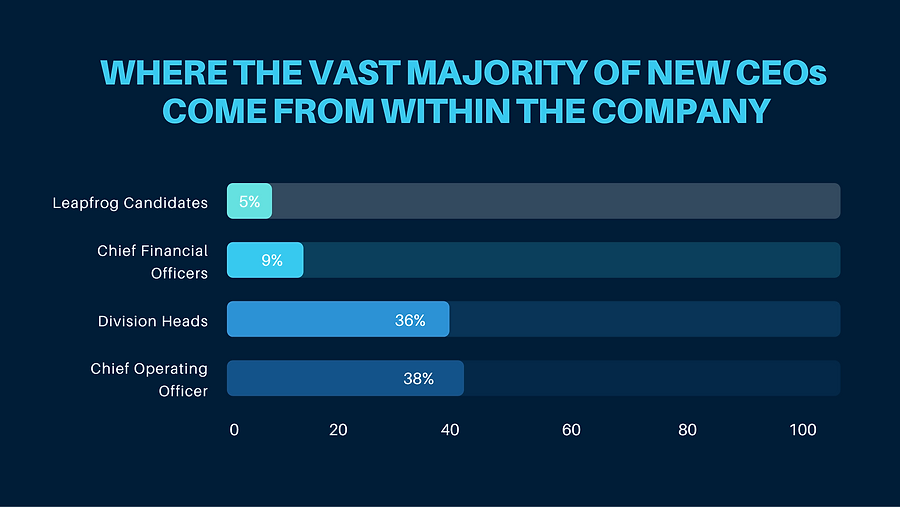
Chart showing why CEOs come from withing the company

Chief operating officers accounted for 38% of new CEOs in the S&P 500. Division heads were only two percentage points behind them, at 36%. Chief financial officers were next, at 9%. CFOs appeal to boards that want to ensure continuity, because they often serve as the right hand to the CEO.

Leapfrog candidates with the least significant representation in the study accounted for roughly 5% of new chief executives.

What is newsworthy is that the last common choice, the leapfrogs, had the highest share of CEOs in the top quartile of performance: 41%. Former division heads and COOs were next, at 27% and 25%, while the share of CFOs in the top quartile of performers was only 8%.

“Leapfrog CEOs” leaders appointed from one level below C-suited officers or division heads, with titles such as senior vice president and general manager, have the best odds to steering their firms into the top quartile performers.

The evidence suggests that CEO succession should not be reduced to a search for the most senior available executive. COOs and division heads remain major routes to the CEO role, but leapfrog candidates represented only around 5% of new CEOs in the study while accounting for the highest share of top-quartile performers at 41%. For boards and executive search firms, this makes potential, enterprise-level capability and evidence of future CEO readiness important dimensions of assessment alongside current position.

Now we know where our future CEO is most likely to come from: how do we succeed at hiring executive search?

In a world in which finding the right candidates is a major factor in success and it is getting harder and harder every time because companies currently face an unprecedented number of change challenges and opportunities. At the same time, more companies than ever are now drawing from the same executive talent pool, which in itself has evolved and has fundamentally changing needs. As we have seen, the priorities and consequently the profiles of today’s executives have changed, and it is key that businesses recognize and acknowledge these changes in order to attract and retain the best executive talent.

An effective executive search approach for CEO succession should therefore look beyond functional expertise. The strongest process combines a clear definition of the leadership mandate with structured assessment of strategic judgement, enterprise-wide responsibility, stakeholder management, cultural alignment and the candidate’s ability to translate experience into future CEO performance. Internal succession planning and external executive search should be treated as complementary options rather than mutually exclusive approaches.

Here is a generalist approach on how to perform an executive search:

  • Always understand what specific skills are critical for the role and use them to focus your recruitment process all the way
  • Keep an organized schedule for the process; set timelines and be prepared for unforeseen changes that may come up throughout the process.
  • Make sure the interviewing process is being kept focused and conducted naturally
  • Maintain open, clear, and respectful communication with candidates during the entire process.

One of the most important parts of this exercise is choosing your Executive Search Partner wisely, because an executive search firm can help you design a process that will effectively assess the candidates’ ability to embrace your mission and build upon the current success, ensuring they are ready from day one. 

Here is a helpful checklist your Executive Search team should have:

  1. Extensive expertise in your industry.
  2. Proven track record of representing companies with professionalism.
  3. Strong Executive Search strategy.
  4. A transparent talent search process.

If you want to find out more about our executive search services and how they can benefit your business, contact our Executive Search Firm Zavala Civitas, which is specialized in executive search in China. Click here.
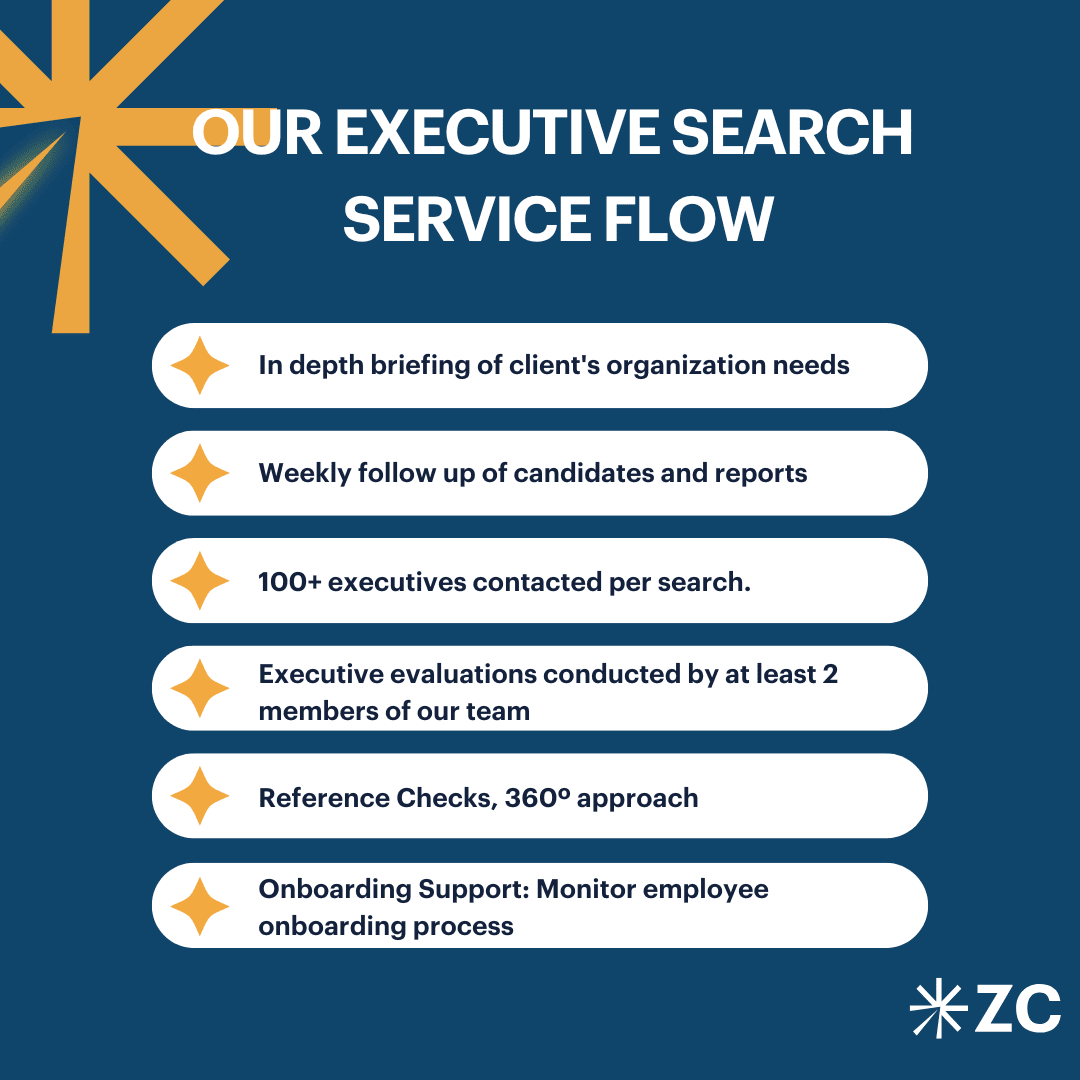
Zavala Civitas executive search methodology

Bibliography

Harvard Business Review. Jan-Feb 2022. Web.https://www.forbes.com/sites/edwardsegal/2022/01/13/outside-ceo-candidates-outperform-in-house-choices-new-study/

Frequently Asked Questions: Executive Search and CEO Hiring

Where do most new CEOs come from?
Most new S&P 500 CEOs are promoted internally. In 2020, 77% of new S&P 500 CEOs were internal promotions. The main pathways included COO, division head, CFO and leapfrog roles.
What executive roles most commonly lead to the CEO position?
In the 2020 S&P 500 data analysed by Spencer Stuart, COOs accounted for 38% of new CEOs, division heads for 36%, CFOs for 9% and leapfrog candidates for approximately 5%.
What is a leapfrog CEO?
A leapfrog CEO is a leader appointed from one level below C-suite officers or division heads. Examples can include senior vice presidents and general managers. Although this group represented a smaller share of CEO appointments, it had the highest share of CEOs in the top performance quartile in the study.
What should an executive search process assess when hiring a future CEO?
An effective CEO search should assess the specific requirements of the role as well as strategic judgement, leadership potential, enterprise-wide responsibility, stakeholder management, cultural alignment, communication and the candidate’s readiness to operate at CEO level.
How does Zavala Civitas approach executive search for CEO hiring?
Zavala Civitas combines executive search methodology with structured assessment of leadership capability, role-specific requirements and organisational fit. Its executive search approach is designed to identify leaders who can embrace the organisation’s mission, build on existing success and be ready to contribute from day one, with a 92% closing rate.

Looking for the right executive search approach for CEO hiring?

Zavala Civitas supports organisations in identifying and assessing senior leadership talent through a structured executive search approach. 92% closing rate.

Executive Search → Executive Search in China → Contact Us →

Executive Search China: Industrial Sector

Key Takeaway: Beijing has launched a nationwide “anti-involution” (反内卷) campaign to address destructive price wars and overcapacity across multiple industrial sectors at once, not just renewables. Electrical machinery and equipment, communications equipment, and medical products all show 29% to 34% of firms losing money in 2024-25. Goldman Sachs estimates Chinese

Read More

Executive Search in Italy for Industrial

Key Takeaway: Turin’s automotive cluster invested roughly €2.8 billion in electrification between 2024 and 2026. Over the same period, regional automotive employment fell by more than 3,200 positions. Fewer than 20% of local engineering graduates hold the specific battery, power electronics, and embedded software skills employers are actually hiring for.

Read More

Executive Search in Portugal for Financial Services

Key Takeaway: French banking group BPCE is investing €6.4 billion to acquire Novo Banco and building a 20,000 square metre campus in Lisbon, alongside a 2,500-strong tech hub already operating in Porto. This single deal is creating demand for highly specialised roles in risk analytics, structured finance, and digital-asset compliance

Read More

Related posts

Trabajo en remoto en los despachos de abogados

Autora: Beatriz Baker Araujo Senior Advisor, Zavala Civitas El debate sobre el trabajo presencial y remoto en los despachos de abogados lleva años activo, pero no ha madurado. Las posiciones se han endurecido desde 2020, y las conversaciones suelen discurrir entre dos polos: socios que invocan la cultura, el mentoring

Read More

Executive Search China: Industrial Sector

Key Takeaway: Beijing has launched a nationwide “anti-involution” (反内卷) campaign to address destructive price wars and overcapacity across multiple industrial sectors at once, not just renewables. Electrical machinery and equipment, communications equipment, and medical products all show 29% to 34% of firms losing money in 2024-25. Goldman Sachs estimates Chinese

Read More
Financial services building in Germany

Executive Search in Brazil for Financial Services

Key Takeaway: The White House targeted Brazil’s Pix payment system in April 2026, calling it a barrier to US payment companies. Brazil’s Central Bank fired back, defending Pix as a matter of payments sovereignty. At the same time, the collapse of Banco Master, the largest banking fraud in Brazilian history,

Read More
law leaders working

Executive Search in Mexico for Legal and Professional Services

Key Takeaway: Mexico’s 2024 judicial reform introduced popular election of judges and magistrates, with implementation beginning in 2025. This has accelerated a shift toward arbitration as the preferred dispute-resolution method in commercial contracts, as companies seek predictability an elected judiciary cannot yet guarantee. Combined with nearshoring-driven M&A activity and the

Read More

Executive Search in Italy for Industrial

Key Takeaway: Turin’s automotive cluster invested roughly €2.8 billion in electrification between 2024 and 2026. Over the same period, regional automotive employment fell by more than 3,200 positions. Fewer than 20% of local engineering graduates hold the specific battery, power electronics, and embedded software skills employers are actually hiring for.

Read More

Executive Search in Portugal for Financial Services

Key Takeaway: French banking group BPCE is investing €6.4 billion to acquire Novo Banco and building a 20,000 square metre campus in Lisbon, alongside a 2,500-strong tech hub already operating in Porto. This single deal is creating demand for highly specialised roles in risk analytics, structured finance, and digital-asset compliance

Read More