
Last updated: August 13, 2026
Our world is becoming more conscious than ever. Customers care where their food comes from, the process used in its making, and how ethical and healthy the products they buy are. As consumers become the primary driver of sustainability expectations in the food and beverage sector, the Chief Sustainability Officer (CSO) role has emerged as the most consequential executive appointment that executive search can make in this industry. This position is crucial where clients are demanding, responsible practices are mandatory, and the integration of environmental impact management with commercial performance is the operating challenge that defines leadership success.
Key Figures at a Glance
| Data point | Finding | Source |
|---|---|---|
| Consumers willing to pay more for eco-friendly brands | 70% | McKinsey, 2021 |
| Growth advantage — companies with sustainability strategy vs. without | +20% higher growth | Deloitte |
| Sustainability leaders struggling to quantify initiative benefits | 52% | PwC |
| Consumer goods companies at risk of regulatory penalties (ESG non-compliance) | Up to 70% | World Economic Forum |
The Role of the Chief Sustainability Officer (CSO)
A CSO’s task is to integrate sustainable practices into every aspect of a company’s operations — from sourcing ingredients to production methods and packaging. As consumer demand for transparency and responsible sourcing increases, the CSO ensures that organisations proactively engage in environmental practices and comply with regulations. In the food and beverage sector, this means translating consumer expectations and regulatory requirements into operational supply chain decisions, packaging engineering commitments, and waste management investments that are simultaneously sustainable and commercially viable.
Why Companies Are Hiring CSOs
- Environmental responsibility: With growing awareness of climate change and resource scarcity, companies are under pressure to minimise their environmental footprints. 70% of consumers are willing to pay more for eco-friendly brands (McKinsey, 2021) — making environmental responsibility a revenue driver, not only a cost centre.
- Regulatory compliance: As governments increase restrictions on food safety, waste management, and emissions, having a CSO ensures the organisation is prepared and protected. The World Economic Forum estimates that up to 70% of consumer goods companies could face regulatory penalties if they fail to comply with emerging regulations.
- Long-term profitability: A Harvard Business Review report indicates that companies integrating responsible practices into their strategies are 5.2 times more likely to experience higher operating performance in the long term — making the CSO appointment a direct contributor to shareholder value, not a cost of compliance.
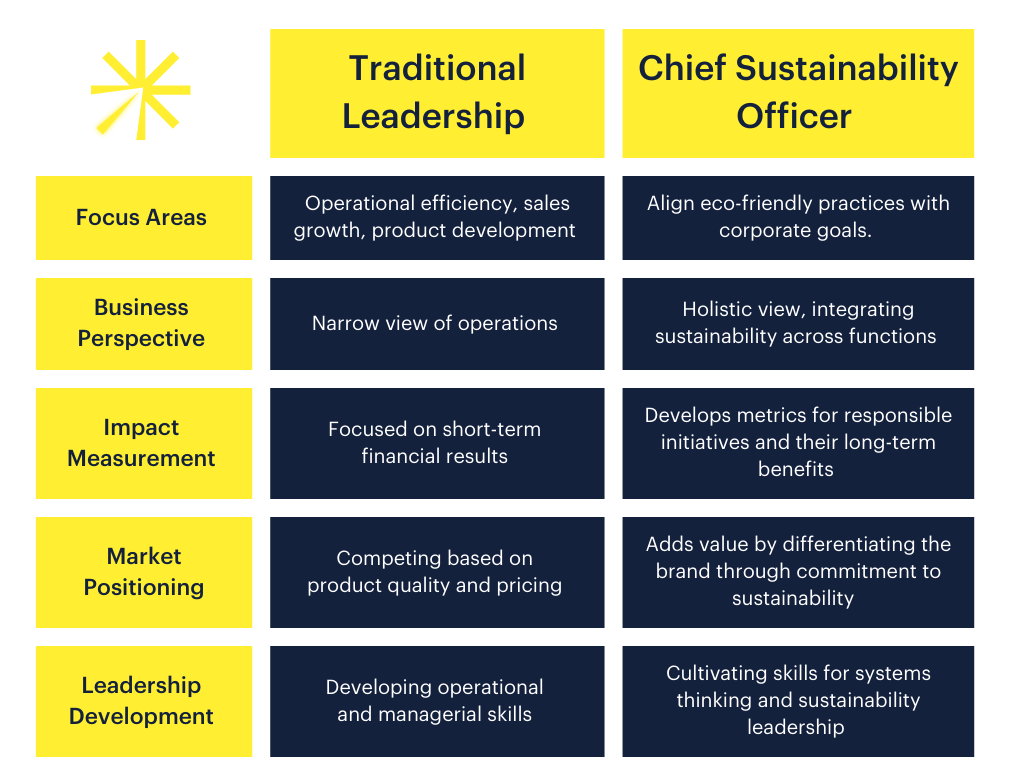
Traditional Leadership vs CSO Leadership
Key Benefits of Hiring a CSO
- Holistic strategy development: CSOs can align sustainability initiatives with overall business strategies — ensuring sustainability becomes a core aspect of the company’s mission rather than a separate compliance function. A Deloitte study found that organisations with a sustainability strategy achieve 20% higher growth than those without.
- Cross-functional collaboration: Effective sustainability strategies require collaboration across R&D, marketing, supply chain, and production. A CSO fosters those relationships — and research indicates that companies with cross-functional teams achieve 40% faster project completion.
- Enhanced brand reputation: 66% of global consumers are willing to pay more for sustainable brands (Nielsen) — making sustainability a direct revenue driver for F&B companies whose pricing power depends on brand differentiation.
- Resilience to market changes: As consumer preferences shift toward more conscious options, companies with a strong sustainability framework are better positioned to adapt. The Ellen MacArthur Foundation estimated that transitioning to a circular economy could generate $4.5 trillion in economic benefits by 2030 — and the F&B sector’s supply chain and packaging intensity makes it one of the primary beneficiaries of that transition.
Challenges in the CSO Role
- Integration into existing structures: One of the greatest challenges for a CSO is becoming an integral part of the existing leadership team and company culture — establishing processes while driving necessary changes in organisations that have operated without those processes for decades.
- Measuring impact: 52% of sustainability leaders struggle to quantify the benefits of their initiatives (PwC) — making the ability to establish meaningful impact metrics and communicate them to stakeholders effectively the most critical and most frequently absent capability in CSO appointments.
The Future of Food and Beverage Leadership: Executive Search
The Chief Sustainability Officer represents a transformative shift in leadership within the food and beverage industry. By integrating sustainability into business strategies, companies enhance their competitive advantage on a long-term view. As demand for sustainable practices continues to rise, executive search firms become the mechanism for adding the necessary executive talent — specifically the CSO who can translate sustainability investment into measurable commercial performance, not just environmental audit compliance.
Click here to get in contact with us.

Mr. Zavala has over 30 years of experience in executive search and leadership consulting, specialising in helping multinational corporations expand into new countries and sectors. Previously a partner at Russell Reynolds, where he served as Managing Director and established offices in Mexico, Argentina, and Brazil. He has lectured on leadership, influence, and power at ESADE Business School in Madrid and Barcelona, as well as IUE in Florence. Fluent in Spanish, English, German, and Portuguese.
Frequently Asked Questions: Executive Search for F&B CSOs
Finding a Chief Sustainability Officer for your F&B organisation?
Zavala Civitas identifies F&B CSOs who translate sustainability investment into measurable commercial performance — not just compliance documentation. 92% closing rate.