China’s business environment is being reshaped by technological transformation, changing workforce dynamics, increasingly complex global-local coordination and continued pressure on companies to adapt their organizational capabilities.
In this environment, organizational performance depends on more than recruiting strong individuals. Companies also need to determine whether leadership responsibilities, decision rights, organizational structures and workforce capabilities remain aligned with the strategy they are trying to execute.
The World Economic Forum’s Future of Jobs Report 2025 found that more than 90% of employers operating in China expect AI to transform their organization, while 65% identify robotics as a transformative technology. At the same time, 38% cite talent shortages as a barrier to transformation.
Source: World Economic Forum, The Future of Jobs in China, 2025.
| China Transformation Signal | Organizational Implication |
|---|---|
| 90%+ expect AI transformation | Roles, workflows and decision rights may need to change alongside technology adoption. |
| 65% identify robotics as transformative | Industrial organizations need leadership capable of integrating automation with operations and workforce planning. |
| 38% cite talent shortages | Organizations need to determine which capabilities to recruit, develop, redeploy or redesign around. |
| 47% cite declining working-age population | Long-term workforce planning, productivity and leadership pipelines become increasingly important. |
Source: World Economic Forum, Future of Jobs Report 2025 – China.
Organizational Consulting as a Strategic Capability in China
Organizational Consulting examines whether the way a company is structured supports the strategy it is trying to deliver.
Depending on the business problem, this can involve organizational design, leadership alignment, role clarity, decision rights, culture, talent capabilities or coordination between different functions and geographies.
The objective should not be restructuring for its own sake. A new organization chart creates little value if accountability remains unclear, leaders continue working across conflicting priorities or employees lack the capabilities required by the new model.
Technology Is Changing Organizational Requirements in China
China’s technology agenda is increasingly relevant to organizational design.
In 2025, China’s State Council launched an expanded “AI+” initiative designed to accelerate the integration of artificial intelligence across the economy.
The policy specifically encourages AI integration across industrial design, testing, production, services and operations, as well as intelligent supply-chain coordination and broader development of AI capabilities among employees.
Source: State Council of the People’s Republic of China, AI+ Action Plan, 2025.
For companies, this creates an organizational challenge as much as a technology challenge. Implementing AI may require new capabilities, redesigned workflows, different management information and closer collaboration between technology, operations and business functions.
Organizational Consulting can help determine which activities should change, where new capabilities should sit and how accountability should evolve as technology becomes integrated into day-to-day operations.
Talent Strategy and Workforce Effectiveness
Talent shortages should not automatically lead to more external recruitment.
The World Economic Forum reports that 38% of employers operating in China identify talent shortages as a barrier to transformation. At the same time, Chinese businesses are expected to invest significantly in reskilling and upskilling as technological change alters required capabilities.
Source: World Economic Forum, The Future of Jobs in China, 2025.
Organizations therefore need to distinguish between four different workforce responses:
- Recruit: when the required capability does not exist internally and cannot be developed quickly enough.
- Develop: when employees already possess relevant foundations and company-specific knowledge.
- Redeploy: when changing technology or business models make existing capabilities more valuable elsewhere.
- Redesign: when the role, process or organizational structure itself needs to change.
This is where Organizational Consulting and Executive Search can complement each other. One determines which organizational capabilities are genuinely missing; the other can access the external executive market when new leadership is required.
Organizational Structure and Role Clarity
Rapid growth, international expansion, acquisitions or new technology can create organizational structures that no longer reflect how the business actually operates.
Common symptoms include duplicated responsibilities, overlapping reporting lines, decisions that repeatedly escalate to senior leadership or functions that are individually strong but poorly coordinated.
Organizational Consulting can examine:
- Whether responsibilities are clearly allocated.
- Where decision authority should sit.
- Whether management layers add value or create unnecessary complexity.
- How information moves between functions.
- Whether leadership roles match the scale of the organization.
- Whether the structure supports current strategic priorities.
The purpose is not necessarily to reduce headcount or flatten the organization. The appropriate design depends on the company’s strategy, operating model and stage of development.
Leadership Development and Executive Capability
Structural change is difficult to sustain if leaders continue operating according to the previous organizational model.
A company may create broader regional roles, introduce matrix structures or delegate more authority to business units, but those changes require executives to adjust how they collaborate, delegate and make decisions.
Leadership assessment can help organizations determine whether current executives are ready for those responsibilities and where targeted development is required.
Zavala Civitas’ Executive Assessment & Leadership Development approach can combine psychometric evaluation, structured interviews, development planning, business cases, role-playing and coaching depending on the requirements of the organization.
Global Headquarters and China: The Organizational Alignment Challenge
Multinational companies operating in China face an additional organizational question: which decisions should remain global and which need to be adapted or owned locally?
Too much centralization can make local teams slow or unable to respond effectively to market conditions. Excessive localization can create fragmentation, duplicated capabilities or inconsistent governance.
The challenge is therefore not choosing between global and local control. It is defining clear decision rights and coordination mechanisms for areas such as:
- Commercial strategy.
- Product and customer decisions.
- Technology and data.
- Finance and investment.
- Talent and compensation.
- Risk, compliance and governance.
- Supply chain and operations.
This type of organizational alignment was also central to a previous Zavala Civitas Organizational Consulting project involving a global beverage company and its rapidly expanding APAC subsidiary. The project identified alignment between headquarters and the local organization as a central challenge following rapid growth.
Change Management: Structure Alone Does Not Create Transformation
Organizations often underestimate the behavioural side of structural change.
A new operating model can redefine responsibilities on paper, but employees and executives still need to understand what decisions have changed, which old behaviours should stop and how success will now be measured.
Globally, the World Economic Forum identifies organizational culture and resistance to change as the second most important barrier to business transformation, cited by 46% of surveyed employers.
Source: World Economic Forum, Future of Jobs Report 2025 – Workforce Strategies.
Organizational Consulting should therefore consider implementation alongside design: communication, leadership alignment, accountability, capability development and mechanisms for identifying whether the new model is working as intended.
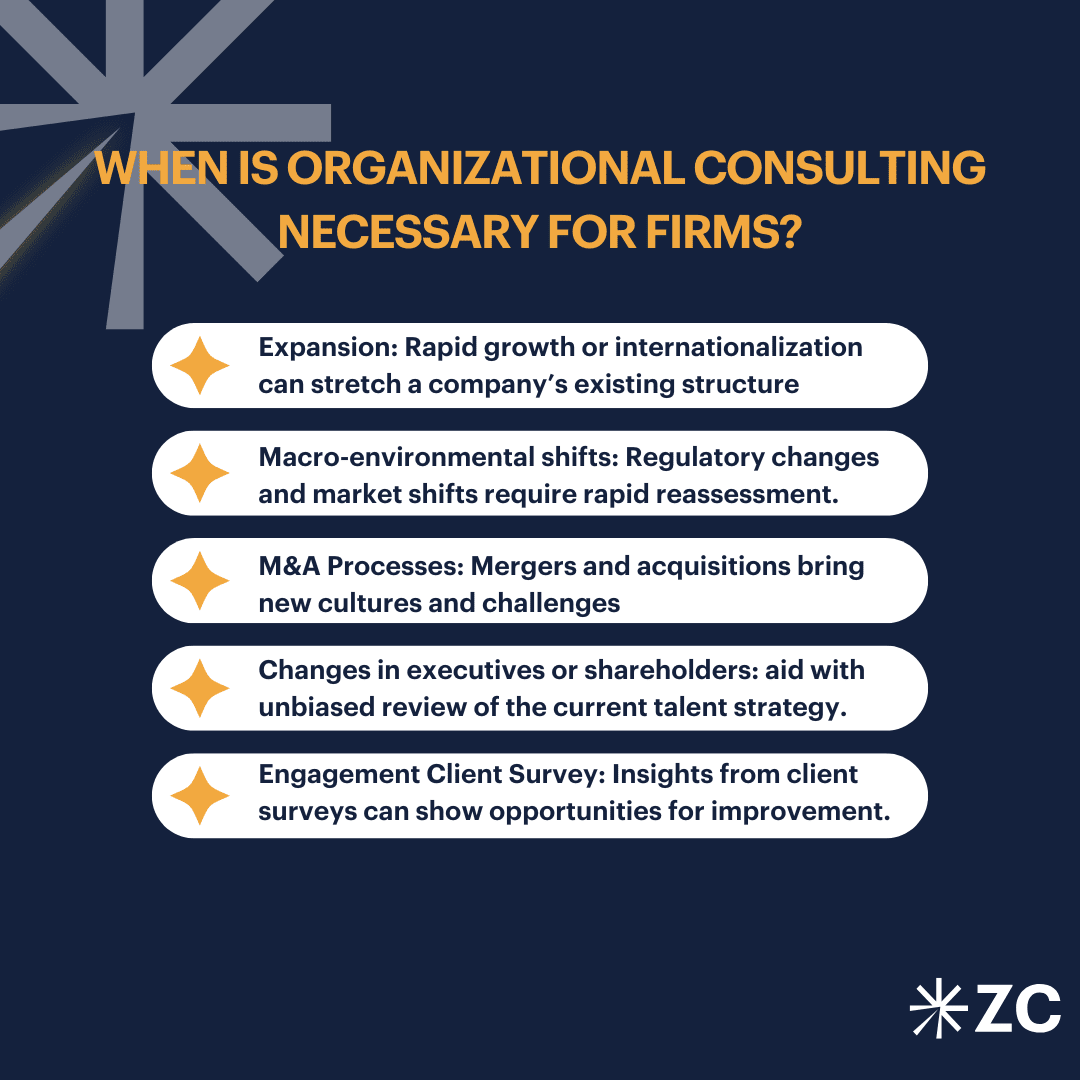
When Does a Company in China Need Organizational Consulting?
External Organizational Consulting can become particularly useful when the company knows performance needs to improve but the underlying organizational cause is unclear.
Common situations include:
- Rapid growth has created unclear roles or duplicated responsibilities.
- The China organization and global headquarters disagree over decision rights.
- A new strategy requires capabilities the organization does not currently possess.
- Technology adoption requires redesigned workflows or responsibilities.
- A merger, restructuring or leadership transition changes the operating model.
- Strong individual leaders are not working effectively as a leadership team.
- The company needs to determine whether a performance problem is caused by people, structure, process or a combination of these factors.
Zavala Civitas Organizational Consulting in China
Zavala Civitas combines Executive Search, Executive Assessment & Development, Board Advisory and Organizational Consulting capabilities to support organizations facing leadership and organizational challenges.
The firm’s current Organizational Consulting proposition focuses on tailored and benchmarked advisory designed to optimize organizational structure, culture, leadership and growth.
With its APAC head office in Shanghai, Zavala Civitas can combine local market understanding with experience supporting international organizations operating across several geographies.
Depending on the organizational challenge, the work may involve leadership assessment, organizational alignment, succession, role definition, leadership development or determining whether external Executive Search is required to bring missing capabilities into the organization.
Source: Zavala Civitas – Executive Search & Organizational Consulting.
Frequently Asked Questions About Organizational Consulting in China
What is Organizational Consulting?
Organizational Consulting examines whether a company’s structure, leadership, capabilities, processes and culture support its strategic objectives. The appropriate intervention depends on the underlying business problem rather than on a predefined organizational model.
Why is Organizational Consulting relevant in China?
Companies in China are operating through rapid technological change, workforce pressures and, for multinational organizations, complex global-local coordination. These factors can require changes in roles, skills, decision rights and organizational structures.
What is the difference between Organizational Consulting and Executive Search?
Organizational Consulting helps determine how the organization should be structured and which leadership or workforce capabilities are required. Executive Search becomes relevant when the analysis identifies a critical capability or leadership role that should be filled externally.
How can Organizational Consulting help multinational companies in China?
Organizational Consulting can help multinational companies clarify which decisions should sit with the China organization and which should remain regional or global, while improving coordination, accountability and leadership alignment between local teams and headquarters.
Can Organizational Consulting support AI transformation?
Yes. Technology transformation frequently requires organizational changes as well as technical implementation. Companies may need to redesign workflows, clarify accountability, develop new capabilities or determine where AI-related responsibilities should sit within the organization.
How does Zavala Civitas support Organizational Consulting in China?
Zavala Civitas combines local APAC market knowledge with Executive Search, assessment, leadership development and organizational advisory capabilities. Depending on the mandate, the firm can support organizational alignment, leadership capability, role definition, succession and related transformation challenges.
Learn more about Zavala Civitas’ Organizational Consulting capabilities, explore our Executive Assessment & Leadership Development services or contact us to discuss an organizational challenge in China.