Key Takeaway: 92.4% of Spanish companies are family businesses — and the generation that built them through the 1990s and steered them through the financial crisis is now approaching retirement. The next decade will produce more leadership transitions in Spanish business than any period since the country’s economic modernisation. The organisations that manage this proactively will preserve competitive advantage. Those that leave it to chance will discover the cost when a succession crisis is already visible.
Last updated: August 13, 2026
A Leadership Turning Point in Spain
Spain’s executive landscape is changing quietly but profoundly. Many of the country’s senior business leaders — those who rebuilt corporations in the 1990s and steered them through the financial crisis — are now approaching retirement. As this experienced generation steps back, companies are facing a new challenge: identifying and empowering successors who think differently, lead faster, and bring global perspective to traditionally local structures.
This is not a simple handover. It is a cultural shift that touches every sector of Spanish business.
Key Figures at a Glance
| Data point |
Figure |
Source |
| Spanish companies that are family-owned businesses |
92.4% |
Instituto de la Empresa Familiar (IEF), 2025 |
| Spanish companies reporting difficulty hiring senior talent |
75% |
IESE Business School |
| PE investment in Spain in 2025 (SpainCap) |
€7,015 million (+11.5% YoY) — accelerating succession pressure |
SpainCap, 2026 |
| Primary risk of unmanaged generational transition |
Loss of institutional knowledge + absence of ready successors + cultural discontinuity |
Zavala Civitas advisory analysis |
A Narrowing Leadership Pipeline
The demographic gap between long-tenured executives and emerging leaders is becoming evident. Executives in their late 30s and 40s often prefer flexible, purpose-driven careers over hierarchical leadership paths. They are less loyal to institutions and more selective about culture, autonomy, and impact — a mindset that contrasts sharply with the corporate traditions that shaped previous generations.
As a result, many Spanish companies are discovering that they lack ready successors for key executive and board roles. The leadership pipeline has depth of experience, but limited renewal.
With 92.4% of Spanish businesses being family-owned and PE investment growing at 11.5% annually, two succession pressures are converging simultaneously. Family enterprises face an inter-generational transition that challenges both ownership structures and leadership culture. PE-backed companies face governance professionalisation requirements that demand a different executive profile than the ones their founders installed. In both cases, the same question applies: is there a successor ready, or is the organisation about to discover the answer in a moment of crisis?
Rethinking What “Leadership Potential” Means
This new context is forcing organisations — and executive search firms — to look beyond the CV. Track record and tenure still matter, but adaptability, curiosity, and global exposure are becoming stronger indicators of readiness. Assessment tools and advisory-led searches are helping boards identify transformative potential, not just proven performance.
Executive search in Spain is evolving from selection to strategic evaluation — aligning leadership profiles with the pace of change each company must achieve.
Sectors Leading the Transition
Some industries are already acting faster. Energy and infrastructure groups are rotating leadership to accelerate the sustainability agenda. Consumer and retail firms are bringing in younger executives with digital and customer experience backgrounds. And in the legal and professional services sectors, the rise of new partnerships is redefining succession planning altogether.
What unites these changes is a growing acceptance that diversity of age, perspective, and leadership style strengthens resilience.
The most common succession failure in Spanish companies is not a lack of talent below — it is a lack of structured preparation above. Boards rarely initiate succession conversations until they are forced to, either by a health event, a retirement that arrives sooner than expected, or a performance gap that reveals the organisation has no credible internal candidate. The companies that begin this process three to five years in advance — with structured assessment, development investment, and honest board conversations about who is actually ready — consistently experience less disruption and retain more institutional knowledge than those that wait.
Executive Search in Spain: Managing the Transition
The most effective transitions in Spain are not abrupt replacements but collaborative successions. Senior leaders remain as mentors and board advisors, while younger executives gradually assume operational control. Executive search partners play a key role in designing these transitions — ensuring cultural continuity while embedding new capabilities at the top.
Spain’s generational shift represents both a risk and a renewal opportunity. Organisations that manage it proactively — investing in assessment, succession planning, and leadership development — will preserve experience while injecting fresh vision.
For executive search firms, the mission is clear: help Spanish companies bridge the gap between legacy and transformation, ensuring that the next generation of leaders not only inherits the business but redefines it.
About Zavala Civitas Executive Search
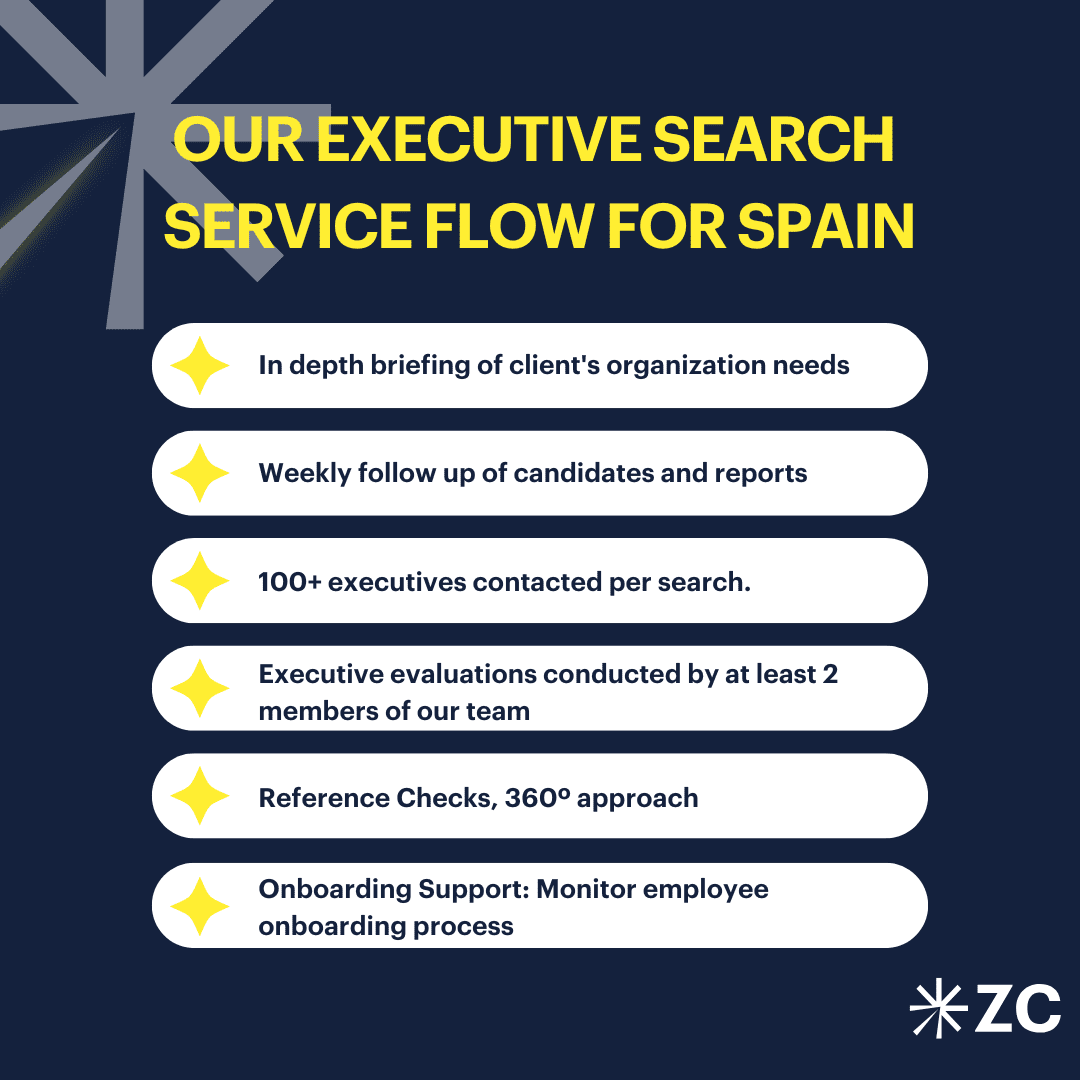
Zavala Civitas supports Spanish and international organisations in identifying, assessing, and developing executives who combine experience with innovation. Our cross-border expertise connects leadership generations and builds succession strategies that ensure long-term continuity and growth. Click here to get in contact with us.
Frequently Asked Questions: The Generational Shift in Spanish Executive Leadership
Why is Spain’s generational leadership transition more complex than in other European markets?
Because 92.4% of Spanish businesses are family-owned, which means the leadership transition is simultaneously a governance transition, an ownership transition, and often a relationship transition — as the next generation leader must earn the credibility of clients, employees, and institutional partners who built their trust with the previous generation. In family businesses, those three transitions are not separable. Getting one wrong tends to destabilise the others.
What makes the next generation of Spanish executives structurally different from their predecessors?
Their decision criteria for career moves. The generation now entering senior leadership in Spain evaluates opportunities based on purpose, culture, autonomy, and long-term impact — not just compensation and title. They are less willing to operate under hierarchical structures they cannot influence, and more likely to leave an organisation that does not invest in their development. This means the succession strategies that retained the previous generation — loyalty to the institution, patience with promotion timelines — do not reliably retain this one.
Why is “collaborative succession” more effective than abrupt leadership replacement in Spain?
Because institutional knowledge, client relationships, and internal credibility in Spanish businesses are frequently concentrated in the departing leader — and those assets do not transfer automatically with the role title. A collaborative transition that keeps the senior leader visible as a mentor and board advisor while the successor gradually builds relationships and accountability creates a bridge that preserves those assets. An abrupt replacement asks the new leader to build them from zero, while simultaneously managing the operational demands of the role.
How does PE investment in Spain (€7,015M in 2025) affect the generational transition dynamic?
By adding a governance professionalisation requirement on top of the leadership succession challenge. PE-backed Spanish companies need successors who are not only operationally credible but also fluent in institutional governance — KPI frameworks, board reporting, investor communication, and audit standards. That combination is rarer than either capability alone, and it creates demand for a different executive profile than family-owned or founder-led companies would typically develop internally.
How does Zavala Civitas support Spanish organisations through generational leadership transitions?
Through a combination of CEO & Board Advisory on succession governance design, structured leadership assessment to evaluate successor readiness and identify development priorities, executive search where internal pipelines need reinforcement, and succession strategy development tailored to the specific ownership structure — family business, PE-backed, or multinational subsidiary. Operating in Spain since 1971 with a 92% closing rate across completed mandates.