
Executive Search in the U.S. 2026: The Next Wave of Leadership Hiring

Key Takeaway: The U.S. executive search market is operating against a GDP of over $28 trillion, a PE market at $1.2 trillion (2nd record in history), and CEO turnover at 12.5% — the highest in eight years. In 2026, the five forces reshaping leadership hiring in the U.S. are AI-driven assessment, purpose-led selection, cross-border mobility, succession urgency, and inclusion as performance. Executive search firms that understand all five will operate with a decisive advantage.

Last updated: August 13, 2026

After a volatile 2025, marked by inflation, rapid technological acceleration, and shifting workforce expectations, the U.S. leadership market is entering 2026 with complexity — and with unprecedented demand for senior executives capable of navigating it.

The traditional definition of leadership is being rewritten: adaptability, ethical decision-making, and global perspective now rank as highly as P&L responsibility. For executive search firms operating in the United States, this means identifying not only high-performing profiles but also leaders who can move through uncertainty with conviction.

Key Figures at a Glance — Executive Search United States 2026

Data point Figure Source
U.S. GDP (world’s largest economy) +$28 trillion Bureau of Economic Analysis, 2025
CEO turnover in the U.S. (2025) 12.5% — highest in 8 years Spencer Stuart / Conference Board, 2025
U.S. Private Equity AUM (2025) $1.2 trillion — 2nd record; 150 deals over $1B PitchBook, 2025
New U.S. CEOs who are external hires 33% — signalling internal pipeline gaps Spencer Stuart CEO Study, 2025

Trend #1 — AI-Powered Executive Search Becomes the Standard in the U.S.

Artificial intelligence will move from experimental to essential in 2026. Predictive analytics and generative AI are transforming how executive search firms in the United States find, assess, and shortlist C-suite candidates. Machine-learning tools can now evaluate leadership potential, cultural fit, and long-term performance indicators with remarkable precision.

However, the most successful retained executive search partners will combine data-driven insights with deep qualitative evaluation — reading between the lines to uncover mindset, adaptability, and integrity. With 88% of U.S. organisations now using AI in their operations (McKinsey, 2025), AI fluency has become a baseline executive competency — not a future consideration.

What this means for senior leadership hiring in the U.S.: Firms that use AI only for candidate identification miss the value. The competitive advantage lies in AI-assisted assessment — mapping behavioural patterns and stress responses against the specific demands of the role — while retaining human judgement for the final evaluation.

AI has made the U.S. executive search market faster at the top of the funnel and more precise at the bottom. What it cannot do is replace the judgement of an experienced search professional who has sat across the table from 400 executives in the same sector and can read the difference between a candidate who is genuinely adaptive and one who has learned to answer adaptability questions well. In a market where CEO turnover is at a 8-year high, that distinction is the entire value proposition.

Trend #2 — DEI Moves from Policy to Performance in C-Suite Hiring

Diversity, Equity & Inclusion in executive search is no longer a corporate initiative — it is a performance standard. U.S. companies are embedding measurable DEI objectives into business strategy and linking leadership diversity to financial performance. The new accountability standard means boards are demanding diverse shortlists from their executive search partners.

Inclusive leadership in 2026 is seen not as compliance but as a source of innovation, market insight, and organisational resilience. Senior executive search processes that cannot demonstrate genuine shortlist diversity — not just stated commitment — are losing mandates to firms that can.

Trend #3 — Cross-Border Leadership Mobility Reshapes U.S. Executive Search

As American companies expand globally and European and Latin American firms increase their U.S. presence, cross-border executive search is becoming a defining capability. Organisations are looking for multicultural leaders who understand both Western governance standards and emerging market dynamics.

From New York to Munich and São Paulo, leadership mobility is defining the next era of talent strategy. Executive search firms with true international reach — and on-the-ground cultural fluency — have a decisive advantage over U.S.-only recruiters when mandates involve international operational scope.

Key cross-border executive search corridors in 2026: US–Germany (industrial, automotive, advanced manufacturing), US–Brazil (infrastructure, agribusiness, financial services), US–Mexico (nearshoring, manufacturing operations), US–UK (financial services, professional services), US–Spain (renewable energy, infrastructure).

Trend #4 — Succession Planning and Interim Executive Search at Scale

Leadership turnover across Fortune 500 boards remains high, and many organisations lack robust succession pipelines. With CEO turnover at 12.5% and 33% of replacements coming from outside, the scale of the gap is structural — not cyclical. Bain’s observation that “12 is the new 5” (average PE hold period extending from 5 to 12 years) further amplifies the succession planning challenge across portfolio companies.

This is fuelling the rise of interim C-suite executives — experienced leaders who step in to stabilise operations while permanent successors are identified. In 2026, companies are increasingly relying on retained executive search firms not just for replacement hires but for strategic succession planning — anticipating transitions years in advance and building the leadership pipeline before the vacancy opens.

With 33% of incoming U.S. CEOs sourced externally, the data confirms that internal development is not generating succession-ready leadership at the pace the market requires. But the external hire does not come without cost: it takes an external CEO 18–24 months on average to match the performance of a well-prepared internal successor in a comparable role. The executive search firms that will define the market in 2026 are those that help boards start the pipeline conversation three years before the vacancy exists — not three months after it opens.

Trend #5 — Purpose, Resilience, and Human-Centred Leadership as Executive Selection Criteria

A new generation of executives driven by purpose as much as profit is emerging across the U.S. market. ESG principles, social responsibility, and psychological safety are requirements that are stronger than ever in C-suite selection.

C-suite candidates are being evaluated not only for what they achieve, but how they achieve their objectives. Leadership style, decision-making under stress, and the ability to build psychologically safe and high-performance teams are now core assessment dimensions — not adjuncts to the technical evaluation.

Key Sectors Driving Executive Search Demand in the U.S. in 2026

Executive search activity in the United States is concentrated in several high-demand sectors:

  • Technology & AI: CTOs, Chief AI Officers, and VPs of Engineering — amid AI commercialisation at scale.
  • Private Equity: Portfolio CEOs, CFOs, and Operating Partners — as the $1.2T PE market requires leadership for value creation timelines.
  • Infrastructure & EPC: Program Directors, COOs, and Project Directors — driven by Bipartisan Infrastructure Law deployment.
  • Financial Services: C-suite and risk leadership — amid regulatory tightening and digital transformation.
  • Life Sciences & Pharmaceuticals: Commercial leadership and R&D Directors — in a post-pandemic expansion cycle.
  • Industrial & Advanced Manufacturing: COOs and Plant Directors — for nearshoring and supply chain resilience mandates.

Key Cities for Executive Search in the United States

Executive search mandates in the U.S. concentrate in specific metropolitan ecosystems, each with distinct sector profiles:

  • New York: Financial services, private equity, media, consumer, professional services.
  • San Francisco / Bay Area: Technology, AI, venture capital, biotech.
  • Chicago: Industrial, financial services, healthcare, consumer goods.
  • Houston: Energy, EPC, infrastructure, industrial manufacturing.
  • Boston: Life sciences, pharmaceuticals, biotech, higher education.
  • Los Angeles: Entertainment, consumer, technology, real estate.
  • Miami: Latin American regional headquarters, financial services, logistics.

About Zavala Civitas Executive Search in the U.S.

Zavala Civitas is an international executive search firm connecting global organisations with transformative leaders. With offices and partners across Europe, Latin America, and North America, our team combines cross-border reach with deep local expertise. We advise boards and investors on leadership strategies that align with business growth, culture, and purpose — with a 92% closing rate across completed mandates.
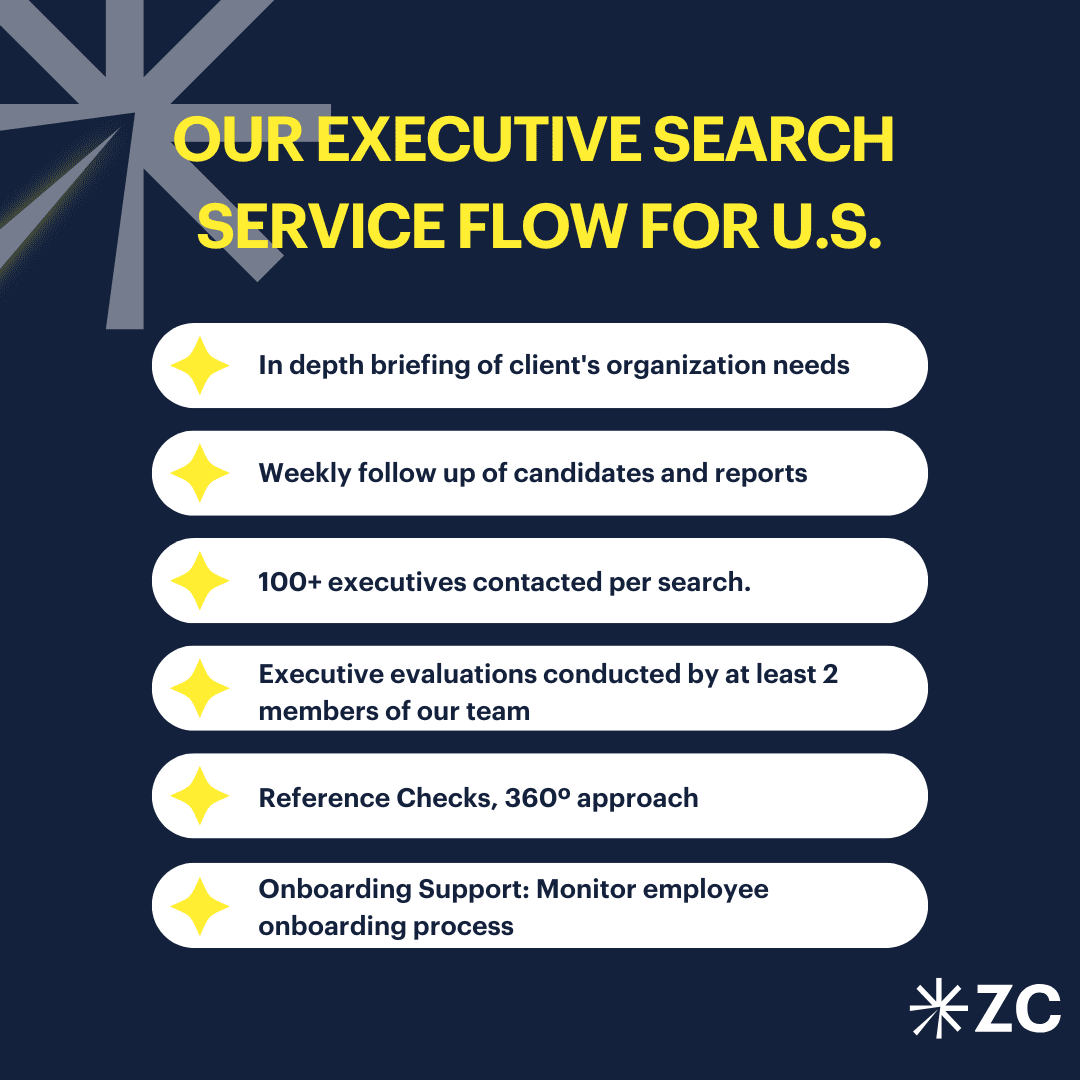
Executive search flow for the United States — Zavala Civitas

Click here to contact our team.

Frequently Asked Questions: Executive Search in the United States 2026

How much does executive search cost in the United States in 2026?
Retained executive search fees in the U.S. for senior leadership roles (VP and above) typically range from 30–33% of the executive’s total first-year compensation, billed in three instalments — at engagement, shortlist delivery, and placement. For C-suite mandates with a total compensation above $1 million, some firms negotiate a flat fee or a blended percentage. The fee reflects not just the placement but the research depth, market mapping, assessment rigour, and onboarding support — which vary significantly between firms.
How long does an executive search take in the U.S. for a C-suite role?
Between 8 and 16 weeks for a well-defined mandate at VP or C-suite level. The factors that most reliably extend timelines are: unclear role definition at the start, internal alignment issues that emerge mid-process, a compensation package below market benchmark, or a role that is genuinely rare in terms of the required combination of capabilities. Firms with existing networks in the relevant sector and geography typically deliver shortlists faster — often in 10 business days — than those building pipelines from scratch.
What is the difference between retained and contingency executive search in the U.S.?
Retained search firms are exclusively engaged on a mandate, paid in advance regardless of outcome, and commit their best researchers and most senior partners to the project. Contingency search firms are paid only on successful placement and typically work on multiple competing mandates simultaneously. For senior leadership roles — VP level and above — retained search consistently produces better outcomes because the firm invests proportionally more time in research, confidential outreach, and assessment. Contingency search is more appropriate for mid-level roles where speed and volume matter more than precision.
Which executive search firms operate across the U.S. and Europe/Latin America for cross-border mandates?
A smaller number than the market suggests. Most firms that claim international reach operate through loose referral networks rather than integrated cross-border teams with genuine local presence. The firms that can genuinely deliver for cross-border mandates — a European company hiring a U.S. General Manager, or a U.S. company building a Latin American leadership team — are those with actual offices and practising partners in each geography, not just affiliate agreements. Zavala Civitas operates across Europe, the Americas, and Asia with practising partners in each market and a 92% closing rate.
What are the most in-demand C-suite roles in the U.S. executive search market in 2026?
Chief AI Officer and VP of AI/Machine Learning (driven by AI commercialisation), Chief Sustainability Officer (ESG reporting mandates), Chief Revenue Officer (SaaS and enterprise growth), Portfolio CEOs and CFOs (PE value creation timelines), Program Directors and COOs for Infrastructure (Bipartisan Infrastructure Law execution), Chief Data Officer (AI governance and data monetisation), and General Managers for international companies establishing U.S. presence. The consistent theme across all of them: the combination of technical depth and cross-functional leadership influence is what creates scarcity.

Planning a C-suite or senior leadership search in the United States?

Zavala Civitas combines U.S. market expertise with cross-border reach across Europe, Latin America, and Asia. 92% closing rate. Founded 1971.

Executive Search →
Private Capital →
Contact Us →

Executive Search China: Industrial Sector

Key Takeaway: Beijing has launched a nationwide “anti-involution” (反内卷) campaign to address destructive price wars and overcapacity across multiple industrial sectors at once, not just renewables. Electrical machinery and equipment, communications equipment, and medical products all show 29% to 34% of firms losing money in 2024-25. Goldman Sachs estimates Chinese

Read More

Executive Search in Italy for Industrial

Key Takeaway: Turin’s automotive cluster invested roughly €2.8 billion in electrification between 2024 and 2026. Over the same period, regional automotive employment fell by more than 3,200 positions. Fewer than 20% of local engineering graduates hold the specific battery, power electronics, and embedded software skills employers are actually hiring for.

Read More

Executive Search in Portugal for Financial Services

Key Takeaway: French banking group BPCE is investing €6.4 billion to acquire Novo Banco and building a 20,000 square metre campus in Lisbon, alongside a 2,500-strong tech hub already operating in Porto. This single deal is creating demand for highly specialised roles in risk analytics, structured finance, and digital-asset compliance

Read More

Related posts

Trabajo en remoto en los despachos de abogados

Autora: Beatriz Baker Araujo Senior Advisor, Zavala Civitas El debate sobre el trabajo presencial y remoto en los despachos de abogados lleva años activo, pero no ha madurado. Las posiciones se han endurecido desde 2020, y las conversaciones suelen discurrir entre dos polos: socios que invocan la cultura, el mentoring

Read More

Executive Search China: Industrial Sector

Key Takeaway: Beijing has launched a nationwide “anti-involution” (反内卷) campaign to address destructive price wars and overcapacity across multiple industrial sectors at once, not just renewables. Electrical machinery and equipment, communications equipment, and medical products all show 29% to 34% of firms losing money in 2024-25. Goldman Sachs estimates Chinese

Read More
Financial services building in Germany

Executive Search in Brazil for Financial Services

Key Takeaway: The White House targeted Brazil’s Pix payment system in April 2026, calling it a barrier to US payment companies. Brazil’s Central Bank fired back, defending Pix as a matter of payments sovereignty. At the same time, the collapse of Banco Master, the largest banking fraud in Brazilian history,

Read More
law leaders working

Executive Search in Mexico for Legal and Professional Services

Key Takeaway: Mexico’s 2024 judicial reform introduced popular election of judges and magistrates, with implementation beginning in 2025. This has accelerated a shift toward arbitration as the preferred dispute-resolution method in commercial contracts, as companies seek predictability an elected judiciary cannot yet guarantee. Combined with nearshoring-driven M&A activity and the

Read More

Executive Search in Italy for Industrial

Key Takeaway: Turin’s automotive cluster invested roughly €2.8 billion in electrification between 2024 and 2026. Over the same period, regional automotive employment fell by more than 3,200 positions. Fewer than 20% of local engineering graduates hold the specific battery, power electronics, and embedded software skills employers are actually hiring for.

Read More

Executive Search in Portugal for Financial Services

Key Takeaway: French banking group BPCE is investing €6.4 billion to acquire Novo Banco and building a 20,000 square metre campus in Lisbon, alongside a 2,500-strong tech hub already operating in Porto. This single deal is creating demand for highly specialised roles in risk analytics, structured finance, and digital-asset compliance

Read More