
Last updated: August 20, 2026
Executive Search has changed considerably from the relationship-driven model that defined the profession for much of its history. Technology has expanded access to information, made cross-border conversations easier and introduced new tools for identifying, organising and assessing talent.
China is an important environment in which to observe this transformation. Its large digital economy, rapidly developing artificial intelligence ecosystem and increasingly technology-enabled human resources market are changing how organisations identify and engage leadership talent.
COVID-19 accelerated one part of this shift by making virtual interviews and remote collaboration a necessity. Those tools did not disappear when offices reopened. Instead, they became part of a broader transformation that now includes AI-assisted research, digital talent intelligence, structured virtual assessment and increasingly sophisticated recruitment platforms.
For Executive Search, however, innovation should not mean automating every stage of the process. Senior appointments involve confidential information, ambiguous evidence and strategic questions that cannot be reduced to keyword matching. The opportunity is to use technology where it improves the process while preserving human judgement where it creates value.
The Transformation of Executive Search in China
China’s human resources industry has itself expanded significantly. According to the Ministry of Human Resources and Social Security, the country had 74,000 human resources service organisations and 1.093 million people working in the sector at the end of 2024. The number of HR service organisations was 61.8% higher than in 2020.
The Ministry also notes that AI-supported CV optimisation, job recommendation, remote interviews and other digital recruitment formats have become increasingly visible across China’s HR services market.
Key Figures at a Glance
| Indicator | Latest Data | Source | Implication for Executive Search |
|---|---|---|---|
| Human resources service organisations in China | 74,000 | MOHRSS, end of 2024 | A large HR services ecosystem is accelerating competition, specialisation and adoption of digital recruitment tools. |
| People working in China’s HR services industry | 1.093 million | MOHRSS, end of 2024 | Technology is entering an already substantial professional services market rather than replacing a small traditional industry. |
| AI and HR model-based application scenarios targeted for 2026 | Around 20 | National Data Administration, 2026 | AI-enabled employment services are becoming part of China’s institutional HR infrastructure. |
| High-value AI and HR application pathways targeted for exploration by 2027 | Around 50 | National Data Administration, 2026 | Recruitment technology is likely to become more deeply embedded in matching, interviewing and employment services. |
How Technology Is Changing Executive Search in China
1. Virtual Interviews Have Expanded the Search Market
Virtual meetings were one of the clearest operational changes accelerated by the pandemic. Before 2020, executive search relationships often relied heavily on face-to-face conversations, business lunches and in-person meetings. Today, senior candidates can be assessed across cities and countries much earlier in a search without requiring travel.
This is particularly useful in China-related assignments where the candidate universe may span Shanghai, Beijing, Shenzhen, Hong Kong, Singapore and other international leadership markets.
The benefit is not merely scheduling efficiency. Remote interviewing makes it possible to test a broader market before deciding which executives justify deeper assessment. It can also support confidentiality when a candidate does not want to be seen meeting an executive search consultant near their current workplace.
2. AI Can Accelerate Research Without Making the Appointment
Artificial intelligence represents a more significant transformation. In June 2026, Chinese authorities issued guidance specifically encouraging AI applications within human resources and social security services. The policy includes job-search and recruitment models, remote recruitment, smart interviews and more precise matching between employers and candidates.
For executive search, AI can support tasks such as organising market information, identifying potential companies and talent pools, comparing career histories, synthesising public information and helping consultants interrogate a larger body of research.
But a senior executive appointment is not simply a matching exercise. A CV rarely explains why a transformation succeeded, how much of a result belonged to the individual rather than the organisation, whether the executive can operate with a particular board or whether the candidate genuinely wants the mandate.
Those questions require interviewing, judgement, references and interpretation.
3. Professional Platforms Have Increased Talent Visibility
Digital professional networks have also changed executive research. In China, platforms such as Maimai and major recruitment platforms can provide additional signals about companies, functions and talent markets that were previously harder to identify from outside an organisation.
The change is important, but visibility should not be confused with assessment. A public profile can help identify a candidate. It cannot establish leadership effectiveness, motivation, cultural adaptability or the ability to execute a specific transformation.
There are also stronger compliance considerations around digital recruitment. China’s 2026 rules for online recruitment require platforms to strengthen identity and qualification verification, ensure recruitment information is genuine and legal and improve protection against abusive or misleading recruitment practices. The Ministry has also emphasised personal information protection across online recruitment. These requirements reinforce the importance of disciplined data use rather than unrestricted collection of candidate information.
4. Talent Intelligence Is Becoming More Strategic
Digital tools also make executive search useful before an organisation formally launches a search. A company can map leadership markets, understand competitor structures, identify where specific capabilities are concentrated and test whether its target profile actually exists.
This is particularly relevant in fast-moving Chinese sectors where the talent market itself can change quickly. In early 2026, for example, AI-related hiring accelerated sharply. Shanghai government reporting based on Zhaopin data found that job postings related to AI agents rose 455% year-on-year during the first three weeks after the Spring Festival.
For an executive search brief, that kind of movement matters. A static job description can become obsolete if the capabilities, competitors and compensation dynamics surrounding the role change faster than the company’s internal assumptions.
Why Human Judgement Still Matters in Executive Search
Technology improves access to information. It does not remove ambiguity.
At executive level, the same career history can mean very different things depending on context. A CEO may have delivered strong growth because the market was expanding, because the organisation already had exceptional capabilities or because the executive genuinely transformed the business. A CFO who succeeds in a highly centralised multinational may not necessarily perform equally well in a founder-led scale-up.
The purpose of executive assessment is to separate those factors.
This is why technology should complement structured interviews, references and contextual evaluation rather than replace them. Our work on Executive Assessment in China follows the same principle: evidence becomes useful only when it is interpreted against the requirements of the role.
Executive Search Innovation Requires Better Process, Not More Technology
The most innovative executive search process is not necessarily the one using the greatest number of digital tools.
A strong process uses technology selectively:
- to investigate a wider leadership market;
- to organise and compare information efficiently;
- to facilitate confidential cross-border conversations;
- to identify changes in talent markets earlier;
- and to free consultants from repetitive tasks so they can spend more time on assessment, references and client judgement.
The result should not be a faster version of the same search. It should be a better-informed search.
Executive Search Services in China
For organisations operating in China, innovation in Executive Search needs to be balanced with confidentiality, data protection and a clear understanding of the local and international leadership market.
At Zavala Civitas, the process begins with understanding the business problem behind the appointment. The search strategy then combines market mapping, direct candidate identification, structured evaluation and reference validation to determine which executives are capable of delivering the required mandate.
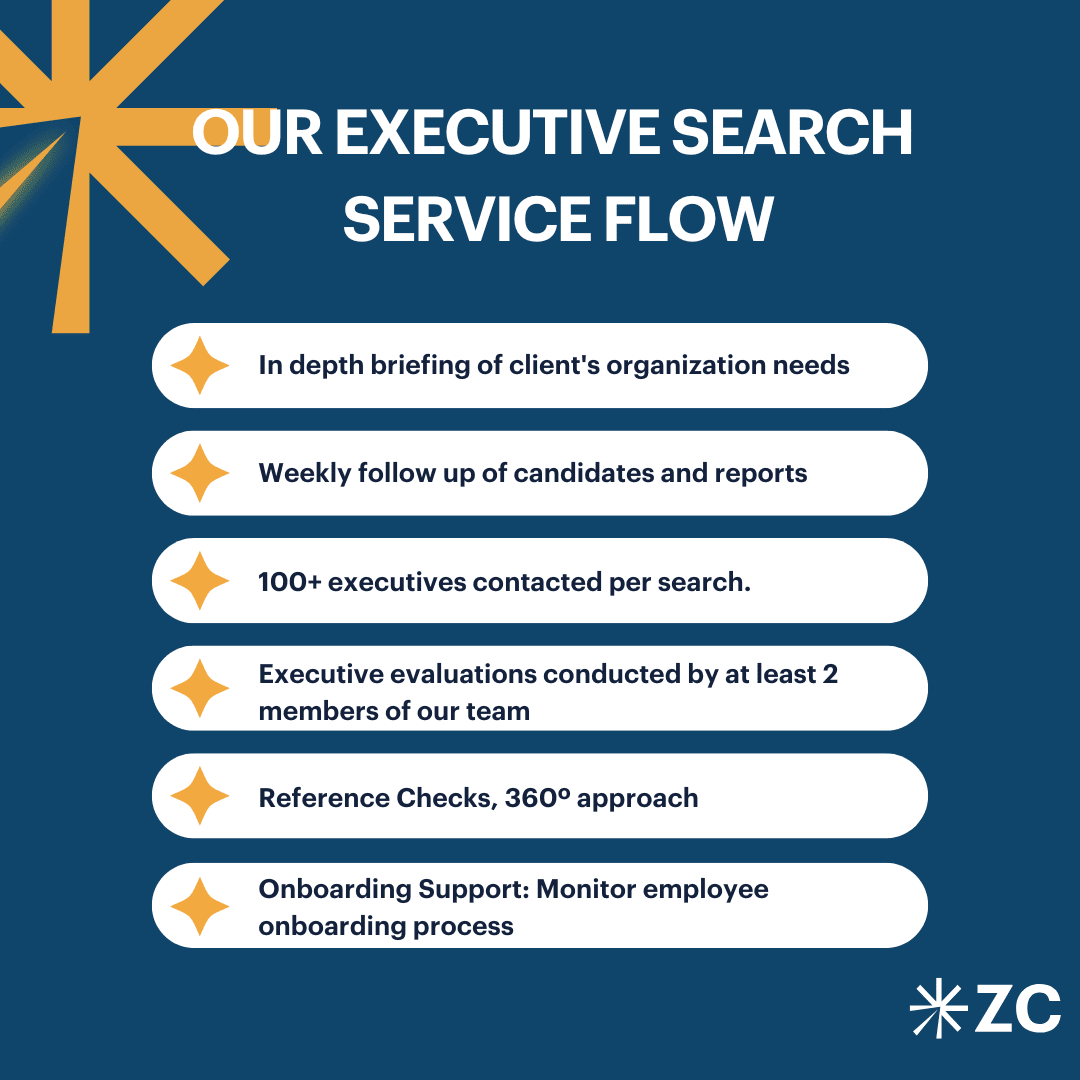
Technology can make each stage more efficient, but it does not change the objective: to understand the market thoroughly and make a better leadership decision.
Frequently Asked Questions: Technology and Executive Search in China
Technology can accelerate Executive Search. Leadership judgement still determines its value.
Zavala Civitas combines market intelligence, technology and structured executive assessment to support senior leadership appointments in China.
Executive Search → Executive Search in China → Contact Us →