
Why Companies Choose Executive Search in China 

Key Takeaway: China’s GDP grew 4.9% in 2024 and is projected at 4.5% in 2025. 71% of companies in China cite the domestic slowdown as a greater concern than tariffs — and welfare compliance stands at just 28.4%. In this environment, the wrong executive appointment does not create a performance gap. It creates a governance and regulatory liability that compounds over time.

Last updated: August 13, 2026

China’s Current Business Landscape

China’s operating environment has become structurally more complex for both global and domestic companies. The combination of moderating growth, domestic demand pressure, and tightening regulatory compliance is redefining what effective executive leadership in China actually requires.

Key Figures at a Glance

Data point Figure Source
China GDP growth (2024 / projected 2025) 4.9% (2024) → 4.5% (2025 projection) World Bank, 2025
Companies citing domestic slowdown as bigger concern than tariffs 71% European Chamber of Commerce in China
Welfare compliance rate among companies in China 28.4% — creating compliance exposure for executives without local regulatory fluency European Chamber / China labour authority data
Annual FDI into China +$160 billion USD UNCTAD World Investment Report, 2025

Four forces are defining the current operating environment:

  • Slower growth: GDP is projected to grow 4.5% in 2025, down from 4.9% in 2024.
  • Domestic weakness: A European Chamber survey revealed 71% of companies cite the domestic slowdown as a bigger concern than tariffs.
  • Labour and welfare pressures: New welfare enforcement is affecting companies across sectors, with compliance at just 28.4% — creating significant exposure for executives who do not understand the full regulatory landscape.
  • Deflation and competition: Persistent price wars have forced Beijing to curb “disorderly competition,” reshaping the commercial environment in multiple sectors simultaneously.

Why Companies Turn to Executive Search in China

In this environment, the quality of senior leadership is not a competitive advantage — it is an operational necessity. The reasons companies engage executive search firms in China are structural:

  • Access to hidden talent: Most top executives are not active job seekers. Executive search firms unlock access to this passive talent pool — the leaders who are currently executing, not looking.
  • Navigating cultural and regulatory nuances: Recruitment in China is shaped by guanxi (relationships), strict regulations, and significant regional differences. C-level recruitment specialists bridge these complexities.
  • Confidentiality in senior hires: When replacing or hiring C-suite executives, discretion is critical. Executive search ensures confidential and secure processes that protect both the organisation and all candidates.
  • Speed and reduced risk: Hiring the wrong leader in today’s environment can be costly — both financially and reputationally. Search firms shorten time-to-hire while ensuring cultural and strategic fit.
With welfare compliance in China at 28.4%, a General Manager or CFO who lacks genuine local regulatory fluency is not managing an operational risk — they are managing an accumulated liability that becomes visible at audit time, not before. The European Chamber survey finding that 71% of companies are more worried about domestic slowdown than tariffs signals that the risk is no longer external and macroeconomic — it is internal and structural. That is precisely the context in which executive quality becomes the primary variable, and the cost of the wrong appointment is measured not in months of onboarding but in years of remediation.

Challenges for Executive Search in China

  • Ageing workforce and shrinking talent pool: China’s demographic trajectory is reducing the available supply of experienced senior executives in certain sectors.
  • Rising wage pressures and welfare obligations: Compliance costs are increasing, and the executives who can navigate this environment effectively are a scarce and sought-after group.
  • Uncertainty in foreign business operations: Geopolitical dynamics and regulatory evolution require executives with genuine risk navigation experience — not theoretical familiarity with China risk.

Opportunities Driving Executive Search Demand in China

  • Growing demand by sector: Technology, biopharma, and advanced manufacturing are generating particularly high demand for senior leadership with both technical depth and commercial expertise.
  • Localisation: Multinationals increasingly require executives who deeply understand policy, market dynamics, and consumer behaviour — rather than applying global frameworks to a market that operates differently.
  • Strategic transitions: Domestic Chinese firms expanding abroad are looking for bilingual leaders with international management experience and the governance credibility to operate under Western ownership standards.

Case example: A European automotive firm entering Shanghai leveraged executive search to appoint a bilingual CFO. This leader successfully navigated new welfare mandates while aligning with global reporting standards — saving the firm months of disruption and avoiding regulatory exposure that would have been costly to remediate.

The localisation requirement in China is not about language — it is about ecosystem credibility. A VP of Government Affairs who can articulate the company’s regulatory position to a municipal authority in Shenzhen is not interchangeable with one who can do the same in Chengdu or Wuhan. Provincial regulatory bodies, local industry associations, and government relationship networks operate differently across China’s major cities. An executive search that treats “China experience” as a single undifferentiated credential will consistently produce leaders who are well-prepared for the market they knew and underprepared for the one they are entering.

How Executive Search in China Adds Value

  • Targeted market mapping: Identifies leadership talent beyond job boards — directly in the ecosystem, not waiting on the periphery of it.
  • Cultural fit analysis: Evaluates adaptability to China’s fast-shifting business climate — including the specific city and sector context, not just national market familiarity.
  • Onboarding and retention support: Ensures executives integrate smoothly and stay longer — critical in a market where the cost of turnover compounds faster than in most other geographies.
  • Strategic advisory: Provides insight on leadership trends, salary benchmarks, and policy changes impacting recruitment across China’s regions and sectors.
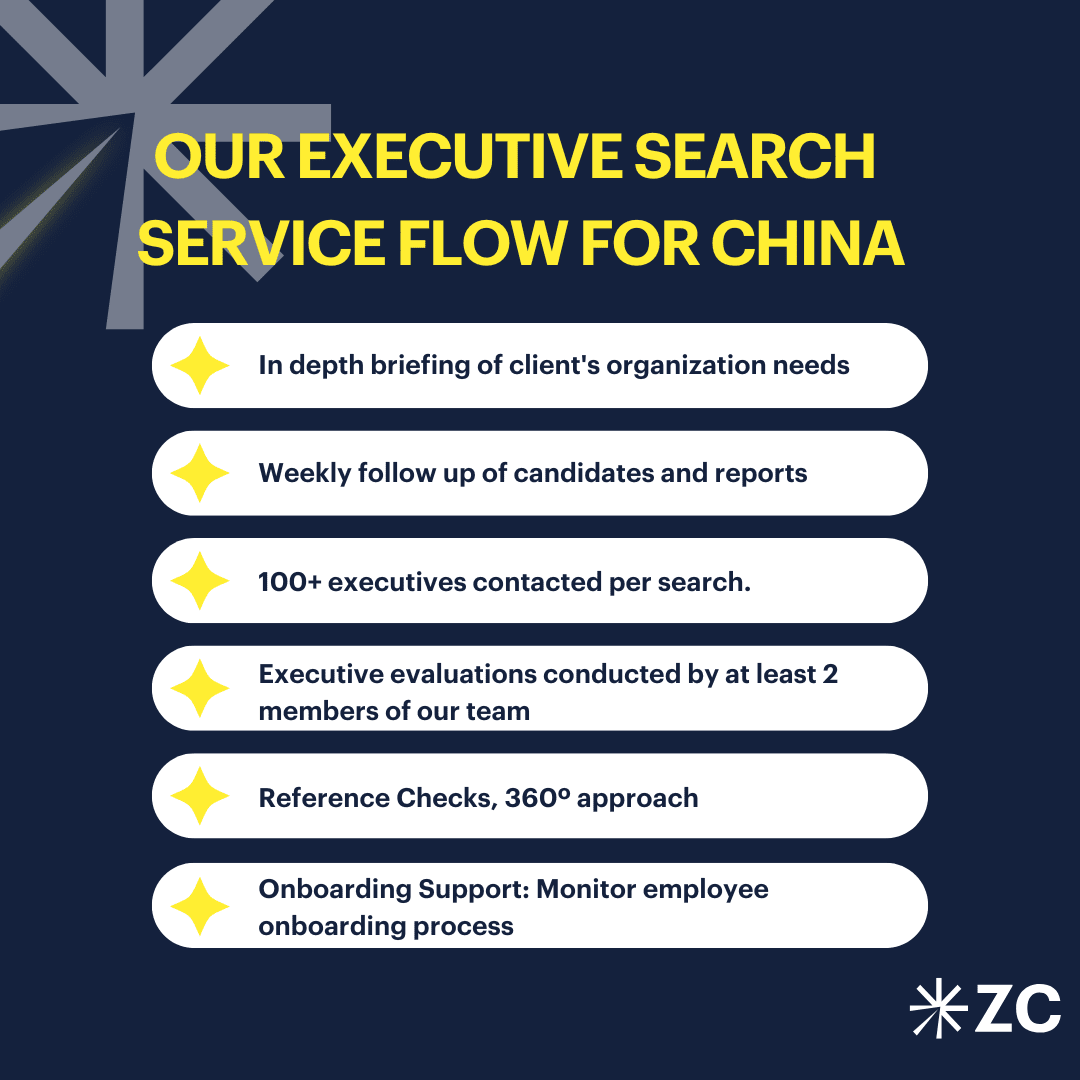
Executive search service flow in China — Zavala Civitas

The Future in China. China’s economy is undergoing transformation. With moderating growth, ageing demographics, and stricter regulations, leadership quality is becoming the ultimate competitive advantage. Companies that invest in top-tier executives will be best positioned to thrive.

At Zavala Civitas, we help global and domestic companies navigate leadership challenges in China with precision, discretion, and market intelligence. If your organisation is seeking the right executive to lead through change, our team is ready to partner with you. Click here to contact us.

Frequently Asked Questions: Why Companies Choose Executive Search in China

Why can’t companies in China simply hire senior executives through standard recruitment channels?
Because the executives with the specific combination of local regulatory fluency, ecosystem relationships, and international governance credibility that senior roles in China require are not looking for work. They are executing — and they are known within the network, not visible on job platforms. Standard recruitment channels surface candidates who are available. Executive search surfaces candidates who are appropriate, regardless of whether they are currently considering a move.
Why does China’s welfare compliance rate of 28.4% matter for executive hiring decisions?
Because a GM or CFO who does not genuinely understand the welfare and compliance landscape is managing an accumulated liability, not just an operational complexity. New enforcement mechanisms mean that non-compliance that has been tolerated will increasingly surface at audit or government inspection — and when it does, the executive in the role is accountable. An executive search that assesses regulatory fluency as a core criterion, not a background check, directly reduces that exposure.
How does guanxi (relationship capital) affect executive search outcomes in China?
Directly and substantially. In China, an executive’s effectiveness in government relations, supplier negotiations, and talent attraction is shaped by the relational networks they bring to the role — not just their functional competency. An executive who is technically qualified but has no established guanxi in the relevant province or sector starts their role at a disadvantage that may take 12–18 months to close. Executive search that evaluates network depth alongside competency produces materially better outcomes in the China context.
Why is “China experience” not a sufficient qualification for senior executive roles in China?
Because China is not a single market. The regulatory relationships, local government dynamics, and industry network that determine effectiveness in Shenzhen’s technology sector are different from those in Chengdu’s industrial ecosystem or Wuhan’s biomedical cluster. An executive whose China experience was built in one city and one sector does not automatically have the context needed for another. Executive search must evaluate which specific experience is relevant to which specific mandate.
How does Zavala Civitas approach executive search in China?
From our Shanghai office, with direct presence in the senior executive ecosystem across Beijing, Shenzhen, and Shanghai. We assess regulatory fluency, guanxi depth, and cross-cultural governance credibility alongside functional competency. We provide full confidentiality throughout the process, and extend the service to include structured onboarding and 180-day integration follow-up. With a 92% closing rate across completed mandates.

Looking for executive leadership in China?

Zavala Civitas operates in China from Shanghai with genuine local presence. Partner-led, confidential process. 92% closing rate.

Executive Search →
Digital & Technology →
Contact Us →

Executive Search China: Industrial Sector

Key Takeaway: Beijing has launched a nationwide “anti-involution” (反内卷) campaign to address destructive price wars and overcapacity across multiple industrial sectors at once, not just renewables. Electrical machinery and equipment, communications equipment, and medical products all show 29% to 34% of firms losing money in 2024-25. Goldman Sachs estimates Chinese

Read More

Executive Search in Italy for Industrial

Key Takeaway: Turin’s automotive cluster invested roughly €2.8 billion in electrification between 2024 and 2026. Over the same period, regional automotive employment fell by more than 3,200 positions. Fewer than 20% of local engineering graduates hold the specific battery, power electronics, and embedded software skills employers are actually hiring for.

Read More

Executive Search in Portugal for Financial Services

Key Takeaway: French banking group BPCE is investing €6.4 billion to acquire Novo Banco and building a 20,000 square metre campus in Lisbon, alongside a 2,500-strong tech hub already operating in Porto. This single deal is creating demand for highly specialised roles in risk analytics, structured finance, and digital-asset compliance

Read More

Related posts

Trabajo en remoto en los despachos de abogados

Autora: Beatriz Baker Araujo Senior Advisor, Zavala Civitas El debate sobre el trabajo presencial y remoto en los despachos de abogados lleva años activo, pero no ha madurado. Las posiciones se han endurecido desde 2020, y las conversaciones suelen discurrir entre dos polos: socios que invocan la cultura, el mentoring

Read More

Executive Search China: Industrial Sector

Key Takeaway: Beijing has launched a nationwide “anti-involution” (反内卷) campaign to address destructive price wars and overcapacity across multiple industrial sectors at once, not just renewables. Electrical machinery and equipment, communications equipment, and medical products all show 29% to 34% of firms losing money in 2024-25. Goldman Sachs estimates Chinese

Read More
Financial services building in Germany

Executive Search in Brazil for Financial Services

Key Takeaway: The White House targeted Brazil’s Pix payment system in April 2026, calling it a barrier to US payment companies. Brazil’s Central Bank fired back, defending Pix as a matter of payments sovereignty. At the same time, the collapse of Banco Master, the largest banking fraud in Brazilian history,

Read More
law leaders working

Executive Search in Mexico for Legal and Professional Services

Key Takeaway: Mexico’s 2024 judicial reform introduced popular election of judges and magistrates, with implementation beginning in 2025. This has accelerated a shift toward arbitration as the preferred dispute-resolution method in commercial contracts, as companies seek predictability an elected judiciary cannot yet guarantee. Combined with nearshoring-driven M&A activity and the

Read More

Executive Search in Italy for Industrial

Key Takeaway: Turin’s automotive cluster invested roughly €2.8 billion in electrification between 2024 and 2026. Over the same period, regional automotive employment fell by more than 3,200 positions. Fewer than 20% of local engineering graduates hold the specific battery, power electronics, and embedded software skills employers are actually hiring for.

Read More

Executive Search in Portugal for Financial Services

Key Takeaway: French banking group BPCE is investing €6.4 billion to acquire Novo Banco and building a 20,000 square metre campus in Lisbon, alongside a 2,500-strong tech hub already operating in Porto. This single deal is creating demand for highly specialised roles in risk analytics, structured finance, and digital-asset compliance

Read More