
Why is Executive Search in China challenging?

China is living up to its reputation as the world’s second biggest economy as an increasing number of companies are appearing on the market as well as the growing success rates of current companies who are restructuring their organisational alignment and staying on top of their reign of the technology sector.

The need of executive talent in China

Nevertheless, this rise in the number of companies or the expansion of existing ones means there is a search for more employees and inevitably, executives. Executive Search consultants are given the task of finding profiles who are skilled, qualified and experienced, with the risk of getting it wrong having a detrimental affect on the future success of the entire company.

There are several challenges other than this one which is also applicable to the rest of the globe. Hiring talent outside of China is surely harder on Human Resources as it costs more money and takes more time, yet, there is less and less talent, not only because the best is being snatched by other companies but also because the newer generation are the most educated but they lack experience, perhaps accentuated by COVID19.

The right filtering and process

On the other hand, a Executive Search consultants´s task necessitates filtering through candidates who aren’t fit for the role, and as so many companies are not only growing and looking for new executives, but also becoming more successful, the executive search must focus on top talent, which can be like trying to find a needle in a hay stack.  According to China Daily “55% of domestic firms set to recruit more staff this year compared to 41% of multinational corporations”,  this has been recognised as a consequence of the recession, as multinational companies were badly affected and halted some of their jobs, even with China. Yet, China continued to grow rapidly and domestically.

Moreover, another challenge for Executive Search consultants is the fact that executives in China find it more secure and reassuring to occupy a position in a local company whereas there is always an unpredictability when working for a multinational company, yet if there is no mobility within the local company for these reasons, the talent will still wish to seek going elsewhere.

Nevertheless, this fast rise to success means there is often a lack of confidence, there used to be a very strong mentality that even in local firms there should be a foreign executive and that local talent would have less experience, yet this has since changed and now there is a counter effect as foreigners want to come and lead but there is a push for local management.

More of a global issue but still often discussed in China is the issue of work mobility within the company, if there is no change in the organisational alignment and progress such as promotions then many people especially higher ranked members of the company will get frustrated as they are driven by wanting to succeed more.

Compensation

The perks of leadership is the main selling point, Executive Search consultants have to search for profiles who are going to be able to lead a successful company to the very top in one the world’s superpowers. Furthermore, this is clearly a challenge as it is a risk for up and coming firms but it also means that these executives are part of change, and guide the company to the top. There is an attractiveness for talent in china to remain at local companies from a patriotic level but also from a compensation level amongst other perks. The challenge in executive search to be the “middle man” in getting an agreement for similar to better opportunities for these executive talents in order for them to move on from local companies for example.

Zavala Civitas Executive Search China

In conclusion, there needs to be an awareness when working in an executive search firm to keep the cultural component in mind, a skill we are able to do thanks to our language bridge with our team who speak mandarin. There also needs to be a deep understanding of the market and its rapid evolution. Moreover, there needs to be an in depth assessment of every client and the ability to put across a sense of security. Zavala Civitas offers a 100 day plan where we offer help in getting adapted as well of meticulous research into candidates for our clients. Click here to get in contact with us.
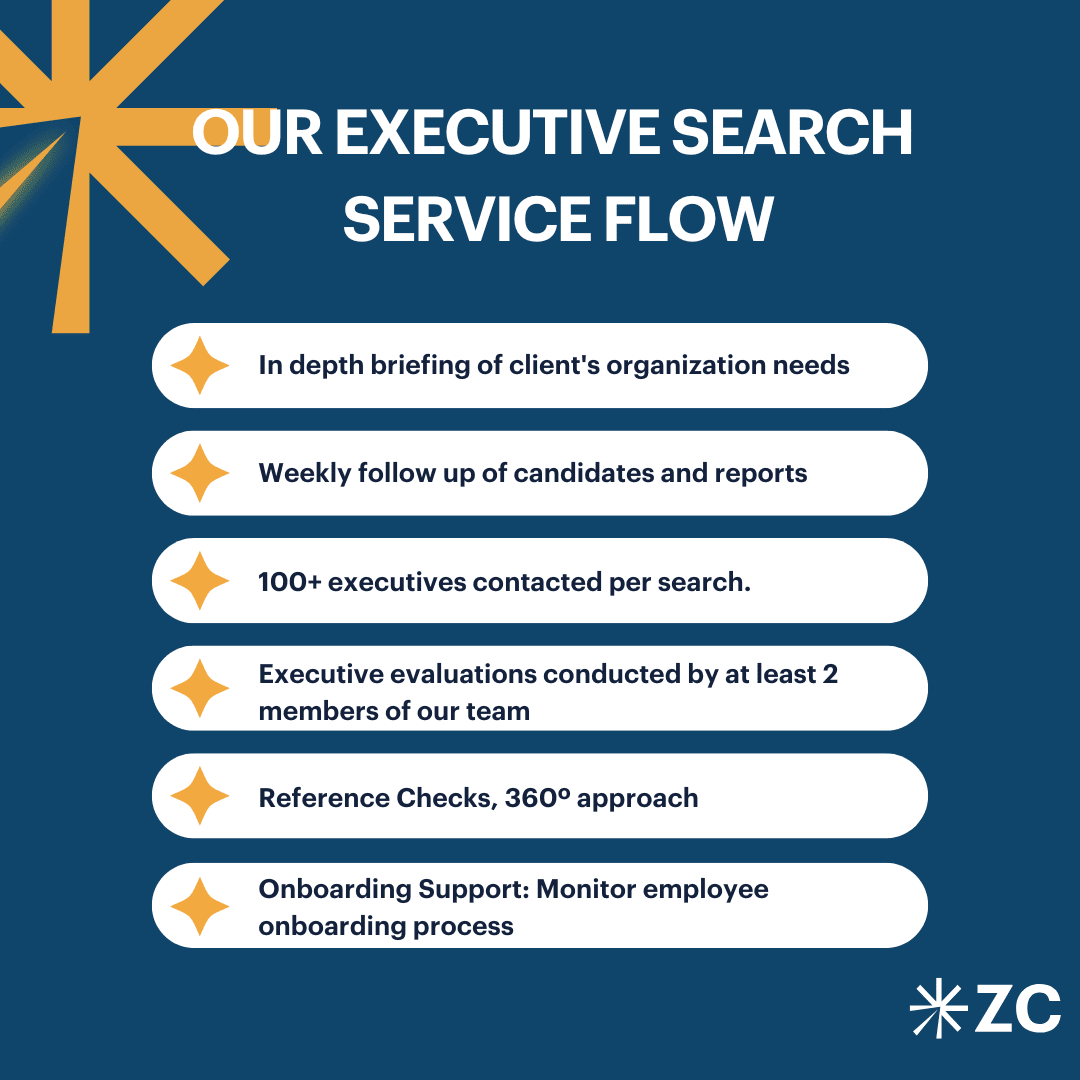
Zavala Civitas executive search methodology for China country

Executive Search en México: Líderes en EPC y Energías Renovables 

México se ha convertido en uno de los países más destacados de América Latina para el desarrollo de proyectos EPC (Ingeniería, Adquisiciones y Construcción) y energías renovables. Sin embargo, el financiamiento y la tecnología ya no son las mayores barreras.  Es el talento ejecutivo.  El crecimiento de este sector está

Read More

Executive Search in Mexico: Leading Sectors Shaping Demand 

Over the last few years, Mexico swiftly garnered international investment, earning it the title of one of the fastest-growing countries in capturing global foreign direct investments.   This scenario creates new talent opportunities.  Most Executive Search firms in Mexico have modified their approach from simply filling highest roles in an organization to competing for the extremely limited pool of qualified executive talent for all roles in all sectors.  The demand isn’t even  It is very much concentrated.  Where Demand is Actually Growing  Mexico’s hiring executive pressure is unequal across all sectors. Some sectors are faster and are pulling talent from other sectors. Manufacturing is the clearest example.  With nearshoring, Mexico is becoming a strategically important center for the supply chain for North America. This is due to the fact that international companies are relocating and/or expanding their operations in Mexico. This is supported by McKinsey & Company.  The growth of a business is dependent on its leadership. Companies are in need of quickly scalable plant directors, operations managers, and supply chain executives. Such profiles are deficit.  Executive Search Energy and Infrastructure: Complexity at Scale  There is the highest demand for executive talent within the energy and infrastructure sectors.  Major projects and regulatory complexities, as well as lengthy investments, require leaders who are comfortable with uncertainty in all the essential domains, not just the technical. This includes stakeholder

Read More

Executive Search in Spain: Talent Gaps and Leadership Trends 

The Spanish talent market is perceived to be mature and easy to operate in. This makes some sense from afar. There is a solid network of business centers, a developing international business presence, and a considerable pool of experienced talent.  Problems arise when businesses attempt to recruit senior executives.  In Spain, executive search is shifting from talent arbitrage to understanding the true gaps and the reasons behind their expansion.  Where the Talent Gaps Are Actually Emerging  Spain may appear to have many senior professionals, but the issues here are more complex.  The problem is not the experience, but the type of experience that is most required by the different companies.  As per McKinsey & Company, the nature of change of senior leadership roles in Europe is at a much quicker pace than the nature of change in the senior leadership roles in the talent pool. Executives are required who are able to be strategic, also have the ability to execute, and be the change agent.  That blend is still too little. This is especially the case in Spain in the industries that are shifting the fastest—energy transition, infrastructure, and technology. There are many executives who have strong functional experience, but far fewer who have held positions to manage large, complex transformations, or to operate internationally in complex situations.  This results in the mismatch between the hopes of the companies and the actual situation in the labor market.  The Shift from Stability to Transformation Leadership  For many years, leadership in Spain emphasized operational stability and incremental change.  This is not enough anymore.  At present, companies expect executives to manage change and uncertainty, and lead in multiple dimensions simultaneously, including at the same time digital transformation, new business models, and the increased need for operational efficiency. 

Read More

Related posts

Executive Search en México: Líderes en EPC y Energías Renovables 

México se ha convertido en uno de los países más destacados de América Latina para el desarrollo de proyectos EPC (Ingeniería, Adquisiciones y Construcción) y energías renovables. Sin embargo, el financiamiento y la tecnología ya no son las mayores barreras.  Es el talento ejecutivo.  El crecimiento de este sector está

Read More

Leadership in the Middle East: Why Fit Matters More Than Origin 

As companies in the Middle East scale and institutionalize, the long-standing debate around local versus international leadership in the Middle East is largely outdated. The real issue today is alignment: whether the leadership profile fits the business challenge the organization is facing.  Too often, leadership appointments are driven by assumptions: that international executives

Read More

The Role of Compliance Officers in Strategic Decision-Making

Over the past decade, the role of compliance functions within organizations has progressed significantly. Traditionally, compliance was responsible primarily for ensuring the company’s compliance with regulation, particularly that Relations to bribery and corruption.  They developed codes of conduct, supplier due diligence process and the like and were responsible for ensuring compliance with these by employees of

Read More

Executive Search in Mexico: Leading Sectors Shaping Demand 

Over the last few years, Mexico swiftly garnered international investment, earning it the title of one of the fastest-growing countries in capturing global foreign direct investments.   This scenario creates new talent opportunities.  Most Executive Search firms in Mexico have modified their approach from simply filling highest roles in an organization to competing for the extremely limited pool of qualified executive talent for all roles in all sectors.  The demand isn’t even  It is very much concentrated.  Where Demand is Actually Growing  Mexico’s hiring executive pressure is unequal across all sectors. Some sectors are faster and are pulling talent from other sectors. Manufacturing is the clearest example.  With nearshoring, Mexico is becoming a strategically important center for the supply chain for North America. This is due to the fact that international companies are relocating and/or expanding their operations in Mexico. This is supported by McKinsey & Company.  The growth of a business is dependent on its leadership. Companies are in need of quickly scalable plant directors, operations managers, and supply chain executives. Such profiles are deficit.  Executive Search Energy and Infrastructure: Complexity at Scale  There is the highest demand for executive talent within the energy and infrastructure sectors.  Major projects and regulatory complexities, as well as lengthy investments, require leaders who are comfortable with uncertainty in all the essential domains, not just the technical. This includes stakeholder

Read More

Executive Search in Spain: Talent Gaps and Leadership Trends 

The Spanish talent market is perceived to be mature and easy to operate in. This makes some sense from afar. There is a solid network of business centers, a developing international business presence, and a considerable pool of experienced talent.  Problems arise when businesses attempt to recruit senior executives.  In Spain, executive search is shifting from talent arbitrage to understanding the true gaps and the reasons behind their expansion.  Where the Talent Gaps Are Actually Emerging  Spain may appear to have many senior professionals, but the issues here are more complex.  The problem is not the experience, but the type of experience that is most required by the different companies.  As per McKinsey & Company, the nature of change of senior leadership roles in Europe is at a much quicker pace than the nature of change in the senior leadership roles in the talent pool. Executives are required who are able to be strategic, also have the ability to execute, and be the change agent.  That blend is still too little. This is especially the case in Spain in the industries that are shifting the fastest—energy transition, infrastructure, and technology. There are many executives who have strong functional experience, but far fewer who have held positions to manage large, complex transformations, or to operate internationally in complex situations.  This results in the mismatch between the hopes of the companies and the actual situation in the labor market.  The Shift from Stability to Transformation Leadership  For many years, leadership in Spain emphasized operational stability and incremental change.  This is not enough anymore.  At present, companies expect executives to manage change and uncertainty, and lead in multiple dimensions simultaneously, including at the same time digital transformation, new business models, and the increased need for operational efficiency. 

Read More

Executive Search in China: The Complexity of Hiring Executives

China is one of those markets where opportunities are easy to find but the right leaders are not.  many international firms, executive recruitment in China becomes challenging for one simple reason: the market does not act as they expect. What works for Europe or the US, tends to break down here.  Recruiting

Read More