
The Insider Paradox: Why APAC Boards Are Choosing Continuity Over Disruption 

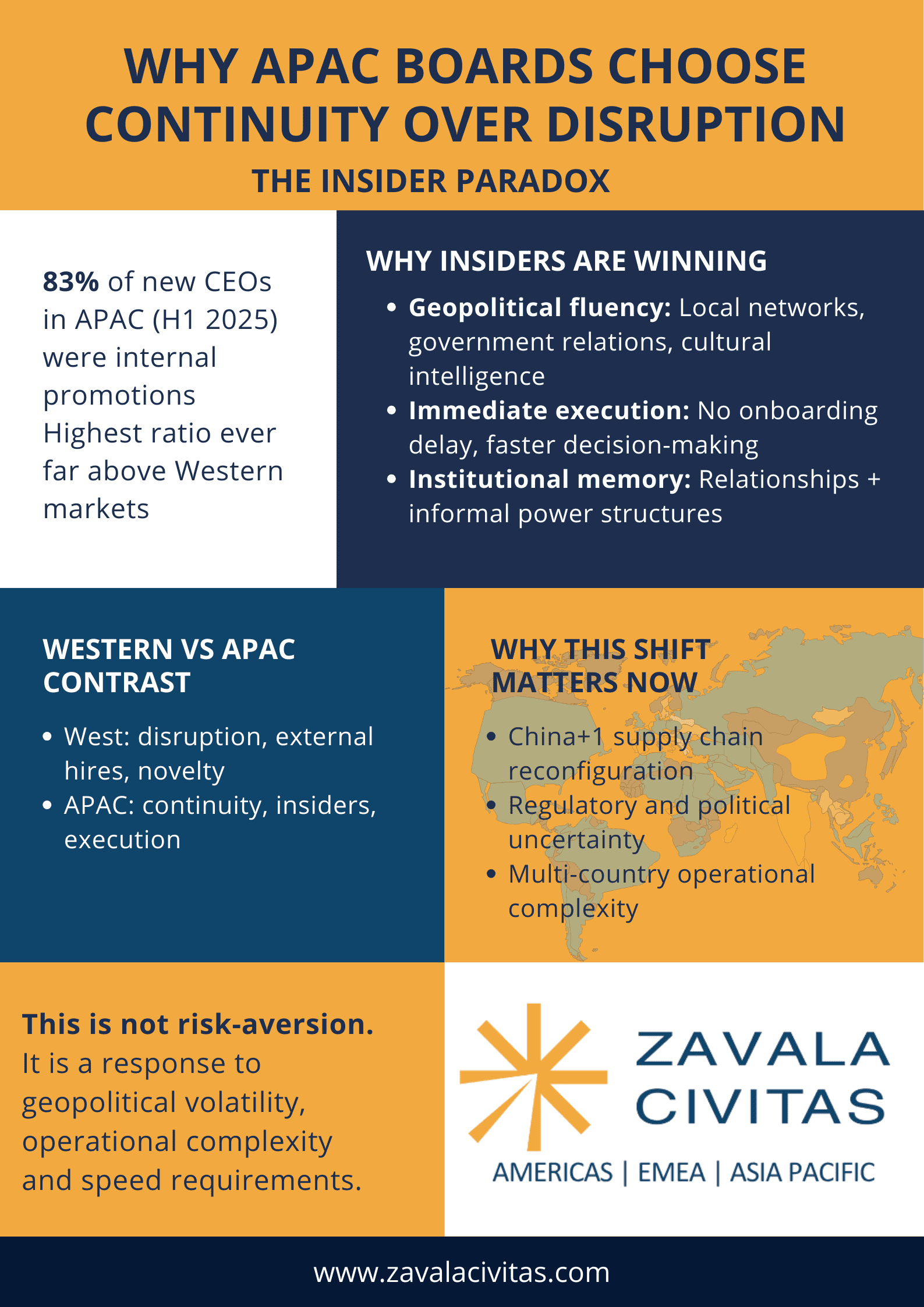
In H1 2025, 83% of all new CEOs in APAC were internal promotions the highest ratio ever recorded and dramatically higher than Western markets.  This surge is not accidental, nor is it a sign of risk-aversion. It reflects a deeper leadership strategy shaped by the geopolitical uncertainty of the region, operational complexity, and the rising value of institutional memory. APAC organisations are discovering that in an unpredictable environment, succession can secure continuity. 
The Data Behind the Insider Shift 

For years, global leadership narratives have celebrated the transformative power of external hires. Yet APAC companies are increasingly finding that “outsider disruption” does not always translate well in markets defined by cultural nuance, regulatory sensitivity, and multi-layered stakeholder ecosystems.  The data is clear: Most APAC Boards now believe insiders deliver better outcomes than external CEOs.  Compared to Western markets  where external CEO appointments remain far more common  APAC’s pivot signals that Boards value execution, integration speed, and contextual intelligence over novelty. In short, insiders know how to lead without destabilising. 

Why the Insider Profile Is Winning in APAC 

  1. Geopolitical Volatility Requires Predictability
With China+1 strategies reshaping supply chains, governments increasing scrutiny, and regulatory environments shifting rapidly, APAC Boards are prioritising leaders who already understand the geopolitical terrain.  Insiders bring familiarity with local networks, government relations and cultural dynamics that would take an external CEO years to build — time organisations cannot afford.   
  1. Operational Resilience Beats Theoretical Transformation
In industries such as manufacturing, logistics, consumer goods, and energy, execution speed determines competitive advantage.  External hires often require a significant onboarding period before they become effective. Insiders, however, can act immediately — informed by relationships, organisational rhythm and a clear understanding of operational realities.  Transformation in 2025 is no longer about radical disruption. It is about precision, stability and momentum — areas where insiders outperform.   
  1. Institutional Memory Has Become a Strategic Asset
APAC organisations are relationship-heavy and deeply interconnected. Much of the real organisational power sits in informal networks, long-term client relationships and cultural continuity.  Institutional memory — once dismissed as “legacy” — is now a strategic advantage. Boards increasingly see insiders as the leaders who can move the business forward without compromising stability.   

Implications for External Candidates 

External talent is not irrelevant — but the standards have evolved.  To compete with insider readiness, external candidates must demonstrate: 
  • Cross-market fluency across key APAC regions 
  • Evidence of resilience in volatile environments 
  • Ability to integrate fast into relationship-led cultures 
  • Sensitivity to stakeholder ecosystems unfamiliar to Western-based leaders 
Boards no longer reward disruption for its own sake. They reward leaders who can strengthen continuity while expanding capability.   

Guidance for Boards and Succession Committees 

This shift highlights a new reality: If insiders are the preferred successors, organisations must become far more proactive in preparing them.  A modern APAC succession strategy requires a dual pipeline: 
  1. High-potential internal leaders with structured development plans 
  1. External candidates used for benchmarking and market calibration 

Boards should prioritise: 

  • Identifying potential successors 3–5 years before transition 
  • Using assessments to map strengths, gaps and derailers early 
  • Providing P&L exposure, multi-country assignments and crisis-management experience 
  • Treating external candidates as pressure testers, not default alternatives 
The greatest succession risk today is not failing to attract outsiders — it is failing to prepare insiders. 

What This Means for APAC Executives 

For ambitious leaders, the message is clear: The strongest path to CEO in APAC is internal progression.  To rise as credible insider successors, executives must demonstrate: 
  • Strategic range that goes beyond operations 
  • Cross-market experience (SEA + China + India exposure) 
  • Ability to navigate complexity without destabilising the organisation 
The leaders who balance contextual depth with strategic clarity will define the next generation of APAC CEOs.   

Closing Insight 

APAC is entering a pro-insider leadership era. Boards are not rejecting transformation — they are ensuring it happens without unnecessary disruption. In a world where uncertainty is constant, the most valuable leaders are those who provide continuity, clarity and operational intelligence.  The next CEO of many APAC organisations is already inside the company today. The real question is whether Boards are preparing them deliberately and early enough  to take the helm. Click here to get in contact with us.  


Picture of Maria Bosch

Maria Bosch

Strategic HR Executive with 20+ years of global experience across APAC and EMEA, advising Boards and C-suite leaders on talent and succession.
Former BCG, McKinsey and Oliver Wyman, with deep expertise in workforce transformation and APAC industrial relations.

Strategic Reflections on Succession Planning

On the last webinar we presented, which I had the pleasure of co-presenting with Javier Alonso Solá, we explored the essential principles of effective succession planning. We explored the common challenges organizations face as well as the reasons it must be integrated into any long-term strategic agenda aiming to ensure

Read More

Related posts

law leaders working on new emerging areas for monetization

How Law Firms Build and Monetize Emerging Practice Areas

Innovation as a Structural Imperative The legal sector has entered a stage where innovation is no longer about adopting technology or improving efficiency. It has become structural: the ability of a firm to anticipate, frame, and institutionalize new legal fields now defines its competitiveness. Emerging topics such as Artificial Intelligence

Read More

Executive Search: What Roles Will Shape the U.S. EPC Sector in 2026? 

Companies that want to stay ahead of industry shifts in 2026 must identify which senior roles will drive execution certainty, risk governance, and technical excellence in increasingly complex environments.  Why 2026 Will Be a Defining Moment for the U.S. EPC Industry  Federal and state infrastructure investment entering full execution Project pipelines for

Read More
executive team working on a business case

Executive Development and Assessment in Portugal: How Companies Improve Leadership Quality 

Executive assessment and leadership development are rapidly gaining relevance in Portugal as organizations face digital transformation, talent shortages, and increasing competitive pressure. Portuguese companies are recognizing that strong leadership is not a by-product of experience alone—it requires structured evaluation, targeted development, and continuous support.  According to Ken Research, Portugal’s corporate

Read More
Dubai executive buildings

Carla Geday joins Zavala Civitas as Senior Advisor, Middle East 

November 11, 2025 Zavala Civitas is pleased to announce the appointment of Carla Geday as Senior Advisor, where she will play a key role in advancing the firm’s strategic initiatives and expansion across the Middle East. Carla brings over two decades of international experience in corporate strategy, business development, and

Read More