
Last updated: August 13, 2026
There has been a great transformation in executive assessment in Germany due to the changing business environment, which requires effective leadership. German firms are embracing sophisticated appraisal tools for identifying and grooming top executives, owing to technological advancements and globalisation. This article looks into the current state of executive assessment in Germany — discussing challenges, opportunities, and perspectives on this critical factor of business success. Learn more about our executive assessment and leadership development programme.
Key Figures at a Glance
| Data point | Finding | Source |
|---|---|---|
| Large German corporations using psychometric tests in executive assessment | 75% | German Federal Ministry of Labour and Social Affairs |
| German companies believing executive assessments improve leadership decisions | 60% | PwC Germany |
| Key legal context making accurate assessment critical | KSchG employment protection — executive termination significantly more difficult and expensive than in most major markets | Kündigungsschutzgesetz (German Employment Law) |
| GDPR data privacy context | Assessment data handling subject to GDPR — digital platforms must meet strict consent, retention, and security requirements | EU GDPR / German Federal Data Protection Act |
Current State of Executive Assessment in Germany
Executive evaluation in Germany is conducted through objective methods including analysis of leadership capabilities, critical thinking, and cultural fit. 75% of large German corporations use psychometric tests as part of their executive assessment process, and 60% believe these assessments make significant contributions to improved leadership decisions (PwC). Sophisticated appraisal tools are increasingly used for identifying and developing top executives — with digital platforms expanding the accessibility and scalability of assessment processes across company sizes.
Why Executive Assessment is Crucial in Germany
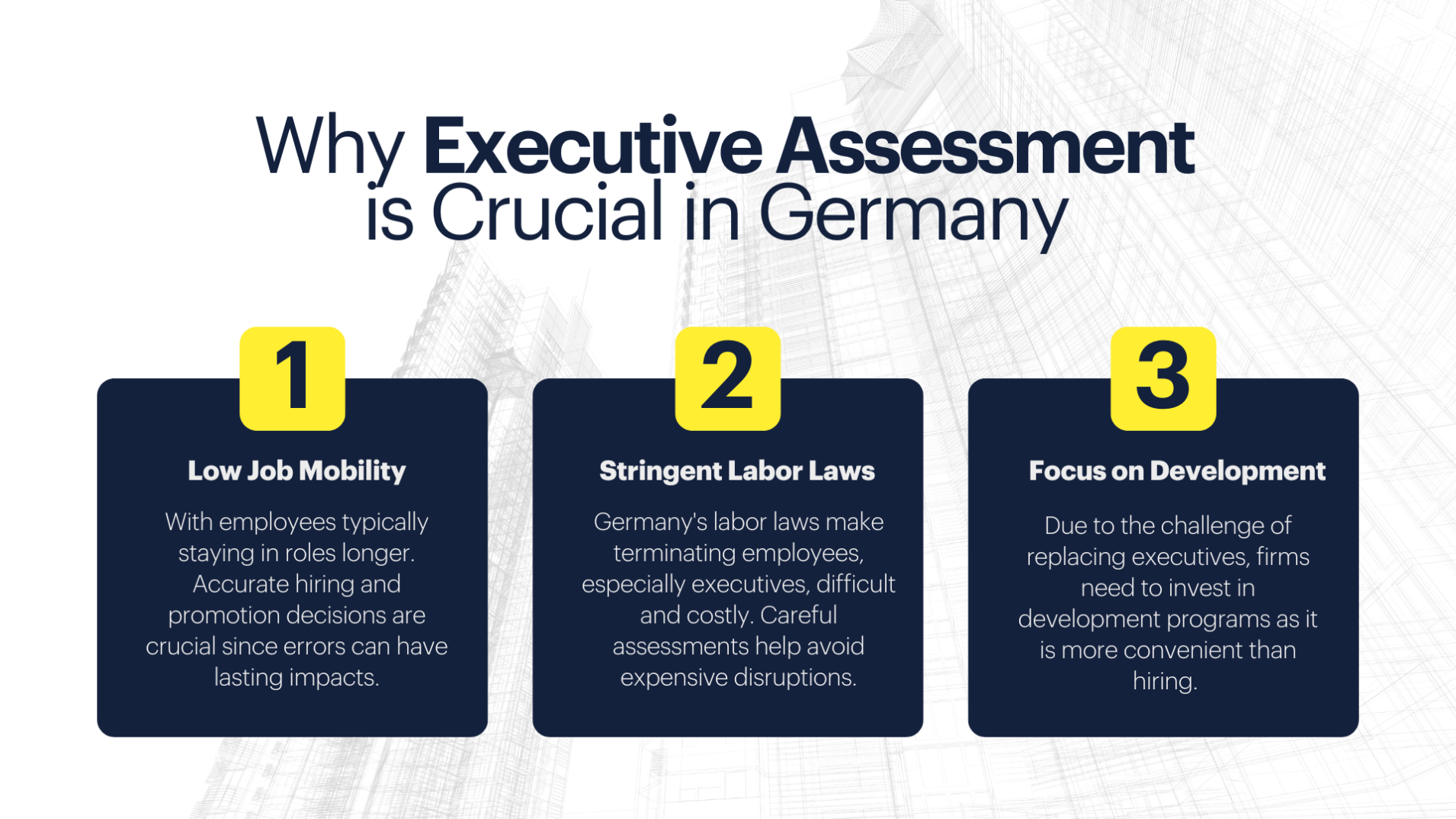
- Low job mobility: Germany has relatively lower job mobility compared to other major markets — with executives remaining longer in their roles. This means that a wrong appointment choice may have far-reaching consequences that are difficult and expensive to correct, making first-time assessment accuracy a governance priority of a different magnitude than in high-mobility markets.
- Stringent labour laws: Terminating employees at the executive level can be difficult under Germany’s Kündigungsschutzgesetz (KSchG) — with long notice periods and significant severance payment obligations. Companies must carry out executive assessments carefully to avoid the costly disruptions that dismissal in Germany creates relative to other major markets.
- Focus on development and improvement: Due to the difficulty of replacing executives, German firms invest heavily in development programmes for existing leadership. Assessment provides the foundation for those programmes — giving organisations insight into individual strengths and areas requiring improvement to structure targeted development interventions rather than generic leadership training.
Challenges in Executive Assessment
- Cultural differences: Navigating cultural complexities in Germany’s diverse workforce requires a nuanced assessment approach that ensures fair and unbiased evaluation — particularly as Germany’s international business environment increasingly requires assessment frameworks that are calibrated for a multicultural executive leadership market.
- Technological integration: While technology has brought sophisticated assessment tools, its integration into existing HR systems can be complex and expensive — and the assessment must meet GDPR data privacy requirements at every stage of the digital process.
- Regulatory compliance: Germany’s strict GDPR implementation creates specific requirements for consent, data retention, cross-border data transfer restrictions, and security standards that digital assessment platforms must meet — requiring assessment firms to ensure their platforms are fully GDPR-compliant, not just generally data-privacy conscious.
Opportunities in Executive Assessment
- Enhanced predictive analytics: AI and machine learning in executive assessment offer predictive insights — enabling companies to forecast leadership success and make data-driven decisions that complement rather than replace the human judgment that remains essential in the assessment stage.
- Tailored development programmes: Assessment data creates personalised development plans — fostering continuous leadership growth that is both more efficient than generic programmes and more effective at addressing the specific capability gaps that the assessment process has identified.
- Global talent acquisition: Germany’s remote work trend has enabled companies to select executive talent globally — expanding the scope for leadership search beyond the domestic German market when the specific capabilities required have not been developed in the domestic executive pipeline at the required density.
The future of executive assessment in Germany hinges on a seamless blending of technology with human intuition. Advanced appraisal tools produce invaluable information — but the human element remains indispensable when interpreting those findings and making holistic decisions that account for the organisational and cultural context that no assessment tool can fully capture. German companies can identify and develop leaders effectively by adopting advanced tools while applying human-centric evaluation approaches that enable them to remain competitive in the global market.
Click here to contact with us.
Frequently Asked Questions: Executive Assessment in Germany
Rigorous executive assessment for German leadership appointments?
Zavala Civitas provides KSchG-context-aware, GDPR-compliant executive assessment for German organisations — calibrated for the specific legal and governance framework that makes German first-time assessment quality a board-level priority.