
Executive Development and Assessment in Spain: What Leadership Skills Are People Developing This Year? 

A turning point for leadership in Spain 

Spain’s corporate scene is moving into a new phase. Digital transformation, ESG expectations, and hybrid work models have combined to change what organisations need from their senior teams. Instead of searching for leaders who can “manage the business as it is,” boards are prioritising those who can reimagine it — leaders who are strategic, resilient and human-centred. That shift reframes executive development: it must be diagnostic, personalised and tightly linked to measurable organisational outcomes. 

Which leadership skills are taking priority in 2026? 

  • Strategic agility
    The ability to anticipate change, test scenarios and pivot quickly is now central. Executives are being developed to think in systems, to prioritise speeded learning cycles, and to translate uncertainty into actionable bets rather than paralysis. 
  • Emotional intelligence at scale
    Managing teams across hybrid and remote setups requires heightened social acuity. Executive development programmes emphasise emotional regulation, difficult-conversation skills and stakeholder empathy as central leadership competencies — not optional extras. 
  • Digital fluency and data judgement
    It is no longer sufficient for a leader to “understand digital.” The expectation is to make data-informed trade-offs, interrogate AI-driven recommendations, and set priorities that balance automation with human judgement. 
  • Purpose-driven decision making
    With ESG rising from compliance to strategy, leaders are trained to align commercial goals with societal impact. This means embedding sustainability into decisions, engaging stakeholders authentically and communicating purpose with credibility. 
  • Resilience and self-awareness
    Continuous pressure and rapid change make personal resilience a board-level concern. Programs that improve stress management, reflective practice and energy sustainability are now read as risk-management measures. 


Executive Assessment and development as the backbone of meaningful leadership in Spain

High-performing organisations are treating assessment as the foundation for any development investment. Rather than generic leadership workshops, the most effective programmes begin with robust diagnostics: cognitive and behavioural mapping, 360° feedback calibrated to business KPIs, simulation-based evaluations and targeted psychometrics. These tools help convert subjective impressions into objective signals about potential, readiness and development ROI. 

Crucially, data alone is not the end point. The interpretation of assessment results — translating patterns into bespoke learning pathways, succession maps and stretch assignments — determines whether investment yields behavioural change and measurable business impact. 

From coaching to strategic transformation 

Development is migrating from HR checklists into corporate strategy. Best-practice organisations blend executive coaching with peer-learning cohorts, rotational experiences and problem-led residencies that expose leaders to real transformation challenges. These modalities accelerate transfer of learning to on-the-job performance and create a pipeline of leaders who can both deliver and transform. 

Another common pattern: modular, longitudinal programmes replacing one-off interventions. Progress is measured against concrete business milestones — not only participant satisfaction scores. 

The role of executive search and advisory firms 

Executive search firms that integrate assessment and development bring disproportionate value at board level. By aligning talent diagnostics with market mapping and succession planning, these advisors help clients make anticipatory choices: identifying hidden successors, planning staged leadership handovers and designing retention levers that matter. In practice, this means search firms act as long-term partners — from talent identification through to onboarding and leadership acceleration. 

What organisations should be doing now 

  • Begin with diagnosis: invest in assessment suites that combine behavioural and situational evidence. 
  • Link development to strategic priorities: every leadership program should map to a clear business outcome. 
  • Design for durability: use multi-modal, longitudinal development rather than episodic training. 
  • Prioritise leader wellbeing: resilience is now an operational necessity. 
  • Build cross-border perspective: Spanish leaders must be fluent in global markets while rooted in local context. 

The leaders who will define Spain’s economic decade are those who can learn faster than competitors, make ethically informed decisions, and lead diverse teams through complexity. Technology will sharpen assessment capabilities, but leadership will remain a fundamentally human practice: judgement, trust and influence will still determine who succeeds. 
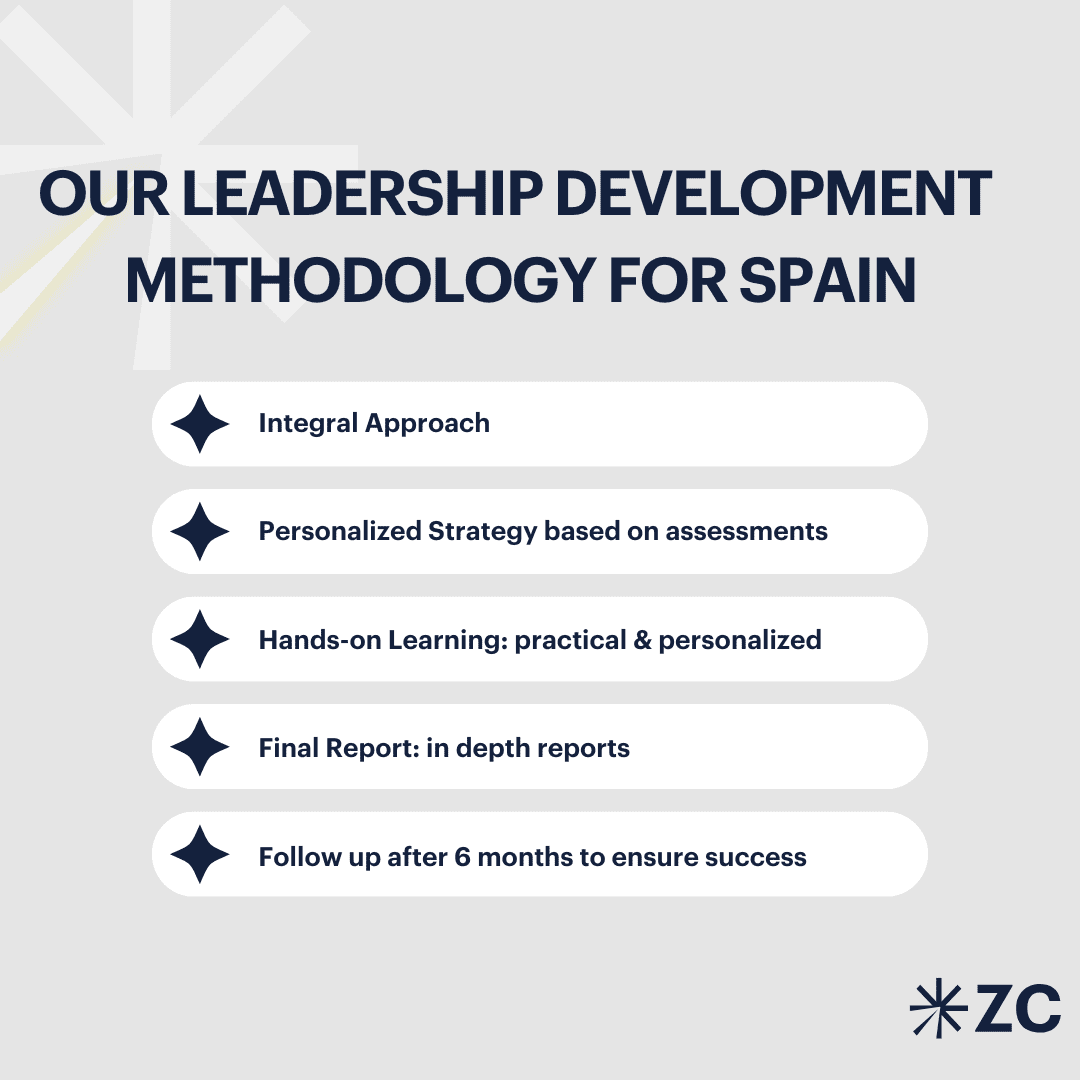
Learn about our leadership development methodology for Spain

About Zavala Civitas
Zavala Civitas partners with Spanish and international organisations to design leadership strategies that combine diagnostic rigour with pragmatic development. The Executive Development & Assessment practice helps boards and HR leaders identify potential, accelerate readiness and embed leadership that lasts. 

Contact the Leadership Advisory team in Spain to discuss how a tailored assessment and development programme can secure your next generation of leaders clicking here.


executive team working on a business case

Executive Development and Assessment in Portugal: How Companies Improve Leadership Quality 

Executive assessment and leadership development are rapidly gaining relevance in Portugal as organizations face digital transformation, talent shortages, and increasing competitive pressure. Portuguese companies are recognizing that strong leadership is not a by-product of experience alone—it requires structured evaluation, targeted development, and continuous support.  According to Ken Research, Portugal’s corporate

Read More

Executive Development and Assessment in the U.S: From Evaluation to Strategic Growth

The new approach to executive growth in the U.S.  Across the U.S., organizations are moving away from traditional performance reviews and investing in data-driven development. Rather than evaluating results retrospectively, American companies now focus on predicting potential — using analytics and behavioral insights to identify executives capable of steering transformation. 

Read More

What Law Firms Should Look for in Future Partners 

In law firms, partnership has long been the reward for technical mastery. High billable hours, legal expertise, and client loyalty were historically the core indicators of readiness. But the demands of the partner’s role and the expectations of clients and colleagues have become increasingly competitive.  From Legal Expert to Business

Read More

Related posts

Executive Search en México: Líderes en EPC y Energías Renovables 

México se ha convertido en uno de los países más destacados de América Latina para el desarrollo de proyectos EPC (Ingeniería, Adquisiciones y Construcción) y energías renovables. Sin embargo, el financiamiento y la tecnología ya no son las mayores barreras.  Es el talento ejecutivo.  El crecimiento de este sector está

Read More

Leadership in the Middle East: Why Fit Matters More Than Origin 

As companies in the Middle East scale and institutionalize, the long-standing debate around local versus international leadership in the Middle East is largely outdated. The real issue today is alignment: whether the leadership profile fits the business challenge the organization is facing.  Too often, leadership appointments are driven by assumptions: that international executives

Read More

The Role of Compliance Officers in Strategic Decision-Making

Over the past decade, the role of compliance functions within organizations has progressed significantly. Traditionally, compliance was responsible primarily for ensuring the company’s compliance with regulation, particularly that Relations to bribery and corruption.  They developed codes of conduct, supplier due diligence process and the like and were responsible for ensuring compliance with these by employees of

Read More

Executive Search in Mexico: Leading Sectors Shaping Demand 

Over the last few years, Mexico swiftly garnered international investment, earning it the title of one of the fastest-growing countries in capturing global foreign direct investments.   This scenario creates new talent opportunities.  Most Executive Search firms in Mexico have modified their approach from simply filling highest roles in an organization to competing for the extremely limited pool of qualified executive talent for all roles in all sectors.  The demand isn’t even  It is very much concentrated.  Where Demand is Actually Growing  Mexico’s hiring executive pressure is unequal across all sectors. Some sectors are faster and are pulling talent from other sectors. Manufacturing is the clearest example.  With nearshoring, Mexico is becoming a strategically important center for the supply chain for North America. This is due to the fact that international companies are relocating and/or expanding their operations in Mexico. This is supported by McKinsey & Company.  The growth of a business is dependent on its leadership. Companies are in need of quickly scalable plant directors, operations managers, and supply chain executives. Such profiles are deficit.  Executive Search Energy and Infrastructure: Complexity at Scale  There is the highest demand for executive talent within the energy and infrastructure sectors.  Major projects and regulatory complexities, as well as lengthy investments, require leaders who are comfortable with uncertainty in all the essential domains, not just the technical. This includes stakeholder

Read More

Executive Search in Spain: Talent Gaps and Leadership Trends 

The Spanish talent market is perceived to be mature and easy to operate in. This makes some sense from afar. There is a solid network of business centers, a developing international business presence, and a considerable pool of experienced talent.  Problems arise when businesses attempt to recruit senior executives.  In Spain, executive search is shifting from talent arbitrage to understanding the true gaps and the reasons behind their expansion.  Where the Talent Gaps Are Actually Emerging  Spain may appear to have many senior professionals, but the issues here are more complex.  The problem is not the experience, but the type of experience that is most required by the different companies.  As per McKinsey & Company, the nature of change of senior leadership roles in Europe is at a much quicker pace than the nature of change in the senior leadership roles in the talent pool. Executives are required who are able to be strategic, also have the ability to execute, and be the change agent.  That blend is still too little. This is especially the case in Spain in the industries that are shifting the fastest—energy transition, infrastructure, and technology. There are many executives who have strong functional experience, but far fewer who have held positions to manage large, complex transformations, or to operate internationally in complex situations.  This results in the mismatch between the hopes of the companies and the actual situation in the labor market.  The Shift from Stability to Transformation Leadership  For many years, leadership in Spain emphasized operational stability and incremental change.  This is not enough anymore.  At present, companies expect executives to manage change and uncertainty, and lead in multiple dimensions simultaneously, including at the same time digital transformation, new business models, and the increased need for operational efficiency. 

Read More

Executive Search in China: The Complexity of Hiring Executives

China is one of those markets where opportunities are easy to find but the right leaders are not.  many international firms, executive recruitment in China becomes challenging for one simple reason: the market does not act as they expect. What works for Europe or the US, tends to break down here.  Recruiting

Read More