Key Takeaway: CEO turnover in the US reached 12.5% in 2025 — the highest in eight years — and 33% of new CEOs are external hires. In an environment where PE investment hit $1.2 trillion and succession pressure is structural, executive development and assessment are no longer HR programmes. They are the mechanism that determines whether an organisation has leadership ready for what comes next.
Last updated: August 13, 2026
The New Approach to Executive Growth in the U.S.
Across the U.S., organisations are moving away from traditional performance reviews and investing in data-driven development. Rather than evaluating results retrospectively, American companies now focus on predicting potential — using analytics and behavioural insights to identify executives capable of steering transformation.
This shift reflects a broader trend: development and assessment are no longer HR processes, but strategic tools for business resilience and competitiveness.
What Defines Effective Executive Development in the U.S. Today
Modern U.S. programmes go beyond classroom training. They integrate coaching, simulation-based challenges, and real-time feedback to accelerate decision-making and adaptability. Core focus areas for 2026 include:
- Strategic agility in volatile markets.
- Cross-functional collaboration and inclusion.
- Digital and data fluency.
- Ethical and purpose-aligned management.
By linking these capabilities to measurable business outcomes, companies ensure development efforts deliver tangible ROI.
With CEO turnover at 12.5% — the highest in eight years — and 33% of new CEOs coming from outside the organisation, the US market is signalling that internal leadership pipelines are not generating enough succession-ready executives at the required pace. That is not a hiring failure. It is a development failure that surfaces at the succession moment. The organisations that have invested in structured assessment and targeted development three to five years earlier are finding the transition faster, less disruptive, and significantly less expensive than those who begin the process when the vacancy is already open.
Assessment Powered by Data and AI
American firms are adopting predictive tools that map behavioural patterns, cognitive agility, and stress-response tendencies. AI-supported assessment allows boards to identify succession gaps, forecast performance, and tailor growth plans for each executive.
Still, technology complements — not replaces — the human perspective. Data informs judgement, but culture fit and integrity remain decisive factors. With 88% of U.S. organisations now using AI in their operations (McKinsey, 2025), the pressure to embed AI fluency in executive competency frameworks is structural — not a future consideration.
The U.S. PE market at $1.2 trillion is creating a specific and growing demand for executives who have been assessed and developed for portfolio leadership — not just operational management. A CFO or portfolio COO in a PE-backed environment is not managing a stable corporate structure. They are managing a value creation timeline with specific milestones, investor reporting obligations, and an exit horizon that shapes every strategic decision. Developing that executive profile before the investment close, not after it, is the difference between a 3x and a 5x return on human capital.
Why Integration Matters
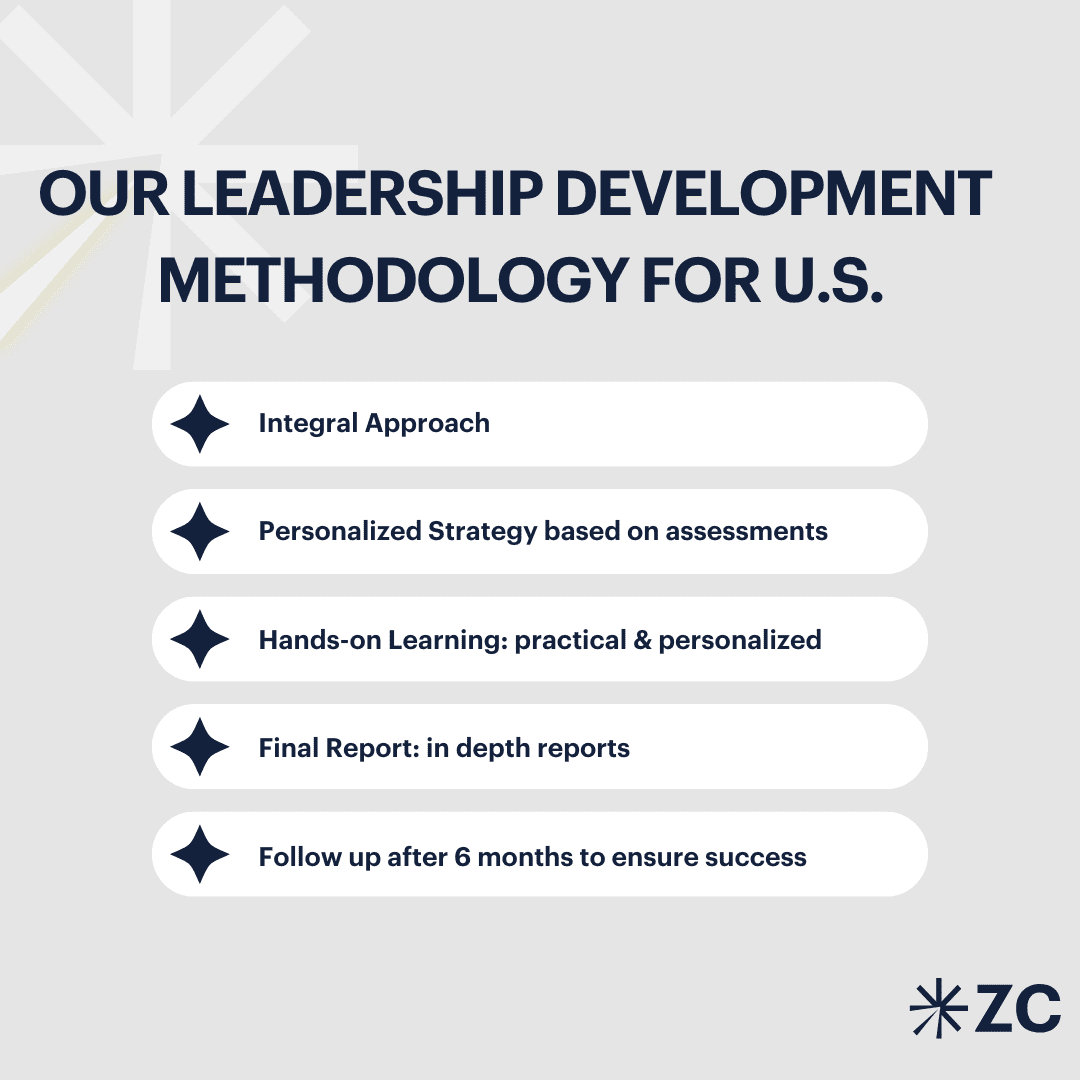
The most advanced organisations in the U.S. combine executive search, assessment, and development into one continuum. This integrated approach helps anticipate future needs, strengthen succession pipelines, and align management capabilities with long-term strategy.
For international companies expanding in or from the U.S., this model ensures consistency across markets while respecting cultural nuance.
In 2026, success in the American market will depend on identifying and growing executives who can adapt quickly, act ethically, and drive innovation through uncertainty. Assessment provides the insight; development turns it into sustained performance.
About Zavala Civitas
Zavala Civitas supports U.S. and global organisations through integrated executive search, assessment, and development solutions. Our advisory practice helps boards and investors anticipate talent needs, measure potential accurately, and design strategies that secure long-term growth.
Contact our U.S. Leadership Advisory team to learn how predictive assessment and executive development can strengthen your management pipeline by clicking here.
Frequently Asked Questions: Executive Development and Assessment in the U.S.
Why is CEO turnover at an 8-year high in the U.S. — and what does that signal about executive development?
It signals that internal succession pipelines are not generating enough leadership at the pace and quality required by a market that is moving faster than development programmes can track. When 33% of new CEOs come from outside the organisation, it is partly a reflection of external search capacity — and partly a reflection of internal development programmes that have not been building at the right pace, with the right people, against the right mandate. The organisations with low CEO turnover disruption in 2025 are not the ones who hired better. They are the ones who developed earlier.
How has the shift to AI-powered assessment changed what US boards can know about executive potential?
It has shifted the knowledge from retrospective (what has this executive delivered) to predictive (how will this executive perform under the specific conditions ahead). Behavioural pattern mapping, cognitive agility assessment, and stress-response modelling can now inform succession decisions with a level of structured evidence that was not previously available. The risk is over-reliance on data without human judgement — culture fit, ethical integrity, and leadership influence are not yet reliably captured by AI-only assessment.
Why does the U.S. PE market create specific executive development needs that corporate environments do not?
Because PE-backed executives operate against a value creation timeline with a defined exit horizon — which changes every strategic decision, every capital allocation choice, and every governance trade-off. A CFO or COO in a PE environment who has not been developed for portfolio leadership will apply corporate operating principles to a context that requires fundamentally different judgment. The development investment before the close, not after the first 100-day review, is where PE returns are actually protected.
What does an integrated executive search, assessment, and development approach look like in practice?
It treats the hire as the beginning of a longer process, not the end of one. The assessment that informed the selection decision continues as a baseline for development planning. The development plan is anchored to the actual mandate the executive was hired to deliver, not to generic competency frameworks. And the search process surfaces not just the best available candidate, but the executive most likely to grow into the requirements the role will place on them 18–36 months after joining.
How does Zavala Civitas approach executive development and assessment for U.S. organisations?
Through an integrated continuum of executive search, structured assessment (including psychometric evaluation and 360° references), and development planning anchored to the specific mandate and organisational context of each leader. For international companies operating in the U.S., we ensure cultural calibration alongside the standard assessment dimensions. For PE-backed environments, we structure assessment specifically against the value creation timeline and exit horizon. With a 92% closing rate across completed mandates.