
Last updated: August 13, 2026
In Portugal’s fast-changing economy, building future-ready executives is no longer optional. According to Eurostat, over 60% of Portuguese companies cite leadership capability gaps as a key obstacle to growth — especially in sectors like technology, industry, and energy. As Lisbon, Porto, and other regions attract increasing foreign investment, organisations are recognising the urgent need to prepare managers capable of leading expansion. Yet many still lack structured strategies to develop their senior teams effectively.
Key Figures at a Glance
| Data point | Figure | Source |
|---|---|---|
| Portuguese companies citing leadership capability gaps as an obstacle to growth | 60%+ | Eurostat |
| Portuguese organisations that increased leadership development investment (2022–2023) | 62% | Randstad Portugal |
| Portugal corporate training and executive development market size | >USD 1.2 billion | Ken Research |
| Multinational companies with operations in Portugal | +2,700 — creating demand for internationally capable executive leadership | AICEP Portugal Global |
Why Structured Leadership Development Still Lags in Portugal
Compared to other European markets, many Portuguese firms rely on informal learning to prepare future executives. Structured management training programmes, coaching, and assessments are often missing — limiting companies’ ability to build competitive leadership pipelines.
The paradox is that investment is growing: 62% of Portuguese organisations increased their leadership development investment in 2022–2023 (Randstad). But investment without structure produces activity rather than capability. Sending managers on programmes that do not connect to their specific development needs, their next role requirements, or their organisation’s strategic context generates training hours without leadership readiness.
The Risks of Promoting Technical Experts into Executive Roles
Portuguese companies frequently promote operational specialists into management positions without providing training in strategic thinking or people management. This limits their ability to lead teams effectively and slows organisational growth.
The technical expert who is promoted into an executive role without structured transition support does not fail because they lack capability. They fail because the capabilities that made them excellent in the previous role — deep functional expertise, individual problem-solving, technical precision — are not the capabilities that determine success in the new one. No amount of functional competency compensates for the absence of strategic thinking, stakeholder management, and leadership under ambiguity.
Cultural Barriers to Building Strong Leaders in Portugal
In many Portuguese firms, leadership is viewed as something learned through experience. Formal feedback processes and structured skill-building remain rare — particularly outside Lisbon and Porto. Soft skills like communication and adaptability are often overlooked in favour of technical competency and institutional seniority.
This cultural model produces leaders who are experienced but rarely self-aware about the specific dimensions of their leadership that limit their effectiveness at the next level.
Generational Expectations Are Changing Talent Development in Portugal
A new generation of professionals in Portugal is reshaping expectations around career development. Millennials and Gen Z employees increasingly prioritise companies that offer structured growth opportunities, ongoing coaching, and transparent career pathways. They view professional development not as a privilege for a few, but as a standard part of employment.
Many Portuguese firms continue to rely on informal, unstructured development models that fail to engage younger talent. Without clear progression frameworks and investment in skill-building, high-potential employees are likely to seek opportunities elsewhere — often with the 2,700+ multinationals operating in Portugal that offer more formalised leadership development programmes.
To attract and retain this next generation of leaders, companies in Portugal must rethink how they approach executive development, embedding coaching and structured advancement into their talent strategies.
What Portuguese Companies Can Do to Build Stronger Leadership Teams
Forward-thinking businesses in Portugal are:
- Implementing management training and structured executive programmes anchored to specific role transitions rather than generic competency frameworks.
- Using leadership assessments to identify the specific capability gaps between current performance and next-role readiness.
- Offering executive coaching to help managers transition into strategic roles — with the coaching agenda defined by assessment results, not self-reported development priorities.
- Aligning skill-building with retention strategies — so that development investment is visible, structured, and communicated as part of the organisation’s commitment to career growth.
These actions help create resilient management teams ready to lead future growth — and to retain the high-potential talent that will either be developed internally or recruited externally by a competitor.
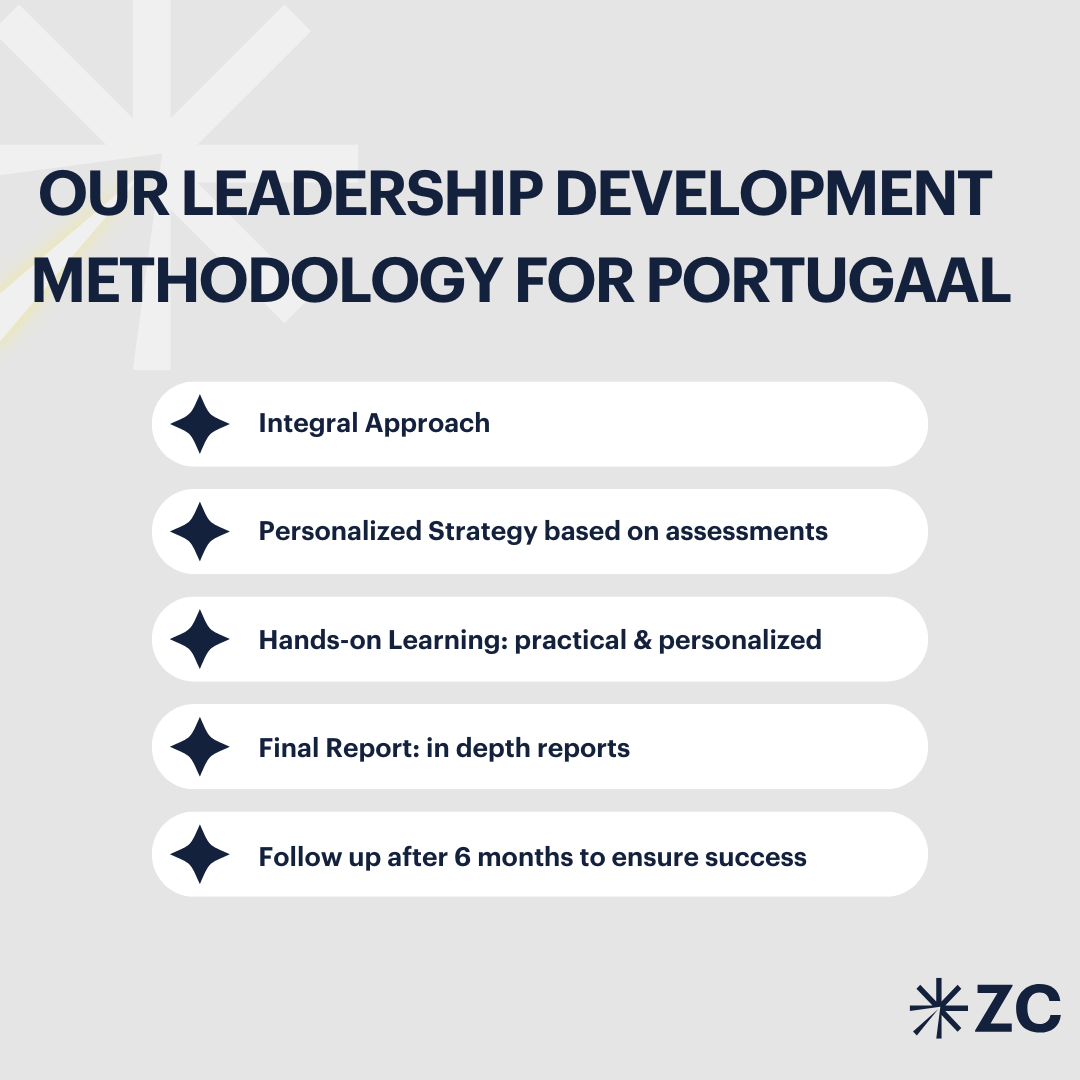
Executive Development in Portugal — The Strategic Imperative
Executive development is no longer optional for companies aiming to compete locally and globally. In a market with 2,700+ multinationals setting the development benchmark and a generation of professionals who will choose their employer partly on development quality, the Portuguese companies that build structured executive development programmes now are building a competitive advantage that compounds over time.
Contact us today to design a structured management development strategy tailored to your organisation’s needs.
Frequently Asked Questions: Executive Development in Portugal
Building a structured executive development programme in Portugal?
Zavala Civitas designs assessment-anchored development programmes for Portuguese companies and multinationals in Portugal.