
Last updated: August 13, 2026
China, among the world’s leading economies today, demonstrates how significant executive leadership development has become within its organisations. As the second-largest economy and a major player in global markets, China has unique issues and prospects in relation to effective leader formation. This article explains why leadership development is important in China and points out some of the challenges that organisations face when wanting to improve their leadership strategies. Learn more about our executive assessment and leadership development programme.
Key Figures at a Glance
| Context factor | Leadership development implication |
|---|---|
| China’s economic position | World’s second-largest economy — requires leaders managing complex market dynamics and global competitiveness simultaneously |
| Confucian cultural framework | Hierarchical obedience and collective well-being over individualism — contradicts Western flat-structure and individualist leadership approaches |
| Education system legacy | Historically focused on memorisation and exam scores — produces technically strong workforce but undertrained in the soft skills that leadership requires |
| Government-business relationship | Leaders must navigate relationships with officials who influence business through shifting policies — political intelligence is a core leadership competency in China |
Why Leadership Development is Important in China
- Sustaining economic growth and global influence: For continued economic growth, effective leadership must handle complex market dynamics and drive innovation. As Chinese firms expand globally, they rely heavily on leaders who can operate across borders, build international partnerships, and compete effectively against organisations from markets with longer global leadership track records.
- Talent management and retention: The high demand for skilled leaders in China creates a leadership gap that continuous development programmes address — providing the career growth opportunities that talented young professionals require to remain with an organisation.
- Adapting to rapid changes: The pace of technological advancement and digital transformation calls for leaders who can guide their organisations through change successfully. The Chinese market’s shifting consumer preferences and competitive pressures require flexible and strategic leadership that can calibrate direction without the luxury of long lead times.
- Cultural and organisational development: Leadership development creates positive organisational culture aligned with company values and strategic goals — and as more Chinese firms collaborate internationally, leaders need the cross-cultural competency required for multinational teams and intercultural relationship building.
- Enhancing corporate governance: Leadership development creates leaders who can maintain corporate integrity and comply with the regulatory framework — identifying and managing risks in a way that ensures long-term business sustainability in China’s specific regulatory environment.
- Innovation and competitiveness: Leadership programmes that promote creative thinking and problem-solving encourage innovation and competitive differentiation — enabling leaders to align their companies with emerging opportunities in China’s rapidly evolving market.
- Responding to government policies: Given China’s strict regulatory environment and active government role in business affairs, leaders must understand government policies and the relationship management with agencies that facilitates national projects and policy implementation.
- Building resilient organisations: Organisations require leaders who maintain performance through economic downturns, geopolitical tensions, and operational shocks — the specific resilience capability that China’s particular exposure to sudden policy shifts and external trade pressures demands.
Challenges of Executive Leadership Development in China
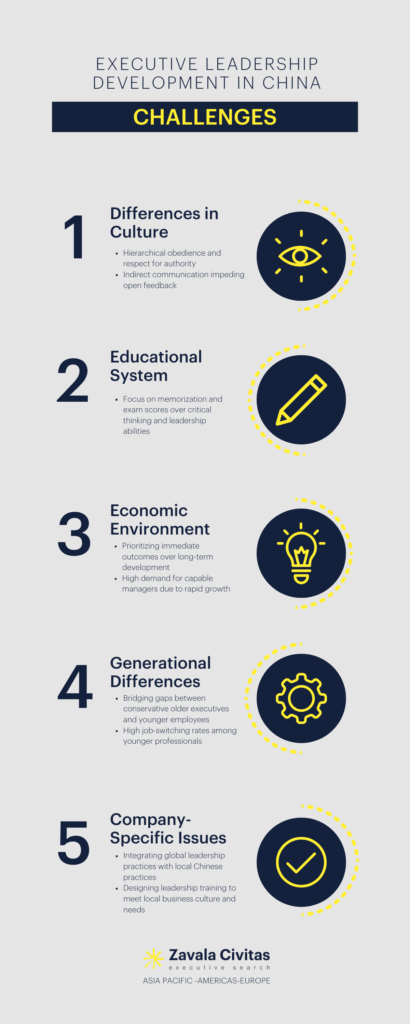
- Cultural differences: Chinese culture emphasises hierarchical obedience, respect for authority, and collective well-being — values that can contradict Western leadership approaches advocating flat structures and individual expression. The indirect communication style common in Chinese professional culture makes giving open, direct feedback particularly difficult in ways that standard Western coaching and feedback frameworks are not designed to manage.
- Educational system: China’s education system has traditionally focused on memorisation and exam performance rather than critical thinking and leadership capability — producing technically strong graduates with less developed soft skills, feedback reception capability, and the self-directed learning agility that leadership development programmes assume.
- Economic environment: Fast economic growth creates pressure to prioritise immediate outcomes over long-term leadership development investment. The high demand for capable managers simultaneously limits the supply of senior executives available to mentor developing leaders — creating a bottleneck at both the development investment and the mentoring resource levels.
- Political and legal context: Navigating relationships with government officials who influence business affairs through policies that change regularly — and within strict regulations that limit some dimensions of organisational leadership independence — requires political intelligence as a core leadership competency that most global leadership frameworks do not specifically develop.
- Generational differences: A significant gap exists between older executives who may be more conservative in their approach and younger professionals who are more accepting of Western leadership styles. Younger Chinese professionals who frequently switch roles compound the retention challenge by disrupting the continuity that leadership development programmes depend on.
- Multinational-local integration challenge: Multinational companies operating in China often struggle to integrate global leadership development practices with local Chinese practices — the programme that meets a global organisation’s leadership competency framework may not be calibrated for the specific Chinese business culture and government relationship context that determines leadership effectiveness in practice.
- Training and development resources: China’s geography creates development resource gaps — companies in remote or less developed regions may lack access to the high-quality, locally relevant leadership development programmes and experienced trainers that their leadership teams require.
Dealing with these challenges requires an approach that combines effective leadership development training with respect for regional cultures. Investing in leaders who can navigate market changes while ensuring resilience and competitiveness — through China-specific programme design rather than imported frameworks — enables Chinese companies to succeed amidst the uncertainties of global trade while contributing positively to broader social and economic stability.
Frequently Asked Questions: Executive Leadership Development in China
Executive leadership development programme for China?
Zavala Civitas provides China-specific leadership development — culturally resonant frameworks, political intelligence development, global cross-cultural capability for Chinese executives.