Key Takeaway: Brazil receives over $60 billion in annual FDI, has $260 billion committed through the Novo PAC infrastructure programme, and saw AI-related executive roles grow 75% year-on-year. In this environment, the leadership profile that creates value is not the one that managed well in stability — it is the one that builds trust, makes sound decisions under uncertainty, and leads culturally complex teams through transformation.
Last updated: August 17, 2026
In the competitive and changing market of Brazil, companies are no longer just hiring well-prepared executives — they are investing in leaders. And that is where leadership capabilities play a highly important role in effective executive search in Brazil.
From São Paulo to Porto Alegre, businesses are facing challenges that require something more than technical expertise. They need strategic thinkers and emotionally intelligent communicators who, in the end, are genuine change-makers. Identifying those profiles is the key to modern senior talent acquisition.
Key Figures at a Glance
| Data point |
Figure |
Source |
| Brazil annual FDI |
+$60 billion USD |
UNCTAD, 2025 |
| Novo PAC infrastructure programme total commitment |
$260 billion USD ($142.2B deployed by end-2024) |
Government of Brazil, 2025 |
| Growth in AI-related executive roles in Brazil |
+75% year-on-year |
LinkedIn Brazil market data |
| BNDES 2024 total disbursements |
$21.4 billion USD (+16.9% YoY) |
BNDES, 2024 |
The New Standard for Executive Search in Brazil: What Leadership Capabilities Are Needed?
In past years, executive hiring in Brazil was focused heavily on résumés, academic background, and years of experience. But now, successful companies prioritise leadership capabilities — the strategic and interpersonal skills that make the real difference and deliver lasting impact.
These capabilities include:
- Decision-making under pressure
- Adaptability in difficult and changing environments
- Empathy and communication
- Strategic vision
- Team empowerment and mentorship
These traits are vital in a fast-paced economic landscape. Senior professionals must lead through change, digital transformation, and cross-cultural collaboration — and in Brazil, through the specific dynamics of a market where relationship capital and trust-building are not soft factors but hard operational requirements.
Brazil’s market conditions make decision-making under pressure not a desirable leadership trait but a daily operating reality. Interest rate volatility, regulatory shifts, and the complexity of managing teams under CLT obligations while reporting to an international headquarters create a context where the executive who cannot sustain composure, credibility, and strategic clarity under simultaneous pressures will not survive the first 12 months. The leadership capability framework must be calibrated to that reality — not to a generic model of executive effectiveness that was designed for more stable operating environments.
Leadership Capability Framework and Why It Matters in Executive Recruitment
What changes the game today is that executive search firms are now using Leadership Capability Frameworks. These models allow recruiters and HR leaders to evaluate potential hires not just on experience, but on their ability to lead, influence, and grow within a company — to create long-term value rather than short-term results.
A well-defined framework supports better alignment between executives and company culture, helping organisations avoid costly hiring mistakes. In Brazil, where the cost of a failed senior hire is compounded by CLT severance obligations and the relationship capital that takes 12–18 months to rebuild, this alignment is not a nice-to-have — it is the primary risk mitigation mechanism in the hiring process.
Leveraging Data-Driven Insights in Brazil to Find the Right Leadership Capabilities
We no longer rely only on intuition to hire leaders. Today, data-driven insights are transforming how companies evaluate candidates during the senior talent acquisition process. By using behavioural assessments, psychometric tools, and AI-based analysis, recruiters can make smarter, faster, and more accurate hiring decisions — especially when sourcing senior talent in competitive markets.
These insights are particularly valuable when assessing performance potential, ensuring that candidates not only fit the role today but can grow into future strategic challenges — including the specific complexity of Brazil’s operating environment.
In Brazil, the data-driven approach to leadership capability assessment is valuable not just for its analytical rigour — it is valuable because it surfaces patterns that interview processes consistently miss. The cultural warmth and relational fluency that make Brazilian executives effective in building internal trust can look, in a structured interview, like a lack of assertiveness. The resilience that has been built through navigating Brazil’s regulatory and economic volatility can look, on a résumé, like career instability. A capability framework that is calibrated to the Brazilian context, combined with psychometric tools that assess under-pressure behaviour directly, produces a materially more accurate picture of who will actually succeed in the role.
Why Zavala Civitas Executive Search in Brazil?
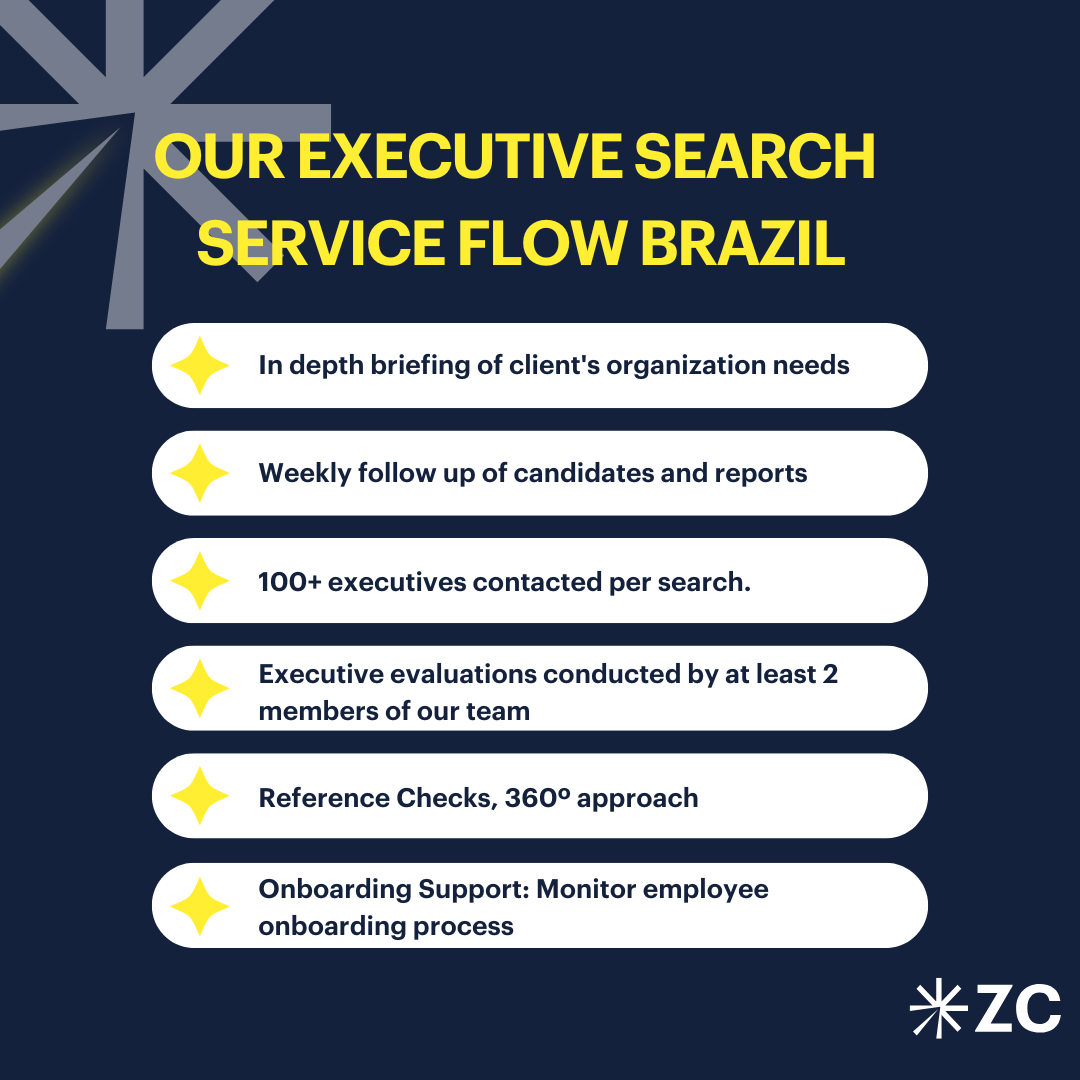
Zavala Civitas brings a localised, strategic, and data-informed approach to C-level recruitment in Brazil. Our methodology blends:
- In-depth local market knowledge — including CLT, labour court dynamics, and sector-specific talent ecosystems
- Competency-based assessments calibrated to Brazil’s specific operating context
- A customised Leadership Capability Framework that evaluates both technical depth and relational effectiveness
- Continuous support through 180 days post-placement — the period most critical for executive integration in Brazil
Whether you are hiring a C-level leader or building a new regional office, we help you find talent that can lead — not just manage.
The future of executive search in Brazil lies in identifying leaders with proven directional capability, high-impact leadership behaviours, and the adaptability to thrive in complex, evolving environments. With the right framework, data, and development strategy, companies can attract and retain the talent they need to lead confidently in this market.
Looking for your next leader in Brazil? Let Zavala Civitas guide you with insight, precision, and results. Learn more about our services or contact us directly.
Frequently Asked Questions: Leadership Capabilities and Executive Search in Brazil
Why is decision-making under pressure the most critical leadership capability for executives in Brazil?
Because Brazil’s operating environment generates simultaneous pressures that do not exist in the same combination elsewhere: interest rate volatility that affects cost of capital and investment decisions, regulatory shifts that change compliance obligations with little warning, labour court exposure that creates legal context for every HR decision, and the expectation of a global headquarters that the Brazilian market performs against metrics designed for more stable environments. The executive who cannot sustain composure, clarity, and credibility through all of these simultaneously will not survive the first year.
Why is cultural adaptability a hard skill — not a soft one — for executive success in Brazil?
Because in Brazil, the relationship is the operating infrastructure. An executive who cannot build genuine trust — not managed professionalism, but trust — with their direct team, key clients, and supplier partners is not facing a cultural adjustment period. They are facing a structural disadvantage that limits their ability to execute. In a market where decisions are made through relationship networks rather than formal processes, cultural adaptability determines access to the informal mechanisms that make strategy achievable.
What is a Leadership Capability Framework and why does it matter for executive search in Brazil specifically?
It is a structured model for evaluating executive potential on the dimensions that actually predict success in the role — not just experience in the previous role. In Brazil, this matters particularly because the standard CV-based evaluation consistently misreads Brazilian market experience. Career patterns that reflect Brazil’s economic volatility look unstable on a global résumé. Relational leadership styles that are highly effective in Brazil look insufficiently assertive in a structured interview. A capability framework calibrated to the Brazilian context surfaces what actually predicts performance.
How do psychometric tools improve executive search outcomes in Brazil?
By assessing under-pressure behaviour directly — not through self-reported responses, but through structured instruments that reveal cognitive patterns, decision-making style, and resilience capacity in ambiguous situations. In Brazil’s operating environment, where the pressures are both structural and relational, these patterns determine who will sustain effectiveness over a two-to-three-year leadership horizon. Combined with 360° references from Brazilian-side stakeholders, they produce a substantially more accurate picture than interview processes alone.
How does Zavala Civitas assess leadership capabilities for executive search in Brazil?
Through a framework that combines psychometric evaluation calibrated to the Brazilian operating context, structured behavioural interviews focused on the specific mandate, 360° references from both international and Brazilian-side stakeholders, and a 180-day post-placement integration follow-up that tracks whether the capability assessment predictions are materialising in actual performance. With a 92% closing rate across completed mandates from our São Paulo office.