
ASEAN has emerged as one of the most strategic regions for global supply chain diversification. Rising geopolitical tensions between the United States and China, combined with regional investment incentives and sustained economic growth above the global average, have accelerated the shift of manufacturing and sourcing activities into Southeast Asia.
According to recent estimates, a significant share of multinational manufacturers now plan to expand or relocate parts of their supply chains to ASEAN markets over the next three to five years, particularly in sectors such as electronics, sustainable consumer goods, smart home technologies, and wellness products. In many cases, this expansion requires building regional operating platforms in countries where companies previously had limited presence.
Yet while the strategic logic for diversification is clear, execution has proven far more complex. The challenge is fundamentally a leadership challenge.
When supply chain diversification fails: a leadership and governance gap
Many diversification initiatives underperform or stall not because of infrastructure, labor, or cost issues, but because leadership models fail to evolve alongside the organization’s new operating reality.
Companies often underestimate the leadership implications of moving from a centralized or single-country operating model to a distributed, multi-country setup. Without clear regional authority, decision rights become blurred. Coordination across markets slows. Local teams hesitate to act, while headquarters retains control over decisions it can no longer execute effectively from a distance.
In ASEAN, where markets differ widely in regulatory maturity, cultural norms, and business practices, these tensions are amplified.
The real leadership challenges in ASEAN operations: what boards must address
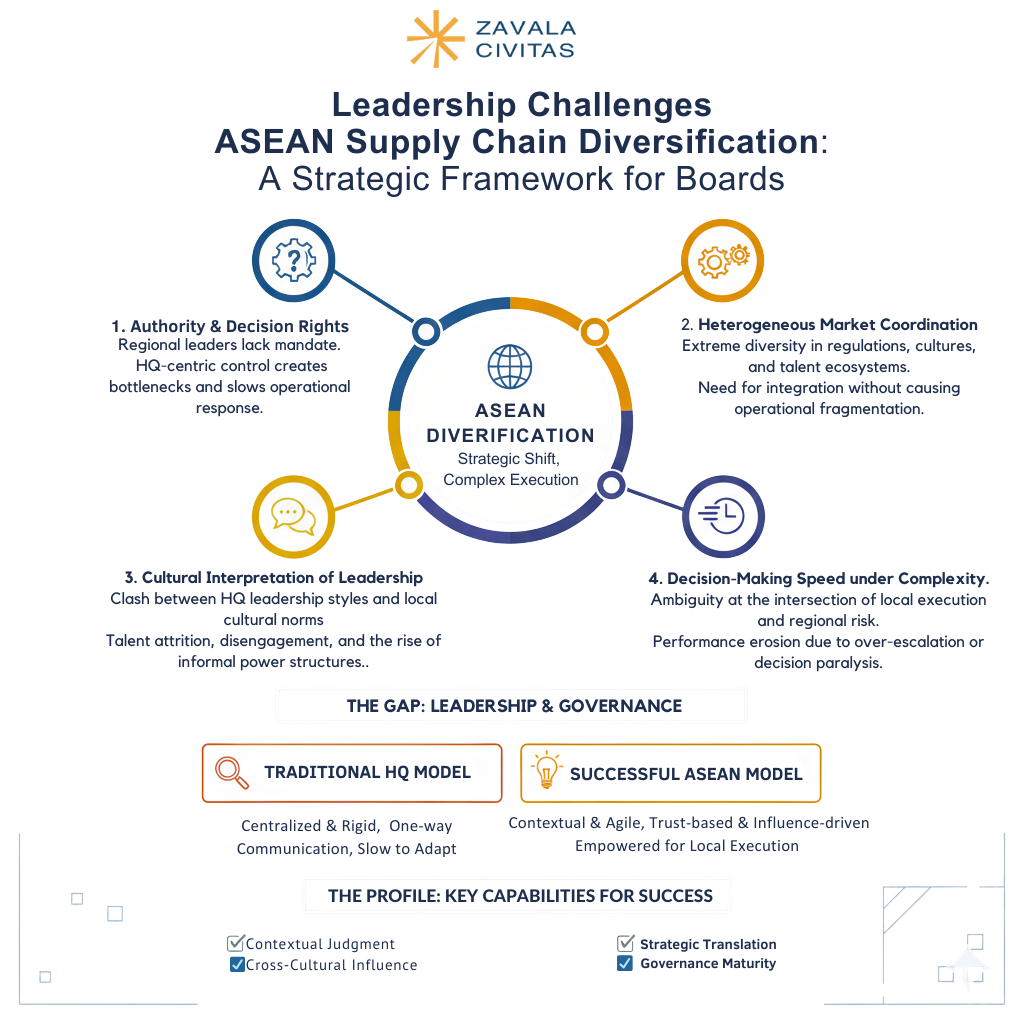
Organizations expanding across Southeast Asia typically face four recurring leadership challenges:
- Authority and decision rights
Regional leaders are frequently appointed without sufficient mandate. When authority remains concentrated at headquarters, regional leadership becomes administrative rather than strategic, limiting responsiveness and accountability.
- Coordination across heterogeneous markets
ASEAN is not a single operating environment. Leading across Vietnam, Indonesia, Thailand, Malaysia, or the Philippines requires managing different regulatory regimes, talent markets, and supplier ecosystems. Leaders must integrate these differences without creating fragmentation.
- Cultural interpretation of leadership
Leadership behaviors that signal strength and clarity in one market may be perceived as distant or overly rigid in another. Misalignment here often leads to disengagement, talent attrition, or informal power structures forming outside the official hierarchy.
- Decision-making speed under complexity
As operations scale, decisions increasingly sit at the intersection of local execution and regional risk. Leaders who lack contextual judgment tend to either over-escalate decisions to HQ or delay action, both of which erode performance.
The limits of exporting HQ leadership models
A common mistake is assuming that leadership frameworks developed at headquarters can simply be replicated across ASEAN markets.
While governance standards, values, and performance expectations must remain consistent, leadership application cannot be standardized. Models that rely heavily on centralized control, direct communication styles, or implicit cultural assumptions often break down when applied without adaptation.
Successful organizations distinguish between what must remain global and what must be localized particularly in leadership behavior, decision authority, and stakeholder management.
What differentiates leaders who scale successfully
Leaders who succeed in building and scaling regional operations in ASEAN tend to share several critical capabilities:
- Contextual judgment: the ability to interpret risk, opportunity, and urgency across different market realities.
- Cross-cultural influence: leading without relying solely on formal authority, and building trust across diverse teams.
- Governance maturity: understanding when to standardize and when to allow local autonomy without losing control.
- Strategic translation: converting global strategy into executable regional priorities that local teams can own.
These capabilities are rarely developed by chance. They require intentional selection, assessment, and development.
A leadership question, not only a supply chain one
Supply chain diversification into ASEAN is no longer a tactical sourcing decision. It is a structural shift that reshapes how organizations are led.
Companies that treat leadership as an afterthought often find themselves correcting course mid-expansion. Those that invest early in defining the right regional leadership structure and in selecting leaders equipped to operate across borders are better positioned to scale sustainably and manage risk as complexity increases.
In this context, leadership decisions are not simply organizational choices. They are strategic enablers of supply chain resilience, requiring deliberate assessment of leadership capability, mandate, and fit across markets.
How Zavala Civitas supports boards and executive teams
At Zavala Civitas, we advise boards and senior leadership teams on regional governance design, leadership assessment, and executive search across ASEAN. We support organizations in defining the right leadership mandate, selecting regionally credible leaders, and building governance structures that enable scale, resilience, and long-term value creation