
Any organization that is to succeed in today’s cut-throat, ever changing, competitive business world must have executive development. At executive level, effective leadership leads to strategic vision, drives innovation as well as helps the company navigate complex issues.
The US is one country whose leadership development market has been and remains highly complex because it is influenced by various factors such as regional differences, industry specific needs organizational culture regulatory environments and technological advancements. These are all important considerations for designing effective executive development programs.
According to Forbes Magazine, American companies lead in leadership development, investing $1,057 per employee annually, totaling an impressive $166 billion. In comparison, Canadian companies allocate $1,014 per employee for all training and development, with an estimated $507 dedicated to leadership training.
Significance of Executive Leadership Development
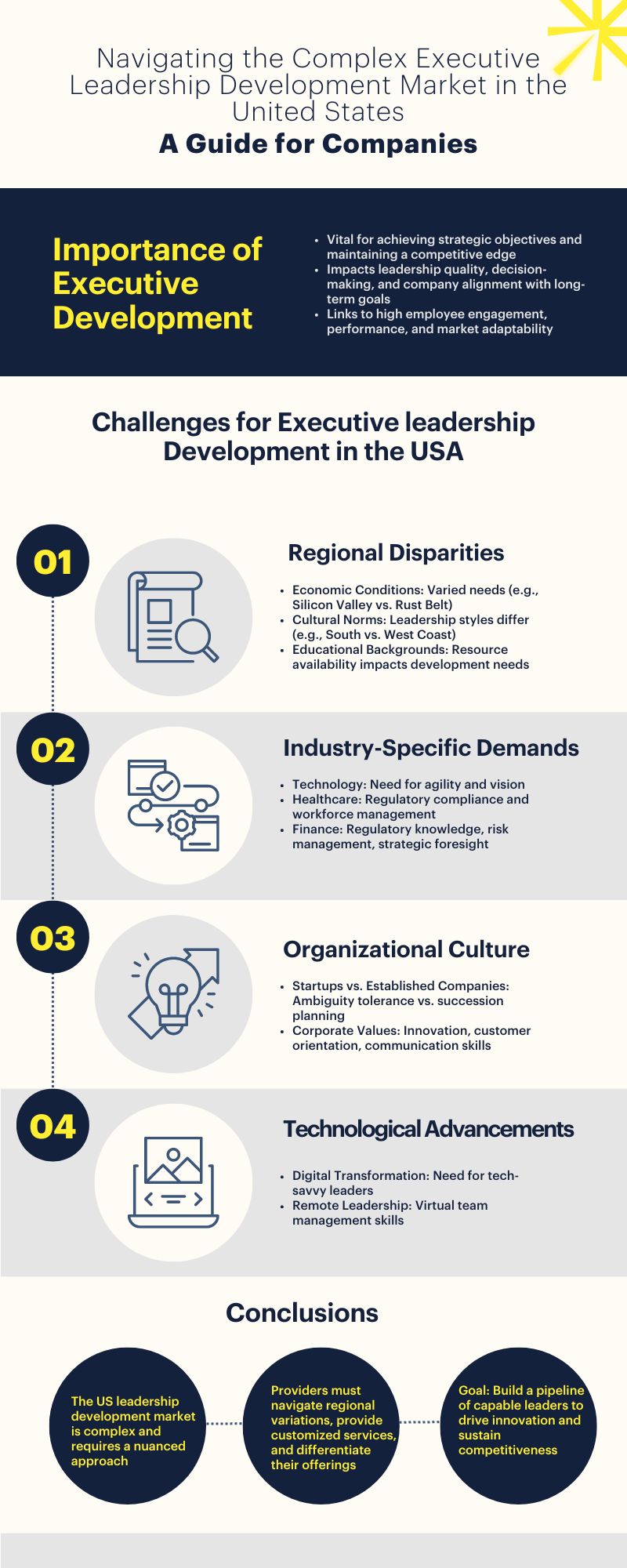
Executive development is a crucial investment for organizations since it directly impacts their ability to achieve strategic objectives and maintain a competitive advantage. Good leaders who are well developed will inspire and lead teams while making informed decisions and implementing strategies that align with the company’s long-term goals. Strong leadership additionally links to high employee engagement, good organizational performance, as well as adaptability to changes in the market.
Regional Disparities in the USA
The United States’ huge size and diversity brings about significant regional disparities regarding leadership development requirements. For instance:
- Economic Conditions: Different regions have diverse economic landscapes. In Silicon Valley, which has a booming tech industry, leaders need skills in innovation or management of rapid growth; this is unlike areas such as Rust Belt which may seek to re-invigorate the manufacturing sector or solve labor problems.
- Cultural Norms: There exists cultural diversity when it comes to attitudes towards leading. In the south traditional hierarchical structures may be more common than on the west coast which may prefer more equalitarian progressive leadership styles.
- Educational Backgrounds: The availability of educational resources varies across states affecting the type and level of leadership development required.
Industry Specific Demands
Different industries have unique forms of leadership demands:
- Technology: Leaders must be agile and visionary due to fast paced innovation cycles and a high degree of change.
- Healthcare: Leadership in this field must negotiate complex regulatory environments ensure compliance and manage a diverse workforce.
- Finance: Without regulatory knowledge, risk management and strategic foresight, leaders in finance are destined to fail.
These specific challenges in each industry will be addressed by leadership development programs which necessitate that they be tailored.
Organizational Culture
Every organization has its own culture, which profoundly influences its leadership development needs:
- Startups vs. Established Companies: On the one hand, startups may need leaders who can do everything while thriving on ambiguity whereas established companies may choose to emphasize succession planning and not veer off course.
- Corporate Values: Organizations emphasizing innovation for example would require leaders capable of fostering creativity and driving change while those with customer-oriented culture could stress empathy and communication skills as important aspects of their leadership practices.
Regulatory Environments in the USA
Leadership development is also influenced by regulatory requirements which may vary from state to state or even industry to industry:
- Healthcare Regulations: Healthcare leaders must have a good understanding of HIPAA regulations and patient care standards.
- Financial Regulations: In finance SEC regulation compliance as well as knowledge about financial law is vital for successful leadership.
This means that these programs must be designed so that the laws governing them are observed by the prospective executives promoted out of them.
Technological Advancements
The rapid pace of technological change adds another layer of complexity:
- Digital Transformation: Business success requires technology-savvy leaders who know how to make it work for them.
- Remote Leadership: Remote working trends call for new skills in virtual team management and digital communication.
Leadership development programmed must address these technological changes so that they are relevant.
The Importance of Ad hoc Services
The ad hoc nature of leadership development services are crucial in responding to several factors. Companies look for customized solutions that meet a unique elements of their organizational culture, industry dynamics, and strategic objectives. In addition to adjusting contents, this customization also involves personalized coaching, context-specific case studies and real-life application projects.
Adding Value at Every Step
Value adding at every stage is critical within this intricate landscape:
- In-depth Needs Assessment: Identifying specific leadership gaps within an organization.
- Customized Program Design: Developing programs that can effectively address these gaps.
- Continued Support: To ensure long term success of development endeavors.
Providers need to incorporate current research and best practices, exploit advanced technology in training delivery and have benchmarks that indicate the return on investment (ROI).
Differentiating Leadership Development Services
A number of things make leadership development services different from other related services:
- Tailored and Personalized Solutions: Leadership Development should not be treated as a standard training program but rather it should be tailored by understanding the needs of organization; both at macro level as well as its leaders.
- All-Round Approach: A combination of workshops, one-on-one coaching sessions, experiential learning opportunities, peer mentoring are usually effective programs.
- Sustainable Outcomes: Because leadership development is measured over a longer period requiring more improvements in leadership effectiveness and consequently organizational performance.
To conclude, United States’ leadership development market is highly complex which requires a nuanced approach. Providers must navigate major regional variations while providing ad-hoc services that add value at every step as well as differentiation their offerings through meeting unique client needs.
By doing so they will help organizations build a pipeline of capable leaders able to drive innovation and sustain competitiveness amid an ever-changing business landscape.