
Only 10% of leaders are self-aware, with just 4% of male executives compared to 19% of women executives.
Source: Harvard Business Review.
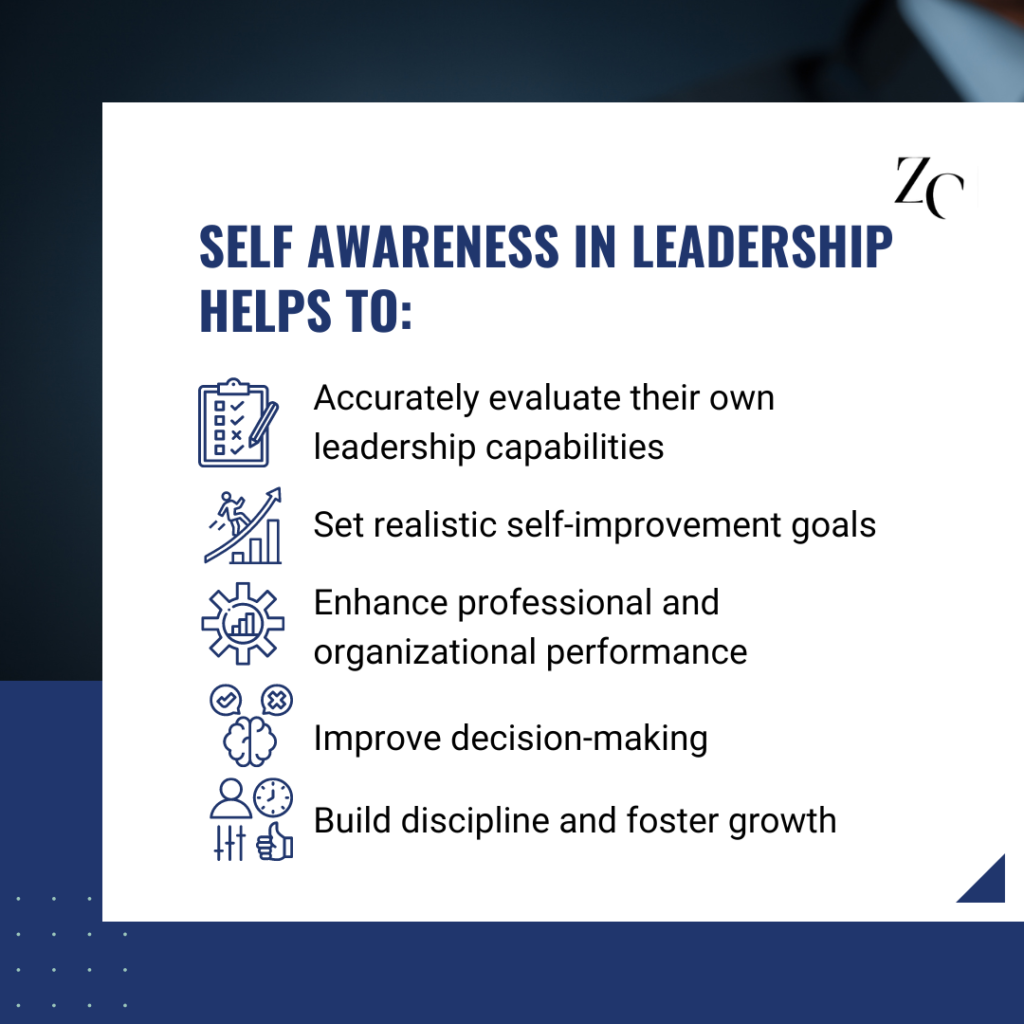
Self-awareness is a crucial trait for effective leadership, a transformative quality that holds immense value for leaders, enabling them to unlock personal and professional growth.
Although leaders’ problem-solving skills are key to determine the effectiveness of their self-awareness abilities is not the only important factor. Their capacity and commitment to continuous learning are key to long-term success allowing them to adapt and be aware of changing environments. Leaders who overestimate their leadership capabilities often have a distorted perception of themselves.
This behavior tends to hinder their own self-efficacy by not setting self-improvement goals. Conversely, leaders who underestimate their leadership capabilities may have a realistic understanding of their strengths and weaknesses but may lack confidence in their ability to enhance their performance. Therefore, achieving accurate self-evaluation is crucial, and seeking feedback or leadership development programs can greatly facilitate this process.
We can consider Self-awareness to be a person’s ability to recognize and understand themselves clearly through reflection and introspection. Going deeper, two primary types of self-awareness can be identified: internal and external.
- Internal: Involves recognizing and understanding our own thoughts, feelings, and values.
- External: It is about accurately perceiving how others see us, despite our own beliefs about ourselves.
The Influence of Self-Awareness on Leadership:
With deeper inner knowledge, leaders can make informed decisions and leverage their talents effectively. It also enhances emotional intelligence, enabling leaders to connect with and inspire their teams, resolve conflicts, and create a positive work environment. Furthermore, self-aware leaders exhibit authenticity and humility, gaining the trust and respect of their colleagues and employees.
Challenges for High-Level Executives:
High-level executives face challenges in gaining self-awareness due to difficulties in receiving candid feedback. Subordinates may hesitate to provide honest feedback to superiors, fearing potential repercussions. Additionally, leaders at the top may become insulated from diverse perspectives, hindering their ability to gain accurate insights into their behavior and impact.
How Can Companies use leadership development to help executives:
1. 360º Feedback:
Implementing a 360º feedback process can be a powerful tool for C-suite leaders to gain a well-rounded view of how are they perceived and their areas for improvement. This process involves gathering feedback from supervisors, peers, and subordinates, ensuring that leaders receive input from multiple perspectives. Anonymity in the feedback process encourages honesty and allows leaders to identify blind spots and patterns in their behavior. By actively reflecting on and integrating this feedback, leaders can enhance their self-awareness and make meaningful changes.
2. Psychometric Tests:
Psychometric tests, provide objective data that leaders can use as a starting point for self-reflection and personal growth. By understanding their natural tendencies, preferences, and areas for improvement, C-suite executives can make informed decisions about their leadership style, communication approach, and skill and leadership development.
3. Coaching and Mentoring:
Coaching or mentoring relationships can provide executives with personalized guidance and support in their self-awareness journey. Coaches and mentors bring an external perspective, challenging assumptions and providing valuable insights into leadership behaviors and blind spots. Offering them a safe space for to explore their strengths, weaknesses, and aspirations, allowing them to set goals and develop strategies for self-improvement. Regular coaching sessions can facilitate continuous growth and self-awareness. You can learn more about our personalized leadership development clicking here.
4. Skill-Building Workshops:
Skill-building workshops focused on leadership development, provide through self-reflection exercises practical tools and techniques that executives can apply in their daily lives. Allowing them to deepen their self-awareness in a controlled and safe environment. Allowing them to deepen their self-awareness in a controlled and safe environment.
By understanding themselves and their impact on others, leaders can build trust, make better decisions, and foster positive work environments. While high-level executives may face challenges in attaining self-awareness, leadership development programs can help them achieve it.
Executive Assessment and Leadership Development
Executive assessment plays a critical role in effective leadership development. Beyond evaluating experience or technical capability, it provides a structured understanding of how leaders think, decide, influence, and perform under pressure. This level of insight allows organizations to move past generic development initiatives and focus on the specific behaviors and judgment required for future success.
When leadership development is grounded in rigorous executive assessment, it becomes both targeted and measurable. Organizations gain clarity on strengths, blind spots, and readiness for complexity, enabling more informed succession planning, role transitions, and long-term leadership investment. In this context, leadership development is not about potential in the abstract, but about performance in real organizational conditions.
If your organization is seeking to strengthen leadership development through objective executive assessment, we invite you to contact us to explore how a structured, evidence-based approach can support sustainable executive performance.