Key Takeaway: More than 80% of Canadian directors now say their boards are directly involved in ESG oversight — up from just 48% five years ago (Institute of Corporate Directors). In a market where the Canada Infrastructure Bank holds a $46 billion portfolio and clean energy investment reached CAD 40 billion in 2024, the boards that govern these decisions are being asked to operate at a level of complexity for which many were not originally designed.
Last updated: August 13, 2026
In a fast-changing business environment, Canadian companies are under increasing pressure to demonstrate responsible leadership, strategic foresight, and boardroom accountability. This makes board advisory services in Canada more relevant than ever — especially for organisations navigating ESG, succession, or digital risk.
Key Figures at a Glance
| Data point |
Figure |
Source |
| Canadian directors whose boards are directly involved in ESG oversight |
80%+ (vs. 48% five years ago) |
Institute of Corporate Directors (ICD) |
| Canada Infrastructure Bank active portfolio |
94 projects — total value $46B CAD |
Canada Infrastructure Bank, 2025 |
| Canada clean energy and infrastructure investment (2024) |
~CAD 40 billion |
Canada Growth Fund / CER analysis |
| Canadian directors with post-secondary education (OECD) |
56%+ of Canadian workforce — one of the highest globally |
OECD Education at a Glance |
What Are Board Advisory Services and Who Needs Them?
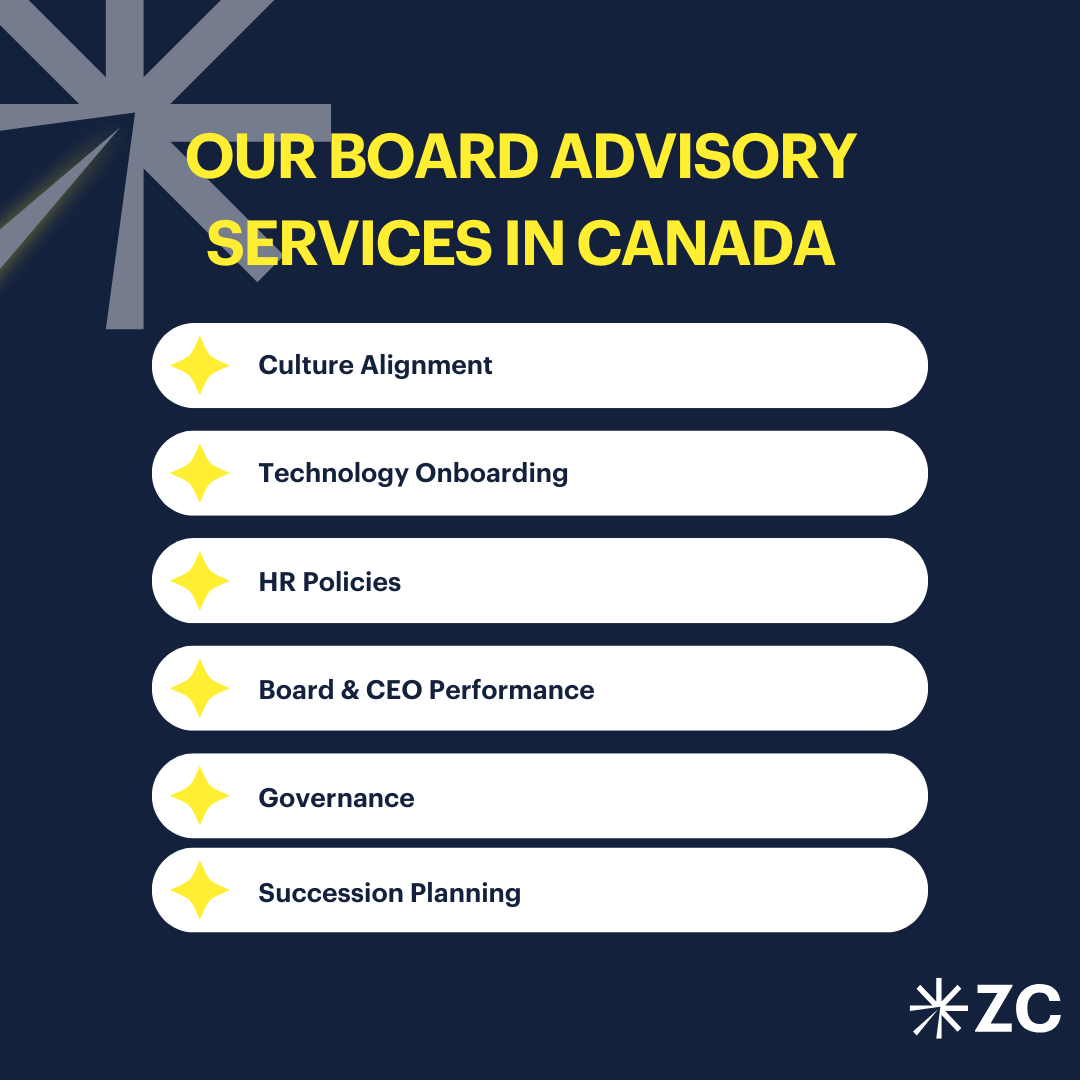
Board advisory refers to specialised consulting that helps boards of directors enhance their structure, decision-making, and long-term effectiveness. These services typically support:
- Governance diagnostics and board performance evaluations
- Director succession planning, including CEO or Chair transitions
- Composition reviews covering independence, diversity, and skill mix
- Preparation for IPOs, M&A transactions, or regulatory audits
- ESG and climate governance readiness
Whether you are a public company in Toronto, a family-owned firm in Calgary, or a growing technology company in Vancouver, aligning your board with strategic goals is no longer optional — it is essential.
Why Corporate Governance Is a Strategic Priority in Canadian Companies
Strong corporate governance in Canada is no longer just about compliance — it is a strategic lever for sustainable growth. According to the Institute of Corporate Directors (ICD), more than 80% of Canadian directors now say their boards are directly involved in ESG oversight and corporate purpose, compared to just 48% five years ago. Meanwhile, the Canadian Securities Administrators continue to push for clearer board-level accountability on climate disclosures and diversity targets.
As organisations adapt to net-zero commitments, cybersecurity threats, and stakeholder activism, boards are being asked to step up. Board advisory firms are helping them do so — through better structures, clearer role definitions, and more future-ready leadership.
The shift from 48% to 80% of Canadian boards directly involved in ESG oversight did not happen because boards became more virtuous. It happened because the Canadian Securities Administrators’ disclosure requirements, institutional investor expectations, and the Canada Infrastructure Bank’s ESG-aligned financing conditions created hard accountability mechanisms. Boards that were not equipped for ESG oversight found themselves in conversations they were not prepared for. The firms that engaged board advisory early converted that regulatory pressure into competitive governance advantage. Those that waited discovered the gap at the worst possible moment — during an audit, an investor review, or a public disclosure cycle.
The Expanding Role of Canadian Boards in Strategy and Risk Oversight
Boards of directors in Canada are evolving from passive stewards to active shapers of business strategy. Today, a high-performing board is expected to:
- Challenge and co-develop long-term strategic plans
- Oversee enterprise-wide risks, from cybersecurity to geopolitical disruption
- Guide ESG and climate commitments with credible frameworks and measurable milestones
- Ensure leadership continuity through planned succession — before the vacancy creates the urgency
For example, a mid-sized financial services firm in Montreal recently engaged a board advisory firm to address concerns about ageing board members and lack of ESG expertise. The result was a refreshed board composition matrix, two new independent directors with sustainability and digital risk backgrounds, and a succession roadmap for the Chair. This kind of strategic realignment is increasingly common — and necessary — for Canadian boards to remain credible and effective.
The Montreal financial services case is representative of a broader pattern across Canada. The issue is not that boards were failing — it is that they were built for a different operating environment. A board that was appropriate for a financial services firm in 2015 — when ESG was voluntary, cybersecurity risk was peripheral, and climate disclosure was aspirational — is structurally underpowered for that same firm in 2026, when all three are mandatory governance domains. Board advisory is not remediation. It is the mechanism that keeps governance architecture current with the operating environment it is meant to oversee.
At Zavala Civitas, we work with boards across Canada to strengthen governance, plan leadership transitions, and ensure alignment with evolving business priorities. With deep expertise in board composition, succession, and strategic advisory, we help organisations build high-performing boards equipped for the challenges of today — and tomorrow.
Click here to learn more about our CEO & Board Advisory services.
Frequently Asked Questions: Board Advisory in Canada
Why did ESG board oversight jump from 48% to 80% of Canadian companies in five years?
Because the governance environment changed structurally. The Canadian Securities Administrators introduced mandatory climate disclosure frameworks. Institutional investors began requiring board-level ESG accountability as a condition of continued investment. The Canada Infrastructure Bank linked its financing to ESG-aligned governance standards. These are hard accountability mechanisms, not cultural preferences — and boards that were not equipped for ESG oversight found themselves in conversations they were not prepared for during regulatory reviews and investor meetings.
What specific governance gaps are most common in Canadian boards today?
Three gaps appear most consistently: ageing board composition with insufficient renewal planning, ESG and climate governance capability that has not kept pace with regulatory requirements, and cybersecurity and digital risk oversight that remains underdeveloped relative to the actual risk exposure of the organisation. The fourth, increasingly common gap is Indigenous consultation governance — particularly for resource, energy, and infrastructure companies whose project approvals and community relations require board-level understanding of UNDRIP and treaty obligations.
What makes a board advisory engagement in Canada different from a standard governance review?
A standard governance review produces a gap analysis. A board advisory engagement produces a governance transformation — including an active search for the independent directors who close the identified gaps, a succession roadmap that is specific to the company’s ownership structure and strategic timeline, and an ongoing advisory relationship that keeps the board current with evolving regulatory requirements. The difference is between a diagnostic and a treatment plan.
Why is board succession planning particularly important in Canada’s clean energy and infrastructure sectors?
Because the capital deployment in these sectors — $46 billion in the Canada Infrastructure Bank portfolio, CAD 40 billion in clean energy investment in 2024 — is governed by boards that must understand project finance, Indigenous consultation obligations, provincial regulatory complexity, and federal ESG disclosure requirements simultaneously. A board that lacks the succession planning to maintain that capability through director transitions creates governance continuity risk in exactly the domains where the capital exposure is highest.
How does Zavala Civitas approach board advisory for Canadian companies?
Through governance diagnostics that identify specific capability gaps against the company’s current strategic mandate, active independent director search that maps the Canadian director ecosystem by sector and province, succession planning that is anchored to the board’s specific renewal timeline and composition requirements, and ongoing advisory that keeps board capabilities current with evolving regulatory requirements. From our Toronto office, with a 92% closing rate across completed executive search mandates.