A turning point for leadership in Spain
Spain’s corporate scene is moving into a new phase. Digital transformation, ESG expectations, and hybrid work models have combined to change what organisations need from their senior teams. Instead of searching for leaders who can “manage the business as it is,” boards are prioritising those who can reimagine it — leaders who are strategic, resilient and human-centred. That shift reframes executive development: it must be diagnostic, personalised and tightly linked to measurable organisational outcomes.
Which leadership skills are taking priority in 2026?
- Strategic agility
The ability to anticipate change, test scenarios and pivot quickly is now central. Executives are being developed to think in systems, to prioritise speeded learning cycles, and to translate uncertainty into actionable bets rather than paralysis.
- Emotional intelligence at scale
Managing teams across hybrid and remote setups requires heightened social acuity. Executive development programmes emphasise emotional regulation, difficult-conversation skills and stakeholder empathy as central leadership competencies — not optional extras.
- Digital fluency and data judgement
It is no longer sufficient for a leader to “understand digital.” The expectation is to make data-informed trade-offs, interrogate AI-driven recommendations, and set priorities that balance automation with human judgement.
- Purpose-driven decision making
With ESG rising from compliance to strategy, leaders are trained to align commercial goals with societal impact. This means embedding sustainability into decisions, engaging stakeholders authentically and communicating purpose with credibility.
- Resilience and self-awareness
Continuous pressure and rapid change make personal resilience a board-level concern. Programs that improve stress management, reflective practice and energy sustainability are now read as risk-management measures.
Executive Assessment and development as the backbone of meaningful leadership in Spain
High-performing organisations are treating assessment as the foundation for any development investment. Rather than generic leadership workshops, the most effective programmes begin with robust diagnostics: cognitive and behavioural mapping, 360° feedback calibrated to business KPIs, simulation-based evaluations and targeted psychometrics. These tools help convert subjective impressions into objective signals about potential, readiness and development ROI.
Crucially, data alone is not the end point. The interpretation of assessment results — translating patterns into bespoke learning pathways, succession maps and stretch assignments — determines whether investment yields behavioural change and measurable business impact.
From coaching to strategic transformation
Development is migrating from HR checklists into corporate strategy. Best-practice organisations blend executive coaching with peer-learning cohorts, rotational experiences and problem-led residencies that expose leaders to real transformation challenges. These modalities accelerate transfer of learning to on-the-job performance and create a pipeline of leaders who can both deliver and transform.
Another common pattern: modular, longitudinal programmes replacing one-off interventions. Progress is measured against concrete business milestones — not only participant satisfaction scores.
The role of executive search and advisory firms
Executive search firms that integrate assessment and development bring disproportionate value at board level. By aligning talent diagnostics with market mapping and succession planning, these advisors help clients make anticipatory choices: identifying hidden successors, planning staged leadership handovers and designing retention levers that matter. In practice, this means search firms act as long-term partners — from talent identification through to onboarding and leadership acceleration.
What organisations should be doing now
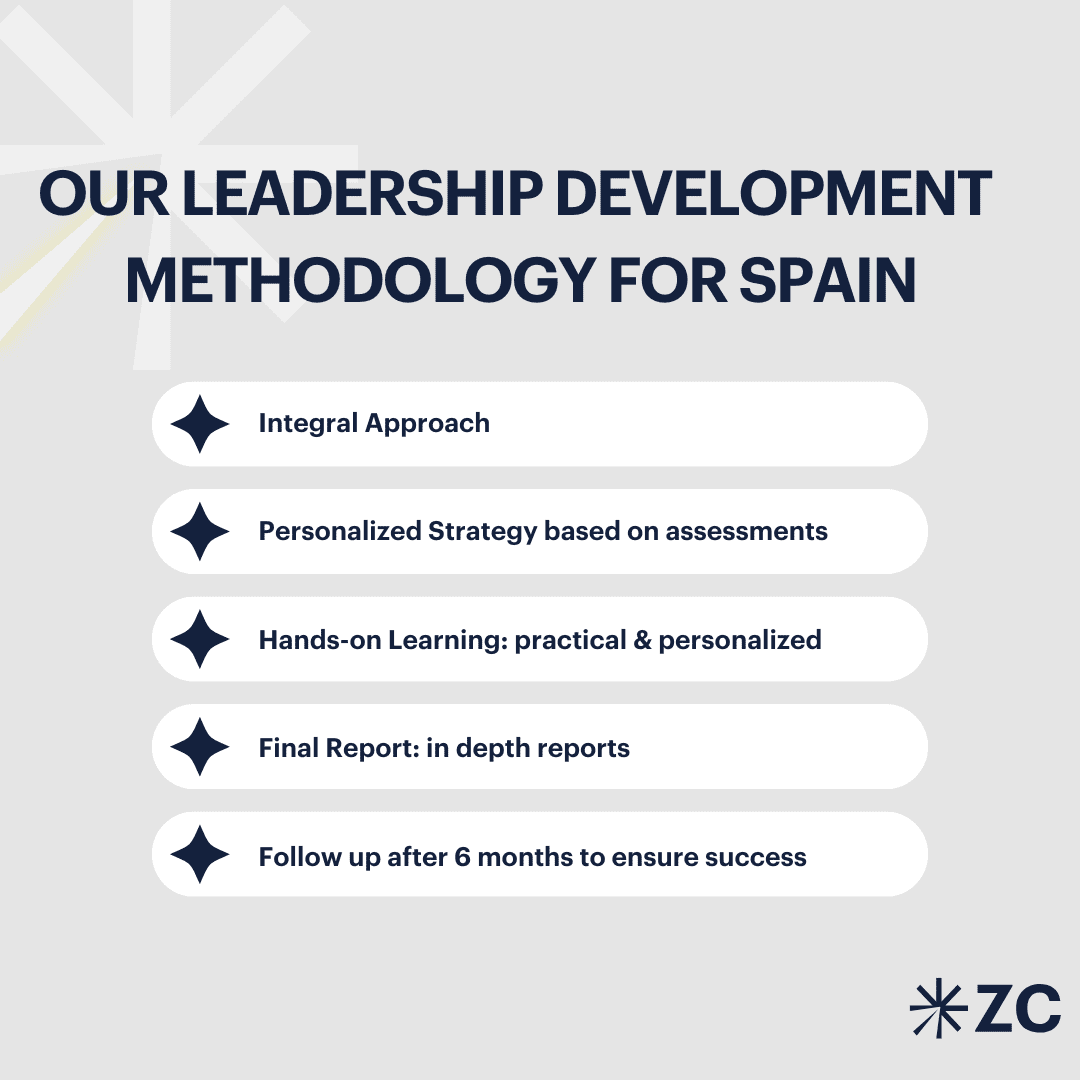
- Begin with diagnosis: invest in assessment suites that combine behavioural and situational evidence.
- Link development to strategic priorities: every leadership program should map to a clear business outcome.
- Design for durability: use multi-modal, longitudinal development rather than episodic training.
- Prioritise leader wellbeing: resilience is now an operational necessity.
- Build cross-border perspective: Spanish leaders must be fluent in global markets while rooted in local context.
The leaders who will define Spain’s economic decade are those who can learn faster than competitors, make ethically informed decisions, and lead diverse teams through complexity. Technology will sharpen assessment capabilities, but leadership will remain a fundamentally human practice: judgement, trust and influence will still determine who succeeds.
About Zavala Civitas
Zavala Civitas partners with Spanish and international organisations to design leadership strategies that combine diagnostic rigour with pragmatic development. The Executive Development & Assessment practice helps boards and HR leaders identify potential, accelerate readiness and embed leadership that lasts.
Contact the Leadership Advisory team in Spain to discuss how a tailored assessment and development programme can secure your next generation of leaders clicking here.