
Executive Development and Assessment in Spain   

Key Takeaway: Spain was Europe’s fastest-growing economy in 2024 at 3.2% — yet 75% of Spanish companies report difficulty finding senior talent, and 92.4% of businesses are family-owned. In this context, executive assessment and development are not HR investments. They are the mechanism through which organisations identify who is ready to lead now, who will be ready in 18 months, and what the cost of getting that decision wrong will be.

Last updated: August 15, 2026

Spain’s business context is undergoing transformation at an accelerated pace. Businesses in Spain continue to face emerging economic challenges alongside new market opportunities. One thing stands out: effective leadership has never been as essential as it is now. This article discusses the case for executive development and assessment in Spain, the main issues businesses face, and the contribution of executive search to business success.

Key Figures at a Glance

Data point Figure Source
Spain GDP growth in 2024 (fastest in Europe) 3.2% Eurostat, 2024
Spanish companies reporting difficulty finding senior talent 75% IESE Business School
Spanish businesses that are family-owned 92.4% Instituto de la Empresa Familiar (IEF), 2025
Spanish government support package to mitigate U.S. trade tariffs €14.1 billion Spanish Economic and Industrial Ministry, 2025

The Current Landscape of Business in Spain

For the past few years, the Spanish economy has been a paradox. In 2024, it was the fastest-growing economy in Europe, growing at a rate of 3.2%. On the other hand, however, several businesses cite increasing costs and a shortage of labour, combined with disruptions in the housing market.

While the Spanish Economic and Industrial Ministry has released support packages — including one worth €14.1 billion to mitigate U.S. trade tariffs — the manufacturing sector remains in contraction, a sign of general economic uncertainty. For companies, this poses a challenge: there needs to be a change in approach, and this begins from the top-most level — leadership.

The Importance of Leadership Quality in Spain

It is evident that in any company, value creation is heavily dependent on its management. Studies indicate that businesses with well-developed leadership teams tend to be significantly more competitive than their direct competitors. However, many organisations in Spain are dealing with gaps in strategic direction at the top.

A contemporary manager has to deal with digital advancements, international competition, and growing economic concerns simultaneously. Static management skills are no longer sufficient. Managers need to be proactive, adaptable, and change-capable. This is precisely what executive assessment and development are designed to build.

Spain’s economic paradox — fastest-growing in Europe at 3.2% GDP growth, yet 75% of companies reporting senior talent shortages — creates a specific and underappreciated leadership risk. Growing fast when you cannot source the leadership to manage the growth produces an organisation that is scaling beyond its management capacity. This is the moment when executive assessment creates its highest return: identifying which current executives have the capability to step up into larger roles, which need structured development investment before they are ready, and where the organisation needs to look externally before the gap becomes a constraint on the growth that the economic environment is offering.

First Step: Executive Assessment in Spain

Every business organisation aiming to develop strong management teams can benefit from the services provided by executive search and advisory firms. These firms do not only help organisations with recruitment but also evaluate candidates at senior levels — ensuring that proper role filling and allocation take place at precisely the leadership levels that determine company direction.

Benefits from executive assessments in the Spanish context:

  • Detection of leadership capability gaps before they surface as operational or strategic failures
  • Alignment between leadership profile and organisational strategy, alongside cultural fit
  • Evidence-based evaluation of decision-making ability and crisis management capacity
  • Protection against the 2–3× salary cost of a failed senior appointment

Employing both strategic search and leadership assessment enables organisations to address challenges they face in advance — rather than discovering them after a hire has been made and the cost of correction is already accumulating.

Opportunities That Come with Executive Development in Spain

Strategic decisions are hard for any company operating in Spain’s competitive context, but they also create significant opportunities for differentiation through leadership quality. Tailored executive development services provide businesses with the following capabilities:

  • Foster innovation and lead digital transformation with the internal capability to sustain it
  • Propel enterprises into new regions or market segments with leadership prepared for the expansion
  • Sustain significant economic shifts without leadership gaps creating operational friction
  • Attract and retain leading industry expertise by demonstrating a genuine commitment to professional development
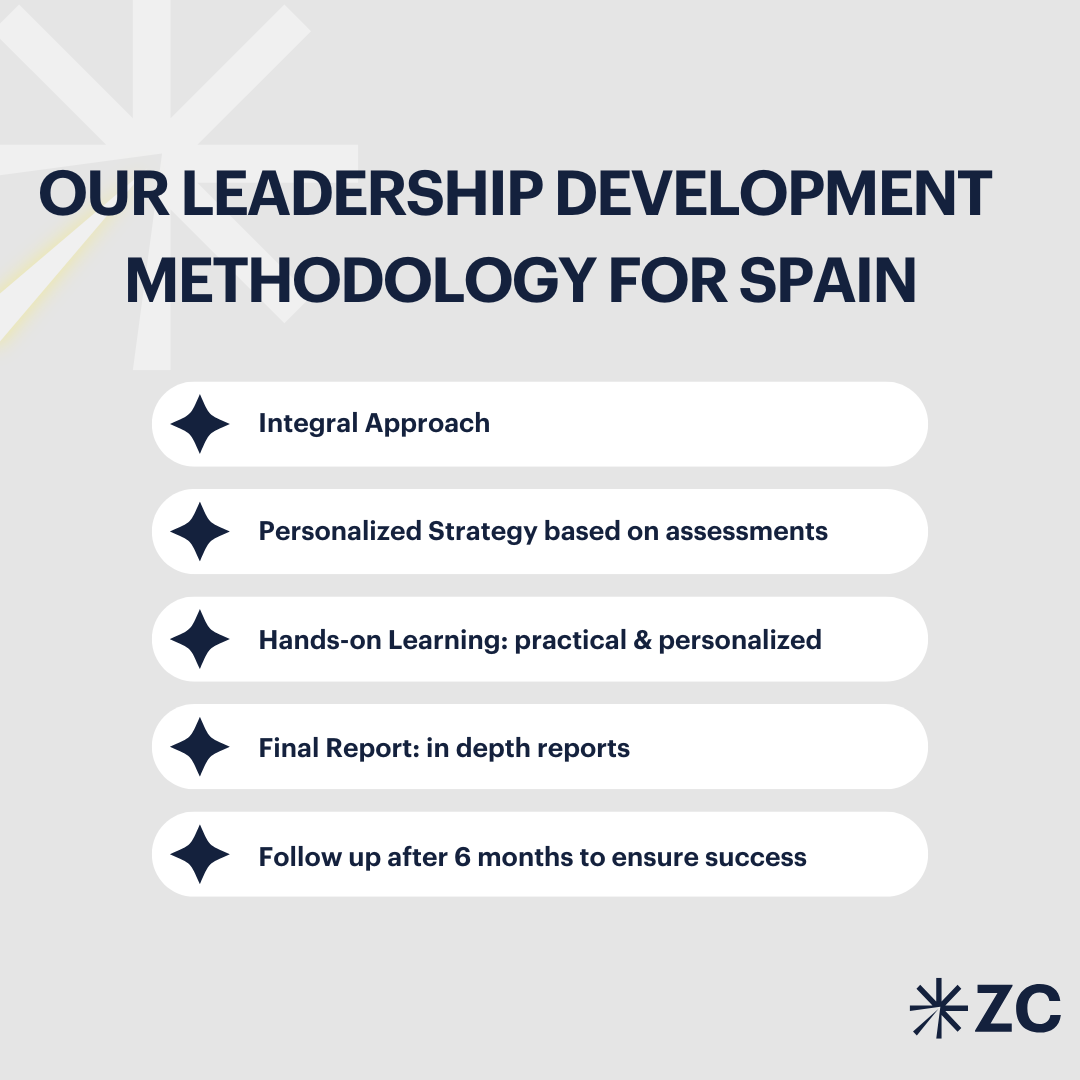
Executive development and assessment methodology for Spain — Zavala Civitas

Spain’s family business landscape — 92.4% of companies — creates a specific executive development challenge that generic leadership programmes do not address. The executive who needs to be developed in a family-owned business is not just developing skills for their current role. They are preparing for the governance complexity, the relationship dynamics with family ownership, and the strategic responsibilities that will grow as the business faces its generational transition. An executive development programme that does not account for that context is producing generic capability for a role that requires specific contextual intelligence.

The Outlook on Leadership Development in Spain

In Spain, the development and assessment of high-level talent presents an opportunity that continues to grow. The firms that focus on fostering leadership will not only manage economic changes more effectively but will also strengthen their competitive position. To maintain an advantage in a market where 75% of companies struggle to find senior talent, partnering with an executive search and advisory organisation is not a cost — it is a strategic investment.

Would you like to assemble a high-impact executive team that will drive peak performance for your firm? Learn more about our executive assessment and development services or contact us at Zavala Civitas.

Frequently Asked Questions: Executive Development and Assessment in Spain

Why does Spain’s economic paradox — fast growth, high talent shortage — make executive assessment particularly urgent?
Because growing fast when you cannot source the leadership to manage the growth produces an organisation that is scaling beyond its management capacity. This is when executive assessment creates its highest return: identifying which current executives can step up into larger roles, which need structured development before they are ready, and where the organisation needs to look externally before the gap becomes a constraint on the growth the economic environment is offering.
What is the specific executive development challenge for Spanish family businesses?
The executive being developed in a Spanish family business is preparing for governance complexity, family ownership relationship dynamics, and strategic responsibilities that will grow as the business faces its generational transition. Generic leadership programmes producing generic capability for a role that requires specific contextual intelligence will not close the gap. Development must be anchored to the specific ownership structure and the specific transition the organisation is managing.
What does executive assessment deliver that internal performance reviews cannot?
External perspective and structured evidence. Internal performance reviews assess current-role performance as seen by people who have a stake in the outcome. Executive assessment evaluates next-role readiness using structured instruments — psychometric evaluation, behavioural interviews, 360° references from outside the immediate reporting line — that surface patterns which current-role reviews systematically miss. The difference is between assessing what someone has done and assessing whether they are ready for what comes next.
How does executive development differ from standard management training in Spain?
Standard management training delivers content to a cohort. Executive development starts with the individual — their specific assessment results, the actual mandate they are preparing for, and the organisational context they will operate in. In Spain’s competitive market, where 75% of companies already struggle to find senior talent, the organisation that develops its own leadership pipeline rather than competing for external candidates has a structural retention and succession advantage.
How does Zavala Civitas approach executive assessment and development in Spain?
Through an integrated process beginning with structured assessment — psychometric evaluation calibrated to the Spanish family business and corporate context, behavioural interviews focused on the target mandate, and 360° references — producing a personalised development plan anchored to the specific role the executive is preparing for. Development milestones are tracked quarterly. Operating in Spain since 1971, with a 92% closing rate across completed executive search mandates.

Building executive leadership capability in Spain?

Zavala Civitas integrates assessment and development with executive search in Spain. Operating since 1971. 92% closing rate.


Assessment & Development →
Executive Search →
Contact Us →

Related posts

Trabajo en remoto en los despachos de abogados

Autora: Beatriz Baker Araujo Senior Advisor, Zavala Civitas El debate sobre el trabajo presencial y remoto en los despachos de abogados lleva años activo, pero no ha madurado. Las posiciones se han endurecido desde 2020, y las conversaciones suelen discurrir entre dos polos: socios que invocan la cultura, el mentoring

Read More

Executive Search China: Industrial Sector

Key Takeaway: Beijing has launched a nationwide “anti-involution” (反内卷) campaign to address destructive price wars and overcapacity across multiple industrial sectors at once, not just renewables. Electrical machinery and equipment, communications equipment, and medical products all show 29% to 34% of firms losing money in 2024-25. Goldman Sachs estimates Chinese

Read More
Financial services building in Germany

Executive Search in Brazil for Financial Services

Key Takeaway: The White House targeted Brazil’s Pix payment system in April 2026, calling it a barrier to US payment companies. Brazil’s Central Bank fired back, defending Pix as a matter of payments sovereignty. At the same time, the collapse of Banco Master, the largest banking fraud in Brazilian history,

Read More
law leaders working

Executive Search in Mexico for Legal and Professional Services

Key Takeaway: Mexico’s 2024 judicial reform introduced popular election of judges and magistrates, with implementation beginning in 2025. This has accelerated a shift toward arbitration as the preferred dispute-resolution method in commercial contracts, as companies seek predictability an elected judiciary cannot yet guarantee. Combined with nearshoring-driven M&A activity and the

Read More

Executive Search in Italy for Industrial

Key Takeaway: Turin’s automotive cluster invested roughly €2.8 billion in electrification between 2024 and 2026. Over the same period, regional automotive employment fell by more than 3,200 positions. Fewer than 20% of local engineering graduates hold the specific battery, power electronics, and embedded software skills employers are actually hiring for.

Read More

Executive Search in Portugal for Financial Services

Key Takeaway: French banking group BPCE is investing €6.4 billion to acquire Novo Banco and building a 20,000 square metre campus in Lisbon, alongside a 2,500-strong tech hub already operating in Porto. This single deal is creating demand for highly specialised roles in risk analytics, structured finance, and digital-asset compliance

Read More