
Last updated: August 20, 2026
Canada’s talent market has changed substantially since the period when national job vacancies approached historic highs.
In the first quarter of 2026, Canada recorded 506,700 job vacancies. Vacancies increased slightly from the previous quarter but remained below the level recorded a year earlier.
At the same time, the national unemployment rate declined to 6.4% in July 2026, its lowest level in two years.
For Executive Search, this creates a more nuanced environment. The challenge is increasingly not whether Canada contains enough professionals in aggregate, but whether the market contains executives with the precise combination of industry knowledge, transformation ownership, geography, language and stakeholder experience required by a particular mandate.
Executive Search in Canada: The Labour Shortage Narrative Has Changed
The original version of this article described approximately one million national job vacancies as the defining challenge for Canadian employers.
That figure should no longer be used as the current benchmark.
Statistics Canada reported 506,700 vacancies in the first quarter of 2026, 3.2% fewer than a year earlier.
More importantly for senior and professional recruitment, positions requiring a bachelor’s degree or higher recorded 5.0 unemployed people for every vacancy.
Vacancies requiring that level of education were also 6.9% lower year on year.
This does not mean that senior leadership recruitment has become easy. It means companies should be more precise about where scarcity actually exists.
Key Figures at a Glance
| Canada Talent Indicator | Latest Data | Source | Executive Search Implication |
|---|---|---|---|
| National job vacancies | 506,700 in Q1 2026 | Statistics Canada | The previous broad labour-shortage narrative has weakened, making role-specific market analysis more important. |
| Unemployed people per vacancy requiring a bachelor’s degree or higher | 5.0 | Statistics Canada | Professional talent availability has improved in aggregate, but specialised executive profiles can remain scarce. |
| National unemployment rate | 6.4% in July 2026 | Statistics Canada | Canada remains an active labour market despite greater candidate availability than during the vacancy peak. |
| 2026 immigration targets | 380,000 permanent residents; 385,000 new temporary residents | IRCC | International talent remains important, but immigration feasibility and timing should be assessed early in cross-border searches. |
Canada Should Not Be Treated as a Single Executive Talent Market
Canada’s geography creates one of the most important distinctions in Executive Search.
Candidate pools, industry concentrations, languages and relocation dynamics vary materially between provinces and metropolitan areas.
The first quarter of 2026 illustrates the scale of these regional differences. Statistics Canada recorded 177,300 vacancies in Ontario, 113,600 in Quebec, 82,800 in British Columbia and 64,100 in Alberta.
These figures cover the wider labour market rather than executive roles specifically, but they reinforce why a national mandate should not automatically translate into a single national candidate pool.
Toronto, Montreal, Calgary and Vancouver each contain different concentrations of industries and leadership networks. A search can therefore require different sourcing strategies depending on where the role sits and how portable the required experience is.
For some roles, relocation is realistic. For others, the stronger strategy may be to widen the relevant industry pool within the province rather than assume candidates from another Canadian market will move.
Bilingualism Can Be Strategically Important, but It Should Not Be a Default Filter
Language remains a distinctive part of Canadian Executive Search, particularly for leadership roles involving Quebec, federal institutions or stakeholder groups operating in both official languages.
According to Canada’s latest Census, 18.0% of Canadians reported knowledge of both English and French.
In Quebec, the rate was substantially higher at 46.4%, while 82.2% of the population identified French as its first official language spoken.
For Executive Search, however, bilingualism should be linked to the actual mandate.
If an executive must regularly engage employees, government bodies, customers or boards in both languages, bilingual capability may materially influence leadership effectiveness.
If the role does not require it, treating bilingualism as an automatic requirement can unnecessarily reduce the talent pool.
Canada’s Immigration Strategy Is Becoming More Selective
International talent remains an important part of Canada’s workforce and leadership market, but immigration policy has also changed.
Under the federal 2026-2028 Immigration Levels Plan, planned permanent resident admissions are stabilised at 380,000 per year.
The target for new temporary resident arrivals is 385,000 in 2026, with the government aiming to reduce temporary residents to less than 5% of Canada’s population by the end of 2027.
At the same time, economic immigration remains a major policy priority, including pathways for high-skilled workers.
For companies conducting international Executive Search, this means immigration feasibility should be considered early rather than after a preferred candidate has been identified.
An international candidate may materially improve the talent pool, but work authorisation, timing, relocation and long-term mobility need to form part of the search strategy.
Broad Candidate Availability Does Not Eliminate Executive-Level Scarcity
One of the most important distinctions in the current Canadian labour market is between general professional availability and executive readiness.
The fact that there are 5.0 unemployed people per vacancy for positions requiring a bachelor’s degree or higher does not mean that a company will find five suitable CFOs, CTOs or General Managers for every leadership mandate.
Executive roles usually combine requirements that are much narrower than education alone.
A company might require direct industry knowledge, experience managing a particular transformation, responsibility for a comparable P&L, regulatory exposure, international headquarters experience and willingness to relocate to a specific Canadian city.
Each additional requirement reduces the realistic candidate universe.
Executive Search therefore becomes most valuable when it distinguishes genuine scarcity from an unnecessarily restrictive specification.
Executive Search Should Test Industry Experience Against Transformation Experience
Canadian organisations often value direct industry experience, particularly in regulated, technical or highly specialised sectors.
Sector experience can provide useful context, but it should not automatically be treated as evidence that the executive has led the transformation required by the role.
An executive may have spent years in a technology company without leading a digital transformation, or inside an industrial group without personally restructuring manufacturing operations.
Conversely, a candidate from an adjacent industry may have already solved a highly comparable leadership problem.
The Executive Search process should therefore identify what sector knowledge is indispensable and what transformation capabilities can transfer.
Executive Market Mapping Is More Useful When the Market Is Uncertain
A more balanced labour market can actually make market mapping more important.
When broad talent scarcity is no longer the dominant issue, companies need better information about where the strongest candidates sit, which organisations develop comparable executives and what would motivate those leaders to move.
Market intelligence can also challenge assumptions before the company commits to an unrealistic profile.
For example, mapping may reveal that the desired combination of industry, location and transformation experience exists only in a very small pool, while relaxing one non-essential criterion significantly expands the market.
This is particularly important for international companies entering Canada that may be unfamiliar with regional talent concentrations or compensation expectations.
Internal Successors Should Be Benchmarked Against Canada’s External Talent Market
External hiring is not always the strongest solution.
An internal executive may already possess deep organisational knowledge, stakeholder credibility and sector expertise while lacking only part of the experience required for the next role.
External market mapping can show whether that internal successor compares favourably with executives available elsewhere in Canada or internationally.
Where the candidate has the potential but requires development in specific areas, Executive Assessment and Leadership Development can help determine whether the gap can realistically be developed.
What Executive Search Should Assess in Canadian Leaders
Transformation Ownership
Candidates should demonstrate what they personally changed, which decisions they owned and how they managed the trade-offs involved rather than relying on the reputation of their employer.
Regional Market Understanding
Leadership requirements can differ substantially by province, industry ecosystem and stakeholder environment. The search should determine how much local Canadian or provincial knowledge the role genuinely requires.
Language and Stakeholder Capability
Bilingual capability can be highly relevant where the executive must operate across English- and French-speaking stakeholders, but it should be tied to the actual responsibilities of the role.
International and Cross-Border Experience
Multinational organisations may require executives who can connect Canadian operations with international headquarters, while Canadian businesses expanding abroad may require leaders who can operate across different markets and governance structures.
Mobility and Motivation
The strongest technical candidate is not necessarily an executable candidate. Location, relocation, family considerations, career trajectory and mandate attractiveness should be tested early in the process.
Ability to Operate Through Change
Canadian companies increasingly require leaders capable of adapting strategy as technology, regulation, economic conditions and workforce expectations change. Evidence of operating successfully through uncertainty can therefore be more relevant than tenure alone.
How Zavala Civitas Approaches Executive Search in Canada
Zavala Civitas operates its North American activities from Toronto and supports Canadian companies as well as international organisations hiring leadership in the country.
A Canadian Executive Search begins by defining the business transformation and critical success factors of the role before deciding where the candidate should come from.
The initial brief may need to clarify:
- which capabilities are genuinely essential for the mandate;
- whether direct industry experience is necessary or whether adjacent sectors should be mapped;
- how local the candidate needs to be;
- whether bilingualism is essential for stakeholder effectiveness;
- whether relocation or international hiring is realistic;
- which transformation the executive must personally lead;
- and what evidence will demonstrate that candidates have successfully managed comparable situations.
The relevant Canadian and international talent markets can then be mapped before direct candidate identification begins.
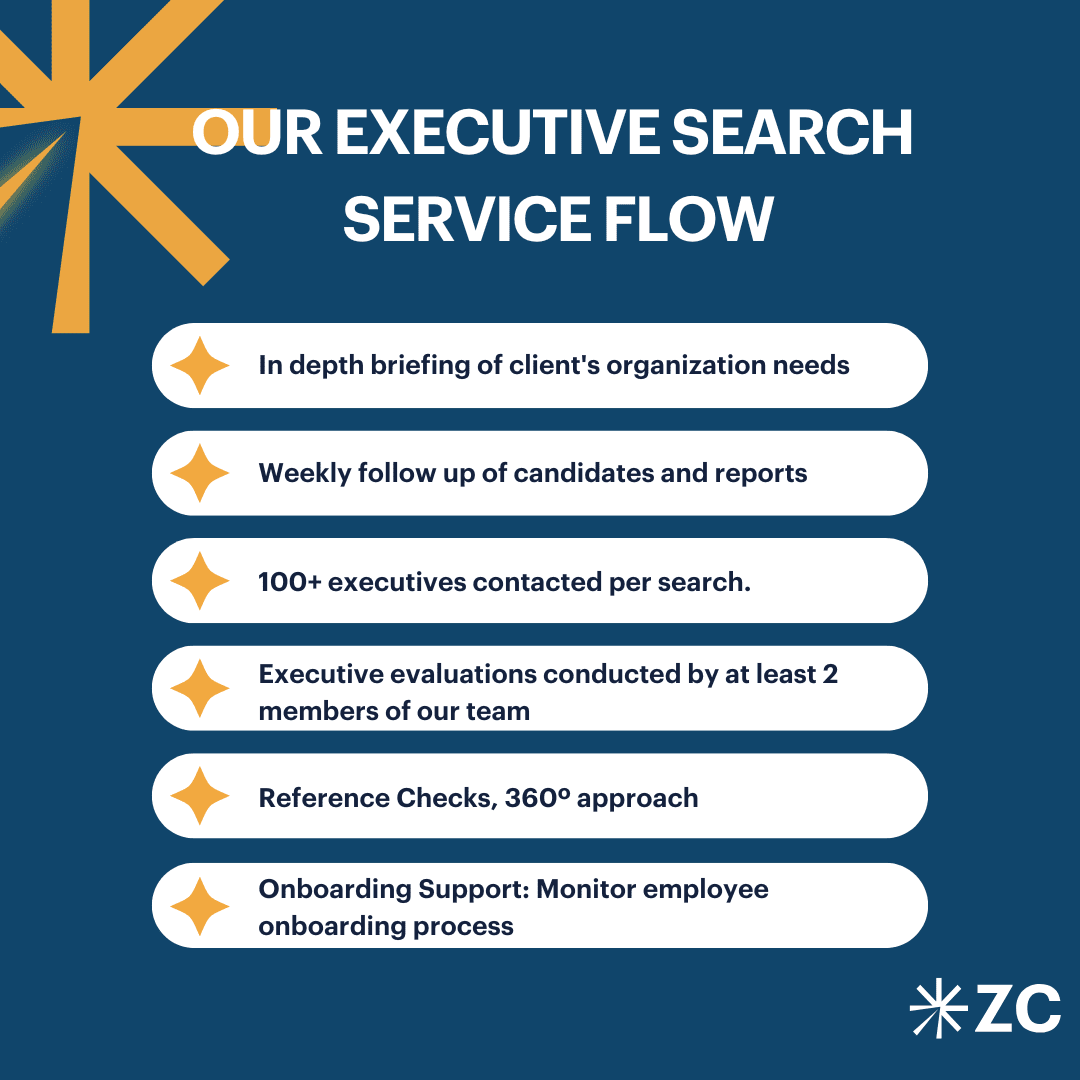
Zavala Civitas’ Executive Search methodology combines market mapping, direct candidate identification, structured assessment and reference validation.
Where organisations are considering internal succession alongside an external search, our Executive Assessment and Leadership Development practice can provide an additional basis for comparing leadership readiness.
Frequently Asked Questions: Executive Search in Canada
Canada has more available talent than during the vacancy peak, but the right executive can still sit inside a very narrow market.
Zavala Civitas supports organisations in identifying Canadian and international leaders through targeted market mapping, direct search and structured assessment.
Executive Search → Executive Assessment → Contact Us →